
 Worksheets
Unit 6 Review- Duncan
Total questions: 84
Worksheet time: 45mins
How frequently an allele shows up in a population is referred to as
Gene Pool
Adaptation
Allele Frequency
Genetic Drift
When a small group leaves their mainland to found a new colony, this is considered as
Bottleneck effect
Adaptation
Founder effect
Cause and effect
A physical trait favored by an environmental change is called an
Possibility
Adaptation
Mutation
Extinction
When the population significantly decreases due to a natural disaster (meteor, hurricane, etc), this type of Genetic Drift is considered the
Bottleneck effect
Gene Flow
Founder effect
Allele frequency
In our mud worm experiment, the hurricane was a representation of -
Genetic Frequency
Bottleneck Effect
Gene Flow
Founder Effect
In the mud worm experiment, the worms on islands 1 and 2 migrated from the mainland to their new colonies. These two islands were a representation of the -
Founder Effect
Gene Flow
Bottleneck Effect
Frequency
In our mud worm experiment, Island 3 had an existing population whereas Islands 1 and 2 did not. Because of this, Island 3 represented the example of -
Adaptation
Genetic Drift
Allele Frequency
Gene Flow

Which type of selection is the image representing?
Directional Selection
Stabilizing Selection
Disruptive Selection

Which type of selection is represented by the image?
Directional Selection
Stabilizing Selection
Disruptive Selection

All the alleles that appear in the same population is called ______
Gene Flow
Fitness
Gene Pool
Allele Frequency
Adaptations that result from natural selection are expected to increase the fitness of an organism. In terms of natural selection, describe fitness.
Being able to survive and move forward
Being able to reproduce asexually
Being able to survive, find a mate, and produce offspring
Being able to survive a natural disaster
How is genetic drift similar to natural selection?
Both cause changes in the gene pool population
They're not similar
They both wipe out populations
None of the above
Jaguars can have no tail, normal tails and long tails. Jaguars with no tails have a hard time balancing in the trees. Jaguars with very long tails are easier to be caught by a predator.
Which type of selection graph best represents the Jaguars type of selection?
Directional Selection
Stabilizing Selection
Disruptive Selection
The concept of gene flow is demonstrated when a cow is driven off from its herd, joins another herd, and reproduces. When the cow contributes to the gene pool of the new herd, which of these most likely increases?
Genetic Drift
Genetic Variation
Gene Flow
Bottleneck
Cheetahs capture prey by outrunning them over short distances. Over time, the fastest cheetahs have been more likely to survive and pass this characteristic to their offspring.
This is an example of -
Adaptations
Natural Selection
Allele Frequency
Genetic Drift
Which of the following most likely supports how giraffes evolved long necks?
More long necked giraffes survived to pass on their genes
More short necked giraffes survived to pass on their genes
Short necked giraffes modified their diets to evolve into a new species
It's because of Sam the giraffe from the video shown in class
A new predator of rabbits has been introduced within an ecosystem. This new predator runs faster than the native predators of rabbits. Which statement best describes what will most likely occur in the rabbit population due to the introduction of the new predator?
The rabbits will mutate their genes and express genes that increase their speed
Slower rabbits will develop stronger legs and pass that trait to their offsprings
Rabbits will mate and produce offspring with a different species that have faster runners
Faster rabbits will survive and reproduce, increasing the average speed of the rabbit population
Some organisms have genes that improve their ability to survive and reproduce. If the genes also help their offspring survive and reproduce, then which of the following will most likely increase?
The frequency of the genes in one individual
The frequency of the genes in the population
The number of genes in one chromosome
None of these are correct
Immigration (establishing a new home) or Emigration (leaving old home) is an example of
Gene Flow
Genetic Drift
Allele Frequency
Founder Effect
What is a random change in allele frequency in a population called?
Genetic Drift
Fitness
Speciation
Gene Pool
What is evolution?
The process by which modern organisms have descended from ancient organisms
The process by which organisms change in order to better survive in a certain environment
The process by which organisms reproduce and pass on their genetic material
The process by which organisms adapt to their environment
Which mechanism of evolution refers to the changes in allele frequencies within a single population?
Natural selection
Genetic drift
Mutations
Gene flow
What is natural selection?
The process by which organisms that are most suited to their environment survive and reproduce most successfully
The process by which organisms randomly change their genetic material
The process by which organisms migrate to new populations
The process by which organisms undergo genetic mutations
Which of the following is an example of natural selection?
Giraffes with longer necks being able to reach leaves on tall trees
Birds eating green beetles instead of brown beetles
Peppered moths changing color to blend in with their environment
Butterflies migrating to a new area and creating a new population
What is genetic drift?
A random change in allele frequency caused by chance occurrences
The movement of alleles from one population to another
The process of genetic material changing in a cell
The change in allele frequencies following a reduction in population size
Which of the following is an example of the bottleneck effect?
A population of organisms experiencing a dramatic reduction in size, resulting in a change in allele frequency
A small subgroup of a population migrating to a new area and changing allele frequencies
Changes in the genetic material of a cell leading to new alleles in a population
The movement of alleles from one population to another
What are mutations?
Changes in the genetic material of a cell, leading to new alleles in a population
The movement of alleles from one population to another
Random changes in allele frequency caused by chance occurrences
The process by which organisms that are most suited to their environment survive and reproduce most successfully
What is gene flow?
The movement of alleles from one population to another
The process of genetic material changing in a cell
A random change in allele frequency caused by chance occurrences
The change in allele frequencies following a reduction in population size
Which mechanism of evolution involves the movement of alleles from one population to another?
Natural selection
Genetic drift
Mutations
Gene flow
What is the founder effect?
A change in allele frequencies as a result of the migration of a small subgroup of a population
A random change in allele frequency caused by chance occurrences
The change in allele frequencies following a reduction in population size
The process of genetic material changing in a cell
Which of the following is an example of the founder effect?
A small group of butterflies migrating to a new area and creating a new population
A population of organisms experiencing a dramatic reduction in size, resulting in a change in allele frequency
Changes in the genetic material of a cell leading to new alleles in a population
The movement of alleles from one population to another
What is the purpose of mutations in evolution?
To change the genetic material of a cell
To increase biodiversity in a population
To cause a reduction in population size
To allow organisms to better adapt to their environment
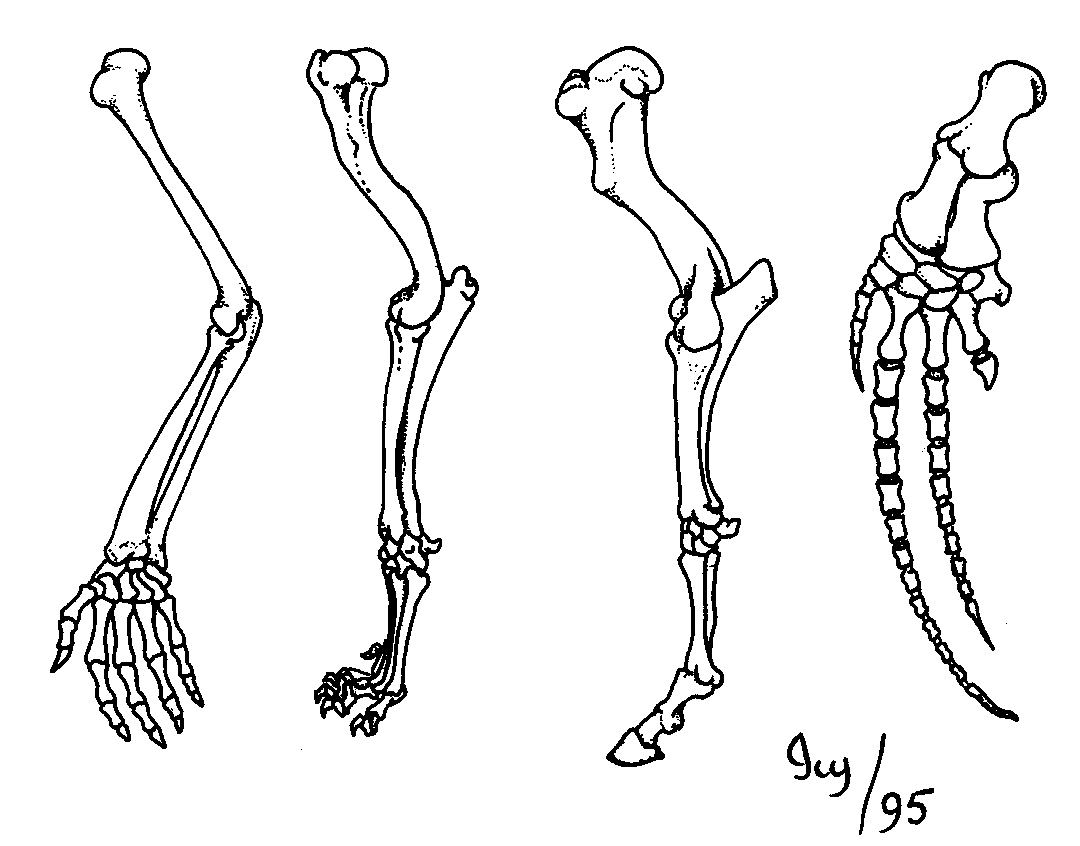


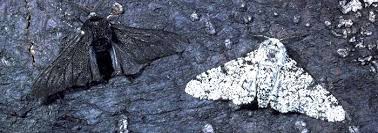
Similar structures with different purposes found in different species are known as _____
vestigial structures
DNA
homologous structures
the fossil record

The picture shows a/an ___________
homologous structure
vestigial structure
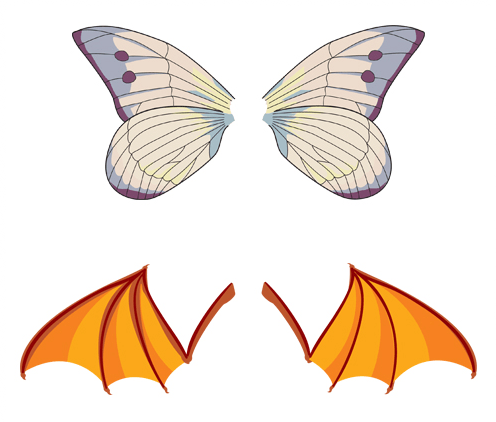
What is this an example of?
Homologous structure
Analogous structure
Vestigial organs
Functional adaption

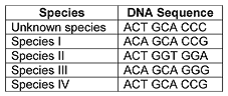
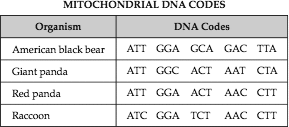
What conclusions can be made based on this table shown?
the American black bear and the giant panda are most closely related
the giant panda and the red panda are most closely related
the red panda and the racoon are the most closely related
the giant panda and the racoon are most closely related
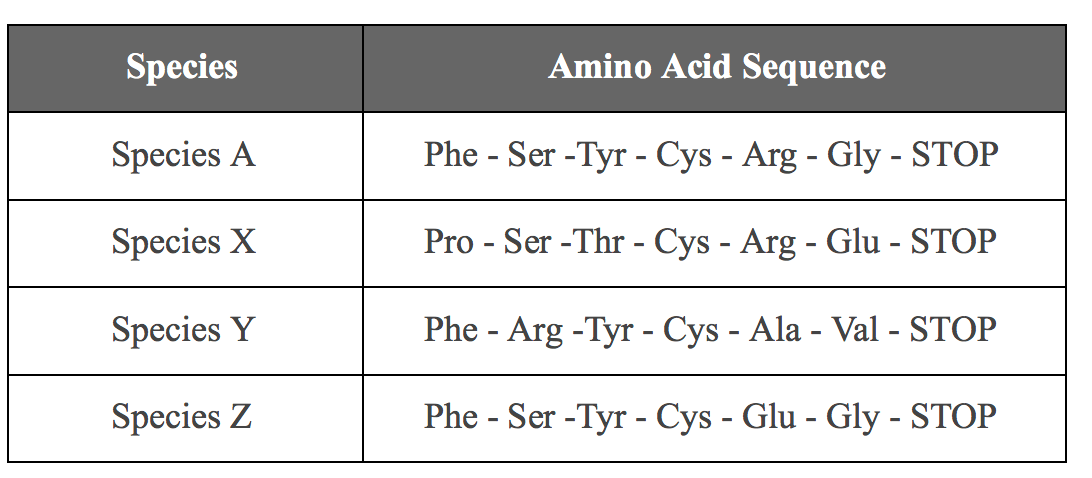
A scientist compares DNA taken from four different living species. Which of the following statements is true?
Species X evolved from Species Y.
Species A and Z share a recent common ancestor.
Species A and Species Y are the same.
Species Y and Species Z can interbreed.
When looking at two birds of the same species, you notice that one has darker feathers than the other one. You also notice that one has a beak that is just a little longer. These slight differences within members of the same species are called.....
Fossils
Extinction
Meiosis
Variations

The picture shows a/an ___________
homologous structure
vestigial structure
Genome maps provide the DNA sequences of chromosomes. Some scientists have compared the genome maps of a hedgehog and a sloth. What do these genome maps allow the scientists to determine?
The color patterns of the offspring of each species
How much the size ranges of the two species differ
The methods of protein synthesis that each species uses
How closely related the two species are to each other.
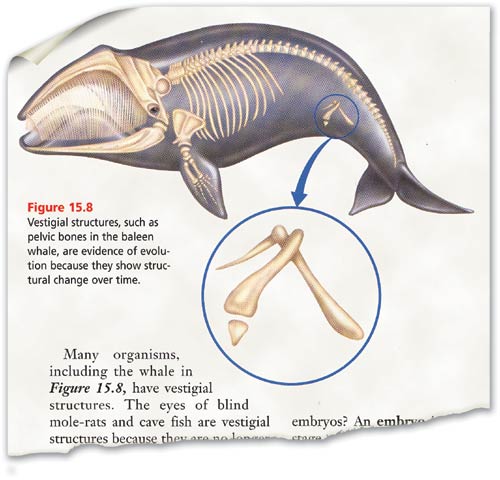
What conclusion can you draw from the fact that many modern whale species have vestigial pelvic and leg bones?
The ancestors of whales may have been land mammals
Whales could walk if they wanted to
Whales are preparing to evolve into land animals
Someday whales will be able to walk and will have legs
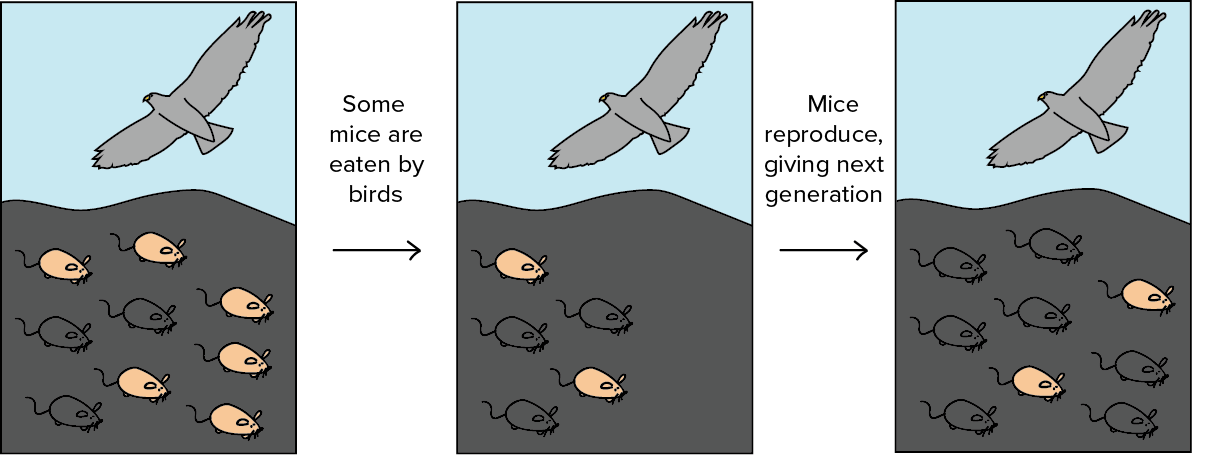

An organisms with the “best” traits (adaptations) will live longer and
reproduce more than others, causing changes in the population over time by acting on traits that are heritable
Evolution
Natural Selection
Fitness
Variation
Genes that are beneficial to the species will....
evolve a new species
will not be passed down to its' offspring
become more common over time
cause the extinction of a species
Individuals don't evolve! (a) do!
Which one does not increase variation?
Gene flow
Migration
Mitosis
Crossing Over
Which of the following is not a principle of natural selection?
Competition for resources
Older organisms are more wise
Variation via mutations
Adaptations
What is the study of prehistoric life through the fossil record?
Embryology
Paleontology
Morphology
Biogeography

According to the diagram, which organism is LEAST related to the others?
5
4
3
2

Which best describes punctuated equilibrium?
Speciation occurs due to natural selection
Speciation occurs due to isolation
Speciation occurs slowly in geologic time, followed by long periods with very fast evolutionary change.
Speciation occurs suddenly and rapidly in geologic time, followed by long periods with little evolutionary change.

What is the common ancestor of Letters A, B, C, D, E?
1
2
3
4


A forest fire ignites in the Sam Houston State Forest and kills many members of a population of pigmy rattlesnakes.
Gene Flow
Genetic Drift
A forest fire ignites in the Sam Houston State Forest and kills many members of a population of pigmy rattlesnakes.
Gene Flow
Genetic Drift

Select the best answer based on the image.
Gene Flow
Genetic Drift
Genetic Diversity is increased through this process.
Gene Flow
Genetic Drift
If a population of lizards is isolated on an island, with no new immigrants over many years, any new genetic variations are most likely to come from
recessive alleles
natural selection
mutations
speciation
An allele combination (BB, Bb, or bb) is called a
phenotype
genotype
mutation
gene flow
Why are advantageous traits more likely to be passed onto offspring?
Because they are more likely to survive and reproduce.
Because they come from dominant alleles.
Because they come from recessive alleles.
Because the organism knew it needed that trait, survives, and passes it on.
If you take antibiotics only the resistant bacteria survive and the non-resistant bacteria die. This is an example of...
Resistance
Survival of the fittest
How antibiotics work

Which letter represents the most recent common ancestor of sponges and mushrooms?
A
B
C
D
E

Which group on the cladogram arose FIRST?
Theropods
Allosaurus
Robin
Velociraptor

