Wayground logo

Free Printable Worksheets

Font size

S
M
L
XL
Worksheets

Chem A Summer Term Test 1

Total questions: 70

Worksheet time: 6hrs 50mins

Name
Class
Date
1.
Which of these contains steps in the right order?
a)
Ask a question, state your hypothesis, research, experiment, analyze, make a conclusion
b)
State your hypothesis, ask a question, research, experiment, analyze, make a conclusion
c)
Ask a question, research, state your hypothesis, experiment, analyze, make a conclusion
d)
State your hypothesis, ask a question, research, make a conclusion, experiment, analyze
2.

To make observations you use your _______.

a)

senses

b)

feet

c)

smile

d)

experience

3.

Performing a test or experiment allows you to test your ___________.

a)

draw conclusions

b)

hypothesis

c)

senses

d)

battery

4.
Should experiments be repeated over and over to see if the results are the same each time?
a)
yes
b)
no
5.
All factors that can change in an experiment.
a)
variable
b)
data
c)
conclusion
d)
result
6.
The outcome of your test.
a)
variable
b)
results
c)
experiment
d)
question
7.
What you learned from the experiment is the ___.
a)
conclusion
b)
hypothesis
c)
variable
d)
materials
8.
If you are testing the buoyancy of a cotton ball and you leave one plain, cover one half in oil, and cover the third in oil completely then place each in water, what is the variable?
a)
water
b)
cotton ball
c)
amount of oil
d)
time
9.
If you conduct an experiment where you place 5 of the same red candies in different types of soda, all in the same amount of liquid and same type cups the variable is what? 
a)
type of cup
b)
color of candy
c)
kind of soda
d)
amount of soda
10.
The standard to which you compare the results of an experiment is called
a)
constant
b)
control group
c)
independent variable
d)
dependent variable
11.
During an experiment, if you purposely change the temperature to test a hypothesis, the temp is called the
a)
independent variable
b)
operational variable
c)
dependent variable
d)
responding variable
12.
Observations that deal with a number or amount are called
a)
manipulated observations
b)
operational observations
c)
qualitative observations
d)
quantitative observations
13.
Which of the following is a valid reason why a scientist might reject a scientific theory?
a)
It covers too broad a topic
b)
New evidence contradicts it
c)
It is too old
d)
Some people disagree with it
14.

Nina and her mother both have cell phones. Nina thinks her cell phone is lighter than her mother's. If Nina wants to compare the masses of the cell phones, what is the best tool for her to use?

a)

graduated cylinder

b)

beaker

c)

thermometer

d)

balance

15.

Mass measures the amount of _________ in a substance or object

a)

matter

b)

vapour

c)

space

d)

gravity

16.

What is the best way to find the volume of an irregular shaped solid object?

a)

triple beam balance

b)

water displacement

c)

L x W x H

d)

1/2 (L x W x H)

17.

The mass of an object is the

a)

amount of matter it contains

b)

amount of space it takes up

c)

force of gravity acting on it

d)

amount of water it displaces

18.

Look at the picture of two blocks made of different materials. If Block A is located on the moon, and Block B is located on Earth, which of the following is true about the two blocks?

a)

They have the same density

b)

They have the same weight

c)

They have the same mass

d)

They have the same volume

19.

Which physical property of matter depends on the pull of gravity?

a)

mass

b)

volume

c)

weight

d)

density

20.

Stephen accidentally breaks a window while tossing a baseball. The window shatters into what seems like a million pieces. WHat happens to the matter in the class

a)

The amount of matter is reduced

b)

The matter looks different, but the amount stays the same

c)

The matter of the glass is completely destroyed

d)

A million new pieces of glass are formed from all the parts created

21.

Which statement is true about matter?

a)

All matter has volume

b)

All matter has mass

c)

All matter has either volume or mass but not both

d)

All matter has both mass and volume

22.

The only thing that is not matter is energy

a)

True

b)

False

23.

On the Moon, you would weigh _________ than on Earth, due to gravitational pull.

a)

more

b)

less

24.
What is the volume of this block
a)
168 cm3
b)
17 cm3
c)
10 cm3
d)
145 cm3
25.
Density is measured with what units?
a)
grams (g)
b)
centimeters (cm)
c)
g/cm3
d)
pounds (lbs)
26.

mass per unit of volume

a)

density

b)

volume

c)

weight

d)

mass

27.
Which scientist developed the atomic theory?
a)
JJ Thomson
b)
Ernest Rutherford
c)
John Dalton
d)
James Chadwick
28.
He developed the planetary model of the atom.
a)
Rutherford
b)
Bohr
c)
Chadwick
d)
Dalton
29.

Subatomic particles with a negative charge

a)

Electrons

b)

Neutrons

c)

Protons

d)

Quarks

30.
Subatomic particles with a positive charge
a)
neutrons
b)
atomic mass
c)
protons
d)
isotopes
31.
Subatomic particles that are neutral in charge
a)
Neutrons
b)
Protons
c)
Nucleus 
d)
Electrons
32.
A tiny but very dense, positively charged portion of the atom that holds most of the atomic mass
a)
Electron Shells
b)
Orbitals
c)
Electron Cloud
d)
Nucleus
33.
Where electrons are likely to be found as they travel around the nucleus
a)
Nucleus
b)
Electron Cloud
c)
Within a Proton
d)
Within a Neutron
34.

He claimed that matter was made of small, hard particles that he called “atomos.”

a)

Democritis

b)

Dalton

c)

Moseley

d)

Einstein

35.
The scientist responsible for "discovering" the nucleus is:
a)
Bohr
b)
Rutherford
c)
Schroedinger
d)
Einstein
36.
What contribution did John Dalton make to atomic theory? 
a)
He discovered that every atom was positively charged. 
b)
He discovered that every element consisted of one type of atom.  
c)
He discovered that atoms had nuclei. 
d)
He discovered that atoms could be divided into smaller parts. 
37.

The number of protons is equal to the number of electrons for an atom. This means an atom is-

a)

electrically neutral

b)

electrically positive

c)

electrically negative

38.

What determines chemical reactivity?

a)

protons

b)

neutrons

c)

electrons

d)

isotopes

39.
A certain photon of light has a wavelength of 4.22x10⁻⁷nm. What is the frequency? (v=c/λ)
a)
7.11x10¹⁴ Hz
b)
7.11Hz
c)
1.41x10⁻¹⁵
d)
-1.41x10¹⁵
40.
A wave with a large wavelength will have a ______ frequency and _____ energy
a)
high, low
b)
high, high
c)
low, high
d)
low, low
41.
Select the correct order of waves on the EMS 
a)
Radio, Micro, Infra, Visible, Ultra, X-ray, Gamma
b)
Gamma, X-ray, Ultra, Vis, Infra, Micro, Radio
c)
Vis, Micro, Infra, Ultra, X-ray, Gamma, Radio
d)
Micro, Radio, Vis, Infra, Ultra, X-ray, Gamma
42.
Which has the LONGEST wavelength and, therefore, the lowest frequency/energy
a)
Gamma Rays
b)
Radio Waves
c)
Visible Light
d)
Infrared rays
43.
Which has the SHORTEST wavelength and, therefore, the highest frequency/most energy
a)
Radio waves
b)
Ultraviolet Rays
c)
Gamma Rays
d)
X-rays
44.
Which section of the spectrum is the ONLY one we can see?
a)
X-rays
b)
Visible Light
c)
Gamma Rays
d)
Ultraviolet Rays
45.
As the frequency of an electromagnetic wave increases, the amount of energy in that wave...
a)
increases.
b)
decreases.
c)
stays the same.
46.
The height of the wave is known as the _____________.
a)
amplitude
b)
crest
c)
trough
d)
wavelength
47.
The blue section of the wave is measuring _________________.
a)
wavelength
b)
crest
c)
trough
d)
amplitude 
48.
What is a photon?
a)
When radiation burst through electric waves
b)
The emission of electrons from a metal caused by light striking the metal
c)
The rate at which a waves energy flows through a given unit of area.
d)
packets of electromagnetic energy
49.
Light behaves like both a particle and a ______.
a)
Mass
b)
Wave
c)
Current
50.
What is the energy of a quantum of light with a frequency of 7.39x10¹⁴Hz.(E=Hv)
a)
4.88x10¹⁹
b)
4.88x10⁻¹⁹
c)
2.22x10²³
d)
2.22x10⁻²³
51.
Certain blue lights have a frequencey of 6.91x10¹⁴Hz. What is the wavelength? (λ=c/v)
a)
4.34x10²¹
b)
4.34x10⁻²¹
c)
4.34x10⁻⁷
d)
2.07x10²³
52.
A light has a wavelength of 5.06x10⁻⁷m. What is the frequency of the light? What is the color of light? (v=c/λ)
a)
16.87Hz, Red
b)
5.93Hz, Orange
c)
5.93x10⁻¹⁴Hz, Blue
d)
5.93x10¹⁴Hz, Green
53.
What is the frequency of a light that has the Energy of 2.84x10⁻¹⁹. (v=E/h)
a)
4.30x10¹⁴Hz
b)
4.30x10⁻¹⁴Hz
c)
4.30x10-54Hz
d)
4.30x1054Hz
54.
What is the Energy of a blue light with the frequency of 6.91x10¹⁴Hz? (E=hv)
a)
4.56x1049J
b)
9.55x10-49J
c)
4.56x10⁻¹⁹J
d)
5.82x10¹⁹J
55.
1.  What is the shape of an s orbital?
a)
sphere
b)
dumbbell
c)
double dumbbell
d)
TOO COMPLEX TO KNOW IT.
56.
What is the shape of a p orbital?
a)
sphere
b)
it's just too complex to thing about it
c)
dumbbell
d)
I don't know this stuff.
57.
How many electrons can each p orbital hold?
a)
6
b)
3
c)
2
d)
4
58.
How many electrons can the d sublevel hold?
a)
8
b)
10
c)
2
d)
4
59.
How many total electrons can the f orbitals in a sublevel hold?
a)
2
b)
14
c)
6
d)
10
60.
Which orbital has the least amount of energy? 
a)
p orbital
b)
d orbital
c)
s orbital 
d)
What is an orbital?
61.
An electron occupies the lowest energy orbital that can receive it.
a)
Hund’s rule
b)
Pauli exclusion principle
c)
Bohr model of the atom
d)
Aufbau principle
62.
All orbitals of equal energy are occupied by one electron before any single orbital is occupied by a second electron.
a)
Aufbau principle
b)
Pauli exclusion principle
c)
Hund’s rule
d)
Core Notation
63.
No two electrons in the same atom can have the same four quantum numbers.
a)
Aufbau principle
b)
Pauli exclusion principle
c)
Hund’s rule
d)
Noble gas notation
64.
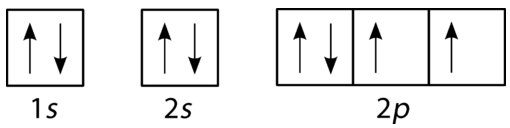
Which element is pictured?
a)
neon
b)
fluorine
c)
magnesium
d)
argon
65.
What is incorrect about this orbital diagram?
a)
Both arrows in the 2p box should be pointing up
b)
There is nothing incorrect with this diagram
c)
In the 2p box there should only be 1 electron in the first 2p box and one in the 2nd 2p box
d)
All the arrows should be pointing up.
66.
This orbital diagram represents:  
a)
C
b)
B
c)
N
d)
O
67.
How many electrons can the s sublevel hold?
a)
14
b)
10
c)
2
d)
6
68.

What is the Aufbau principle?

a)

Within an energy level, s orbitals are the lowest energy, followed by p, d and then f. F orbitals are the highest energy for that level.

b)

The lower the principal quantum number (n) the lower the energy.

c)

All three.

d)

The Aufbau Principle states that electrons enter the lowest energy orbitals first.

69.
What atom matches this electron configuration?
1s22s22p63s23p64s23d10
a)
Zinc
b)
Copper
c)
Nickel
d)
Germanium
70.
How many valence electrons are represented here?
a)
7
b)
5
c)
2
d)
8