wayground logo

Free Printable Worksheets

NEW

Font size

S
M
L
XL
Worksheets

Unit 1 - Matter & Measurement (Acc Chem)

Total questions: 66

Worksheet time: 1hrs 10mins

Name
Class
Date
1.
How many significant digits are there in the following number:   0.00530
a)
2
b)
3
c)
5
d)
6
2.
How many significant digits are there in the following number:   590800
a)
2
b)
3
c)
4
d)
6
3.

If you add 20 ml to 172 ml, how many ml do you have to the correct significant digits?

a)

190

b)

192

c)

200

d)

2.0 x 10²

4.
A student poured three samples of solution.  In their beaker, they had 22.5 ml, 22.4 ml and 22.8 ml.  They needed 26 ml per sample.  Were they accurate or precise in their measurements?
a)
Precise
b)
Accurate
c)
Both
d)
Neither
5.
How many kilograms are in 500,000 milligrams?
a)
0.5
b)
50
c)
500
d)
500,000
6.
An object has a mass of 25 grams and a volume of 50 ml.  What is its density?
a)
0.5 g/ml
b)
2 g/ml
c)
5 g/ml
d)
1250 g/ml
7.
An 20 gram sample was placed in a beaker containing water.  The volume of the water changed from 22 ml to 26 ml when this occurred.  What was the density of the object?
a)
5 g/ml
b)
0.2 g/ml
c)
0.8 g/ml
d)
0.9 g/ml
8.
Measure to the nearest milliliter.
a)
73 mL
b)
73.1 mL
c)
76 mL
d)
76.1 mL
9.
How many significant figures:  6.50 x 10⁴
a)
6
b)
3
c)
5
d)
4
10.
Round 12,678.56 to four significant figures.
a)
1,268
b)
12,700
c)
13,000
d)
12,680
11.
A metal has a density of 10.8 g/cm3.  What is the volume if the mass is 560 g?
a)
32.6 cm3
b)
2.78 cm3
c)
0.019 cm3
d)
51.9 cm3
12.
A description of how close measurements are to each other is 
a)
accuracy
b)
closeness
c)
precision 
d)
target location 
13.
If an object has a density of 3.6 g/mL and you put it into water, will it sink or float?  
a)
sink
b)
float
14.
11,000 mL = _____ L
a)
11L
b)
12 L
c)
1,100 L
d)
110,000 L
15.

The attraction between particles when a solid changes to a liquid become

a)

stronger

b)

weaker

c)

stays the same

d)

cannot be determined

16.

Substances in a mixture

a)

maintain their own properties

b)

chemcially combine

c)

form new properites

d)

can be destroyed

17.

Condensation is when

a)

water vapor is warmed so the particles slow down and become a liquid.

b)

liquid water becomes water vapor and forms ice crystals

c)

water vapor is cooled so the particles slow down and become a liquid

d)

water vapor is cooled so the particles speed up and become a liquid.

18.

Solids and Liquids are similar because they

a)

each have their own volume

b)

each have their own shape

c)

can both be deformed easily

d)

each have quickly moving particles

19.

The following is a physical property

a)

the flammibility of a piece of paper

b)

the volume of a rock

c)

the effect of oxygen on iron

d)

the ability of silver to tarnish

20.

Compounds are formed when

a)

elements mix together

b)

two or more elements are chemically bond

c)

a solute and a solvent combine

d)

deposition occurs

21.

Changes of state

a)

change the identity of a substance

b)

change the appearance of a substance

c)

change the mass of a substance

d)

change the chemical make up of a substance

22.

An example of a homegenous mixture is

a)

lemonade

b)

milk

c)

concrete

d)

a snowglobe

23.
What unit of measurement is used to measure mass?
a)
grams
b)
meters
c)
liters
d)
centimeters
24.
What is an example of matter?
a)
air
b)
juice
c)
atom
d)
all of the above
25.
What is the volume of water inside this graduated cylinder?
a)
10.3 mL
b)
13.0 mL
c)
14.0 mL
d)
15.0 mL
26.

What is a characteristic that you can observe like color, shape, size?

a)

physical fitness

b)

real estate properties

c)

physical properties

d)

matter

27.

Which state of matter that takes the shape of its container and takes up a definite amount of space? (This matter can be poured from one container to another.)

a)

solid

b)

liquid

c)

gas

d)

matter

28.
a)

Element

b)

Compound

c)

Homogeneous Mixture

d)

Heterogeneous MIxture

29.
Round 1009 to three sig figs
a)
100
b)
101
c)
1010
d)
1000
30.
Calculate 345.009 g - 23.009 g and give your answer with the appropriate number of significant figures.
a)
322.00 g
b)
322 g
c)
322.000 g
d)
322
31.
Calculate 1.23 m x 0.89 m and give your answer with the appropriate number of significant figures.
a)
1.0 m2
b)
1.1 m2
c)
1.0947 m2
d)
1.09 m2
32.
What is the volume of a rectangular block that has a length of 2.5 cm, a width of 2.5 cm and a height of 1.5 cm? (make sure your answer has the correct # of sig figs)
a)

9.375 cm3

b)

9.4 cm3

c)

9.4 cm

d)

9 cm3

33.
Which of the following is a correct unit of density?
a)
g
b)
mL
c)
g/mL
d)
mL/g
34.
When iron and oxygen combine, rust is formed. This is an example of a:
a)
physical change
b)
chemical change
c)
mass change
d)
volume change
35.
Sucrose (C6H12O11) is an example of a(n):
a)
Element
b)
Compound
c)
Homogeneous Mixture
d)
Heterogeneous Mixture
36.
Helium (He) is an example of a(n):
a)
Element
b)
Compound
c)
Homogeneous Mixture
d)
Heterogeneous Mixture
37.
Oil and water is an example of a(n):
a)
Element
b)
Compound
c)
Homogeneous Mixture
d)
Heterogeneous Mixture
38.
This picture represents which of the following?
a)
element
b)
compound
c)
mixture
39.
A mixture that appears to be evenly mixed throughout is called:
a)
an element
b)
a compound
c)
a homogeneous mixture
d)
a heterogeneous mixture
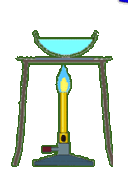
40.
Which one of the following is the name for separation technique in the picture below
a)
distillation
b)
seiving
c)
evaporation
d)
decanting
41.
Water and alcohol are easily separated by distillation because of their
a)
different densities
b)
different boiling points
c)
different colours
d)
different melting points
42.
Filtration can be used to separate...
a)
an insoluble solid from a solution
b)
a soluble solid from a solution
c)
a dissolved solid from a solution
43.
Two or more substances that are mixed together but not chemically combined is a ___
a)
compound
b)
mixture
c)
keratin
d)
chromatography
44.
Two or more substances that are chemically combined is a ___
a)
compound
b)
mixture
c)
solvent
d)
solute
45.

Ink can be separated by a method of -----------------------------------------------

a)

distillation

b)

filtration

c)

chromatography

d)

sedimentation

46.

Convert 50 decimeters/week to kilometers/year

a)

.026 kilometers/year

b)

2.6 kilometers/year

c)

.26 kilometers/year

d)

26 kilometers/year

47.

Convert 700 centiliters/day to Liters/year

a)

2,555 Liters/year

b)

255.5 Liters/year

c)

25.55 Liters/year

d)

2.555 Liters/year

48.
What unit should be in the numerator of the conversion factor?
a)
yards
b)
leagues
c)
feet
d)
fathoms
49.
What unit is the largest unit
a)
hm
b)
cg
c)
g
d)
dm
50.
1 L = _______ mL
a)
1
b)
10
c)
100
d)
1000
51.
m stands for....
a)
millimeter
b)
meter
c)
centimeter
d)
Liter
52.
1 Meter = ______cm
a)
100
b)
10
c)
1
d)
1000
53.
In general what is the most dense form of matter?
a)
solid
b)
liquid
c)
gas
d)
plasmas
54.
I have two objects with the same volume but different masses.  Which object will be more dense?
a)
The object with less weight.
b)
The object with more weight.
c)
The object with more mass.
d)
The object with less mass.
55.
Archimedes used density to discover if the crown of gold was real because
a)
Substances have their own unique densities
b)
Substances can change densities depending on their size
c)
Substances can change densities depending on their mass
d)
Substances can change densities depending on their volume
56.

Bubbles and fizzing can be seen instantly when baking soda is mixed with vinegar. The bubbles are evidence of which of the following?

a)

A gas is formed when baking soda and vinegar are mixed.

b)

Baking soda dissolves in vinegar when they are mixed.

c)

Vinegar turns into alcohol when it is mixed with baking soda.

d)

A precipitate is formed when baking soda and vinegar are mixed.

57.

When two substances are mixed, they might form a new substance. Which of the following would indicate that a new substance has been formed?

a)

The temperature of the mixture decreases.

b)

The volume of the mixture increases.

c)

The mass of the mixture increases.

d)

One of the substances dissolves.

58.

A student mixes two clear liquids together. After a few minutes, a white powder can be seen settling on the bottom of the test tube. Which of the following is a conclusion that the student can draw based on these observations? The two clear liquids -

a)

have combined to produce a new substance.

b)

were pure substances before they were mixed.

c)

are toxic and should be handled with extreme caution.

d)

have been stored too long and are no longer good.

59.

Which of the following characteristics is shared by all chemical reactions?

a)

Produce a precipitate

b)

Show a color change

c)

Release heat energy

d)

Form new substances

60.

All of the following are evidence of a chemical change EXCEPT -

a)

change in state of matter.

b)

formation of a gas.

c)

color change.

d)

precipitate forms.

61.

If we have any substance, it can be concluded that a chemical change has happened if -

a)

there is a color change.

b)

the state of matter changes.

c)

there is a decrease in mass.

d)

the matter is stirred thoroughly.

62.

Four substances were mixed with a clear liquid. The observations are recorded in the following table. Based on the observations, for which mixture is there best evidence that a new substance was formed?

a)

Substance 1

b)

Substance 2

c)

Substance 3

d)

Substance 4

63.

Blowing up a balloon

a)

Physical Change

b)

Chemical Change

64.

Rusting Nail

a)

Physical Change

b)

Chemical Change

65.

Evaporating Water

a)

Physical Change

b)

Chemical Change

66.
Salt dissolves in water
a)
physical Change
b)
chemical change