
 Worksheets
Honors Chem Chapter 7
Total questions: 66
Worksheet time: 4hrs 35mins
How does an atom become a cation?
An atom loses electrons to become a cation, which is positively charged.
An atom loses electrons to become a cation, which is negatively charged.
An atom gains electrons to become a cation, which is negatively charged.
An atom gains electrons to become a cation, which is positively charged.
How does an atom become an anion?
An atom loses electrons to become an anion, which is positively charged.
An atom loses electrons to become an anion, which is negatively charged.
An atom gains electrons to become an anion, which is negatively charged.
An atom gains electrons to become an anion, which is positively charged.
Sort the following atoms into two groups
Ca
Mg
Fe
S
Cl
N
Sort the following atoms into two groups
Cs
Bi
Ag
O
P
Te
Categorize these elements based on the charge they make in an ionic compound.
F
I
O
Se
Na
K
Ca
Ba
Categorize these elements based on the charge they make in an ionic compound.
Cl
Br
S
Te
N
P
Li
K
Organize these compounds as either ionic or covalent:
LiF
CaCl2
KBr
H2O
PF5
Organize these compounds as either ionic or covalent:
Fe2O3
SrF2
CH4
SiO2
SF6
From its position on the periodic table, determine which atom in each pair is more electronegative:
Br or Cl (a)
N or O (b)
S or O (c)
From its position on the periodic table, determine which atom in each pair is more electronegative:
P or S (a)
Si or N (b)
Ba or P (c)
How many valence electrons does PF3 have? (a)
What is the molecular geometry of PF3? (b)
How many valence electrons does N2 have? (a)
What is the molecular geometry of N2? (b)
How many valence electrons does carbon tetrachloride, CCl4, have? (a)
What is the molecular geometry of CCl4? (b)
How many valence electrons does boron trichloride, BCl3, have? (a)
What is the molecular geometry of BCl3? (b)
How many valence electrons does phosphorus pentabromideide, PBr5, have? (a)
What is the molecular geometry of PBr5? (b)
How many valence electrons does sulfur hexafluoride, SF6, have? (a)
What is the molecular geometry of SF6? (b)

What is the molecular geometry of this molecule?
Bent

Choose the molecular geometry for this molecule:
Trigonal Bipyramid

Tetrahedral

Choose the molecular geometry for this molecule:
Linear

Choose the molecular geometry for this molecule:
Linear
Trigonal Planar

Linear
Trigonal Planar

Linear

Choose the Molecular Geometry for this molecule:
Trigonal Planar

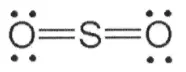
A student says, "SO2 is a nonpolar molecule." Using this correct Lewis Structure, explain whether this is true or not.
This is a nonpolar molecule because of the lone pair on the central atom
The S=O bond is polar but the two polar bonds cancel each other out, making the molecule nonpolar
Actually, the molecule is polar b/c the S=O bond is polar and the bonds don't cancel
The S=O bond is nonpolar, therefore the molecule is non polar.
True because this molecule has a linear shape.
NH3 is covalent and not ionic because:
H and N share electrons
There are single bonds in this structure
Each H transfers an electron to N
N transfers an electron to each H
H is more electronegative than N
CH4 is covalent and not ionic because:
H and C share electrons
There are single bonds in this structure
Each H transfers an electron to C
C transfers an electron to each H
H is more electronegative than C
CO2 is covalent and not ionic because:
O and C share electrons
There are double bonds in this structure
Each O transfers two electrons to C
C transfers an electron to each O
C is more electronegative than O
NaCl is ionic and not covalent because:
Na and Cl share electrons
There is a double bond in this structure
Na transfers one electron to Cl
Cl transfers an electron to Na
Na is more electronegative than Cl
CaF2 is ionic and not covalent because:
F and Ca share electrons
There are two single bonds in this structure
Ca transfers one electron to each F
Each F transfers an electron to Ca
Ca is more electronegative than F

Here are two structures for OCS.
A student claims structure A is correct because each atom has an octet.
A second student claims structure B could be correct as each atom still has an octet.
Which is the correct structure?
Structure B b/c each atom has zero formal charges.
Structure A b/c each atom has an octet but not in structure B
Structure B b/c each atom has an octet but not in structure A.
Structure A b/c each atom has zero formal charges
Both structures are equally correct as they are resonance structures.
A student claims the bond angle in SeCl2 is 109°. Do you agree, why or why not?
No, the bond angle is 120° b/c Se has only 1 lone pair with 2 attached atoms.
No, the bond angle is 180° b/c the electron geometry is linear.
Yes, the electron geometry is trigonal pyramidal.
Yes, there are 3 electron domains around the central atom.
Yes, the electron geometry is tetrahedral and molecular geometry is bent.
A student claims the bond angle in PF3 is 109°. Do you agree, why or why not?
No, the bond angle is 120° b/c P has only 0 lone pairs with 3 attached atoms.
No, the bond angle is 180° b/c the electron geometry is linear.
Yes, the molecular geometry is trigonal pyramidal and electron geometry is tetrahedral.
Yes, there are 3 electron domains around the central atom.
Yes, the electron geometry is tetrahedral and molecular geometry is bent.
Consider the bond between B and N. Is this bond pure covalent, polar covalent or ionic? Explain.
Polar covalent; the shared electrons are more attracted to N b/c it's more
electronegative
Ionic; B gives 3 electrons to N giving B a 3+ charge and N a 3- charge.
Pure covalent; the electrons are not shared equally between B and N.
Polar covalent; the shared electrons are more attracted to B b/c it's more
electronegative
Pure covalent; the electrons are shared equally between B and N.
A student claims, "The nitrogen atom in NH3 would be expected to have a partial positive (δ+) charge." Please explain if this is true or not.
False: this is a covalent molecule and N is the more electronegative atom giving N a partial negative charge (δ-).
False: this is an ionic bond and N gained an electron from each of the H giving N a charge of -3.
True: this is a covalent molecule and N is the less electronegative atom
False: N is the larger atom and the larger atom is always negative.
True: this is a covalent molecule and N is the more electronegative atom giving N a partial positive charge (δ+).
Based on electronegative trends on the periodic table, choose the bond that is most polar.
C-H
C-C
C-Cl
C-Br
C-F
Based on electronegative trends on the periodic table, choose the bond that is most polar.
H-H
H-C
H-N
H-O
H-F
Based on electronegative trends on the periodic table, choose the bond that is most polar.
H-H
H-I
H-Br
H-Cl
H-F

A student says, “CO2 is a nonpolar molecule.” Using this correct Lewis Structure explain whether or not this is true and why.
Actually the molecule is polar b/c it’s not symmetrical.
This is a non polar molecule because the lone pairs cancel each other out.
The C=O bond is non polar, therefore the molecule is non polar.
The C=O bond is polar but the two polar bonds cancel each other out, making the molecule non polar.
Actually the molecule is polar b/c the C=O is polar.
A student counted 18 total electrons for SO2. They placed 16 of the electrons on the structure, like the image shows. Explain where the last two electrons should be placed.
The last two electrons should be placed on S as a lone pair b/c S can have an expanded octet.
Put one electron as a single electron on each of the O atoms.
Make a triple bond between S and one of the O atoms.
The last two electrons should be placed on S as a lone pair b/c S didn’t have an octet before.
Place the last pair on one of the O atoms b/c O can have an expanded octet.
Consider the bond between C and O. Is this bond pure covalent, polar covalent or ionic? Explain.
Polar covalent; the shared electrons are more attracted to C b/c it’s more electronegative
Pure covalent; the electrons are shared equally between C and O.
Ionic; C gives 3 electrons to O giving C a 3+ charge and O a 3- charge.
Polar covalent; the shared electrons are more attracted to O b/c it’s more electronegative
Pure covalent; the electrons are not shared equally between C and O.
A student claims that NH3 has a trigonal pyramidal molecular geometry. Do you agree? Why or why not?
Yes, b/c there are no lone pairs on N.
Yes, b/c there are only 3 electron domains.
Yes, b/c N has a lone pair of electrons on it along with the 3 attached atoms.
No, it is actually trigonal planar b/c only 3 attached atoms and 0 (zero) lone pairs on N.
No, it’s molecular geometry is actually tetrahedral b/c there are 4 electron domains around N.
A student claims the number of valence electrons for PO43- is 26. Explain why this is true or not.
False: P + 4(O) = 5 + 4(6) = 29. The charge doesn’t change the electron total.
True: P + 4(O) = 5 + 4(6) = 29, then subtract 3 for the charge = 26 electrons total.
False: (P + O) x 4 = (5 + 6) x 4 = 44 then add 3 for the charge = 47 electrons total.
False: P + 4(O) = 5 + 4(6) = 29, then add 3 for the charge = 32 electrons total.
True: O + 4(P) = 6 + 4(5) = 26. The charge doesn’t change the electron total.
Choose the bond below that is most polar.
B-B
B-H
B-C
B-N
B-O
A student claims, “The phosphorus atom in PCl3 would be expected to have a partial positive (δ+) charge.” Please explain if this is true or not.
True: this is a covalent molecule and P is the less electronegative atom
False: this is an ionic bond and P gave an electron to each of the Cl giving P a charge of +3.
False: this is an ionic bond and P gained an electron from each of the Cl giving P a charge of -3.
True: this is a covalent molecule and P is the more electronegative atom
True: P is the smaller atom and the smaller atom is always positive.
H2O is covalent and not ionic because:
Each H transfers an electron to O
there are double bonds in this structure
H and O share electrons
O transfers an electron to each H
H is more electronegative than O

Here are two structures for OCl2. Why is structure B incorrect?
Because each atom has a formal charge of zero
Because each Cl has a formal charge of 7
Because O doesn't have an octet
Because each Cl has a negative formal charge
Because there are formal charges on each atom in structure B and the best structure has less formal charges
A student claims the bond angle in PH3 is 120°. Do you agree, why or why not?
No, bond angle is actually 180° degrees.
No, bond angle is 90° b/c a circle with 360° divided by 4 = 90°.
No, bond angle is actually around 109° b/c there are 4 electron domains around P.
None of these are correct.
Yes, b/c there are 3 electron domains around P.
Find the formal charge for each atom in this structure.
-1
-2
+1
0
+2
Find the formal charge for the C and the S this structure.
-1
-2
+1
0
+2
Find the formal charge for the C and the N in this structure.
+3
-3
-1
-2
+1
0
+2
Find the formal charge for each atom in this structure.
+3
-3
-1
-2
+1
0
+2
Find the formal charge for each atom in this structure.
+3
-3
-1
-2
+1
0
+2
Find the formal charge for each atom in this structure.
+3
-3
-1
-2
+1
0
+2


What is the correct Lewis Dot Structure for ammonia NH3


Which is the correct molecular structure for carbon dioxide?


Which of the following compounds has only single bonds?
I only
II only
III only
I and III
III and IV
NH3 has how many lone pairs?
0
1
2
3
CCl4 has how many double bonds?
0
1
2
3
In HCN (Carbon is usually the central atom) what kind of bond is between the C and N
Single
Double
Triple

