
 Worksheets
Year 12 Organic Term 3
Total questions: 50
Worksheet time: 50mins
What would you observe if HNO3 and AgNO3 were added to a solution containing l- ions?
Yellow precipitate
Cream precipitate
White precipitate
No visible change
How can you test for the presence of carbonate ions?
Add HCl and bubble through limewater
Add HNO3 and bubble through limewater
Add H2SO4 and bubble through limewater
Add AgNO3 and bubble through limewater
Which equation is a propagation step in the conversion of trichloromethane into tetrachloromethane by reaction with chlorine in the presence of ultraviolet light?
CHCl3 + Cl2 ⟶ CCl4 + HCl
●CCl3 + ●Cl ⟶ CCl4
CHCl3 + ●Cl ⟶ CCl4 + ●H
●CCl3 + Cl2 ⟶ CCl4 + ●Cl
What is a structural isomer?
Same molecular formula but different structural formula.
Different functional groups.
Different bonds in the structure.
Change in the position of the functional group.

Name this isomer of heptane
5-methyl-heptane
2-methyl-hexane
2-methyl-heptane
5-methyl-hexane

What is the correct relationship between the two molecules shown below?
There is no relationship
They are positional isomers
They are chain isomers
They are functional group isomers
Which among the following does not exhibit geometric isomerism
1-hexene
2-hexene
3-hexene
4-hexene
Which of the following chemicals will have the highest boiling point?
hexan-1-ol
hexanal
hexane
hexene
What mechanism is an halogenoalkane reacting with KCN in a warm aqueous solution
Nucleophillic Substitution
Electrophillic Addition
Elimination
Free radical substitution
What mechanism would turn an alcohol to an alkene
elimination
nucleophilic substitution
electrophilic addition
What conditions favour nucleophillic substitution
warm
warm and aqueous
hot and aqueous
warm and ethanolic
Which of the following carbocations is the least stable?
Secondary
Primary
Tertiary

What is the general formula for alkenes?
CnH2n
CnH2n+2
CnH2n-2
Cn2Hn
Which bond breaks during cracking?
C-C bond
C-C double bond
C-H bond
C-OH bond
Which reagent is needed to change a haloalkane to an alcohol?
KOH (aq)
KOH(alc)
H2O/ dilute H2SO4
Cr2O72-/H+
Which reagent is needed to change a haloalkane to an amine?
KOH (aq)
NH3(alc)
H2O/ dilute H2SO4
Cr2O72-/H+
Which reagent is needed to change CH3CH2OH to CH3COOH
KOH (aq)
NH3(alc)
H2O/ dilute H2SO4
Cr2O72-/H+
Which reagent is needed to change an alcohol to an alkene?
KOH (alc)
water/dilute H2SO4
concentrated H2SO4
Cr2O72-/H+
alcohol ------> carboxylic acid - reaction type?
addition
substitution
elimination
oxidation
Which is not a possible product when propane, C3H8, reacts with chlorine in sunlight?
H2
C6H14
C3H7Cl
Cl2
Which statement is correct about the polymerization of ethene to poly(ethene)?
The polymer is an alkene.
The monomer ethene and the repeating unit have the same empirical formula.
The monomer ethene is less reactive than the polymer.
The polymer contains C−C single and C=C double bonds.
What is the trend in ionisation energy down group 2
decreases
increases
stays the same
What does the last peak in a mass spectrum tell you?
the molecular ion
any isotopes present
the mass of a segment
mass of an ion
The most insoluble hydroxide in group 2 is...
Ca(OH)2
Ba(OH)2
Sr(OH)2
Mg(OH)2
Magnesium reacts slowly with cold water as follows...
Mg + H2O → MgO + H2
2Mg + 2H2O → 2MgOH + H2
Mg + 2H2O → MgO2 + 2H2
Mg + 2H2O → Mg(OH)2 + H2
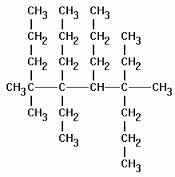


Which one of these is a secondary alcohol?
Butan-1,4-diol
2-methylpropan-2-ol
Pentan-2-ol
Pentan-1-ol
Dehydration of an alcohol gives
an aldehyde
an alkane
an alkene
a ketone
Which equation represents a termination step?
CH3CH2CH3 + Br* --> CH3C*HCH3 + HBr
ClO* + O3 --> Cl* + 2O2
RO* + CH2=CH2 --> ROCH2C*H2
CH3C*FCl + Cl* --> CH3CFCl2
Which products are formed when magnesium reacts with steam?
magnesium hydroxide and hydrogen
magnesium hydroxide and oxygen
magnesium oxide and hydrogen
magnesium oxide and oxygen

Which of these steps is nucleophilic substitution
A
B
C
D

What two monomers will form this polymer?
CH2=CHF and CH2=CHCF3
CH2=CH2 and CHF=CHCF3
CH2=CH2 and CH2=CHCF3
CH2=CHF and CHCF3=CHF
What following statement about sulfur dioxide is true?
sulfur dioxide is insoluble in water
sulfur dioxide is an ionic compound
sulfur dioxide is removed by calcium oxide
sulfur dioxide is a basic oxide
What is a functional group isomer of an alkene
alkane
cycloalkane
aldehyde
ketone

What is the reading on the titre?
24.10cm3
24.30cm3
25.70cm3
25.90cm3
Which of the alcohols below can be oxidised by potassium dichromate but not dehydrated by sulphuric acid?
2,3-dimethylbutan-2-ol
2,2-dimethylpropanol
2 methylpropan-2-ol
pentan-3-ol
Which of the statements about fractional distillation true?
a zeolite catalyst is used
each fraction contains a mixture of hydrocarbons
gaseous fractions are formed by breaking covalent bonds
the fractionating column is hottest at the top
Which compound is used to treat the symptoms of indigestion?
MgO
Mg(OH)2
CaO
BaSO4

which compound reacts with Tollen's reagent to give a silver mirror?
butan-2-ol
butanal
butanone
but-2-ene

Which diagram gives the skeletal formula of
2-chloropentan-3-ol ?
A
B
C
D

Which of these always applies to a nucleophile
A
B
C
D

A
B
C
D

Name the following molecule:
3,3-dimethyl-1-butanol
3,3-methyl-1-butanol
2,2-dimethyl-4-butanol
3,3,3-trimethyl-1-propanol
Which is the structures with IUPAC nomenclature
2,2,4-trimethylpentane
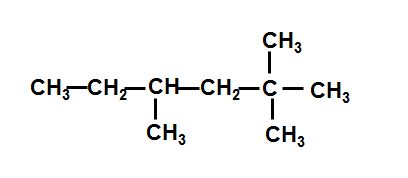
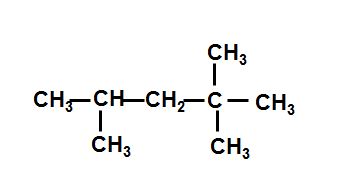
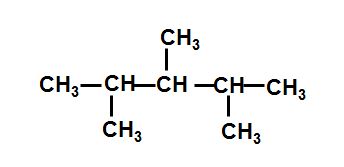
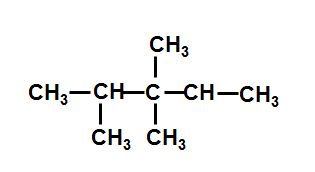
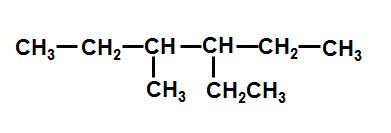
Give the IUPAC name for this compound
3-methyl-4-ethylhexane
3-ethyl-4-methylhexane
3-methyl-4-ethylheptane
3-ethyl-4-methylheptane
Which of the following is correct about hydration of ethene?
uses yeast
reversible reaction
uses base
low yield
Which technique allows us to produce a carboxylic acid from an alcohol
primary alcohol distillation
acidified potassium dichromate
secondary alcohol
distillation
potassium dichromate
primary alcohol
reflux
potassium dichromate
secondary alcohol
reflux
potassium dichromate

