
 Worksheets
The Frames in Visual Art
Total questions: 66
Worksheet time: 19mins
The way in which personal concerns can be paramount to an artist in his or her artmaking
Structural
Subjective
Cultural
Contemporary
Artists mirroring the values and influences of society
Structural
Subjective
Cultural
Contemporary
Emerging technologies such as digital art and the huge impact on aesthetic conditions
Structural
Subjective
Cultural
Contemporary
The ability of artworks to provoke emotional, sensory and intellectual responses from the viewer
Structural
Subjective
Cultural
Contemporary
The use of irony, parody and recontextualisation
Structural
Subjective
Cultural
Contemporary

What are the main ideas that make the subjective viewpoint?
opinions, feelings, memories
elements of art
principles of design
photoshopped images

What are the main elements of the structural viewpoint?
Composition, materials used, media, elements and principles of art
thoughts, feelings, memories, emotions
challenging the norm, appropriating images
social issues

What is the contemporary frame really about?
challenging the norm and appropriating images or artworks to create new work
a new way of creating art
Van Gough
Looking at things the same way as always, taking artworks for granted
In this classroom we...
Clean up after ourselves before leaving class
are NOT dismissed until AFTER the bell rings
make sure all supplies are clean and put away neatly
All of the above
True or False: It is MY responsibility to keep up with the due dates of assignments, turn my work in on time, AND reach out to Ms Pultar about make up work when sick.
True
False
What are the 5 types of lines
Circles, Squares, Rectangles, Cones and Triangles
Straight, Thick, Thin, Long, and Short
Vertical, Horizontal, Curved, Zigzag and Diagonal
None of the above
What are different variations of lines.
Thick, Thin, Short, Long
Line, Shape, Space, Color
Dashed, Dotted, Rhythm, Movement, Variety
Length, Width, Weight, Texture, Style
Diagonal lines slant and suggest movement?
True
False
Zigzag lines are diagonal lines that suggest excitement?
True
False
Curved lines bend and are shown in...
Contour Lines
Gesture Lines
Implied Lines
Continued Line
All of the above
Linear perspective uses diagonal line and a vanishing point to show deep space on a flat surface?
True
False
A horizon line...
Is a line that goes up and down
Separates the sky from the ground in a landscape drawing
Both A & B
None of the above
The Vanishing Point is....
Vanishing space
A moving point on a line
Something you can not see
The point on the horizon line that all diagonal lines merge toward.
Contour Lines...
Are straight
Create short think lines
Outline the shape of an object
None of the above


What type of balance is shown?
asymmetrical
symmetrical
radial
Radial balance is based on what shape? (Select the best answer.)
Triangle
Star
Circle
Square
____________ is a feeling of balance attained when the visual units on either side of a vertical axis are actually different but are placed in the composition to create a “felt” balance of the total artwork.
Radial Balance
Asymmetrical Balance
Symmetrical Balance
Composition
THE FRAMES IS THE THIRD CONTENT AREA AND HAS FOUR PARTS:
name those four parts:
Subjective Frame, Cultural Frame, Structural Frame, Postmodern Frame
Subjective Frame , Structural Frame , Postmodern Frame
Cultural, Structural, Subjective, Structural
Postmodern, Cultural, Subjective Frames


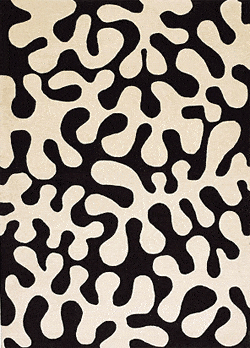


Q1. What element of art is best represented in this picture?
Color
Form
Value
Line
Which element of art is 3 dimensional?
Shape
Line
Space
Form
The sense of touch or feel of a surface (rough, smooth, or spiky)
Color
Texture
Shape
Contrast

This is the element of art that is the area between, around, above, below or
within things.
Value
Line
Form
Space
How many tertiary colors are there?
3
6
9
12
The complement of red is
Blue
Green
Orange
Pink
Select artwork/s described as abstract


Which of these artworks are a landscape?


The Cultural Frame refers to
materials
politics
size
scale
Name the FOUR Frames

The definition of Principles of Art/Design is...
The building blocks to create art
The size of one object compared to another
The tools to plan and organize an artwork
The lightness and darkness of hue

Balance is a Principle of Art - identify the 3 types of balance:
perpendicular, parallel, diagonal
symmetrical, asymmetrical, radial
complementary, analogous, monochromatic
rough, smooth, reflective

The difference between elements such as rough and smooth refers to which principle of art?
contrast
emphasis
movement
rhythm

The path your eye takes around the artwork refers to which principle of art?
contrast
texture
pattern
movement

The irregular repetition of similar elements that creates a visual tempo refers to which principle of art?
rhythm
contrast
emphasis
pattern

The area of interest or focal point refers to which Principle of Art?
Emphasis
Movement
Color
Space

The predictable repetition of the same elements refers to which Principle of Art?
Emphasis
Shape
Pattern
Contrast

This artwork demonstrates which type of balance?
symmetrical
asymmetrical
radial
perpendicular

This artwork demonstrates which type of balance?
symmetrical
asymmetrical
radial
perpendicular

This artwork demonstrates which type of balance?
symmetrical
asymmetrical
radial
perpendicular

Which Principle of Art is primary focus of this artwork?
pattern
contrast
line
form

Which Principle of Art is active in the sky of this artwork?
line
texture
movement
whole

Which Principle of Art is the most obvious in this tessellation artwork?
stars
emphasis
pattern
shape

Which Principle of Art refers to a harmonious composition that feels complete and whole?
Unity
Movement
Color
Emphasis

The definition of an art medium or media (plural) is...
materials used to create artworks
mass communication through news outlets
the tools to create artworks
none of the above

Which are examples of dry media?
acrylic, tempera, watercolor
stone, metal, clay
graphite, charcoal, pastel
red, blue, yellow

Which is an example of wet media?
acrylic, tempera, watercolor
stone, metal, clay
graphite, charcoal, pastel
red, yellow, blue

Which are examples of 3-D media?
acrylic, tempera, watercolor
graphite, charcoal, pastel
stone, metal, clay
red, yellow, blue
Which image represents 3-D media?


Which one represents dry media?


The term "Contemporary Art" was coined in the year _____________.
1909
1910
1911
1912

