wayground logo

Free Printable Worksheets

Font size

S
M
L
XL
Worksheets

Light and Sound Waves

Total questions: 50

Worksheet time: 1hrs 23mins

Name
Class
Date
1.

What are the two types of wave?

a)

Transform & Longitudinal

b)

Transverse & Longitudinal

c)

Transform & Divergent

d)

Transverse & Latitudinal

2.

What may happen to light that strikes an object? 

a)

The light may be reflected, refracted or absorbed.

b)

The light may be reflected, transmitted and refracted.

c)

The light may be refracted, absorbed and transmitted.

3.

Which of the following is the best example of an object absorbing light?

a)

A black sweater in the sun.

b)

A clean window in the sun.

c)

A curved mirror in the sun.

d)

A long shadow in the sun.

4.
The bouncing of light off an object is ....
a)
a mirror
b)
absorption
c)
reflection
d)
refraction
5.

Light is Electromagnetic (EM) Radiation a kind of.....

a)
reflection
b)
energy
c)
heat
d)
matter
6.
Which of these describes how light travels through an empty space?
a)
It travels straight but may change direction to avoid objects.
b)
It changes direction often even if there are no objects. 
c)
It comes to a stop after it travels a certain distance. 
d)
It travels in a straight line without stopping. 
7.
What surface best reflects light?
a)
dull
b)
shiny
c)

rough

d)

course

8.

This leaf will

a)

Reflect only green light

b)

Absorb green light

c)

Reflect red and blue light

d)

Reflect all but green light

9.

Which has more energy than visible light?

a)

Microwaves

b)

Radio waves

c)

Infrared light

d)

Gamma rays

10.

Which has less energy than visible light?

a)

Radio waves

b)

Gamma rays

c)

X-Rays

d)

UV light

11.

Superman's red cape and blue outfit both appear black. What color is the light shining on him?

a)
Blue 
b)
Red
c)
Magenta
d)
Green
12.
A plane mirror produces a/an 
a)
a small, real image
b)
a large, real image
c)
 a small, virtual image
d)
a same sized, virtual image
13.
_______ is an imaginary line that divides a mirror into half.
a)
focal point
b)

refractive angle

c)

normal

d)
incident angle
14.

Which of the following is a source of light

a)

Eye

b)

Mirror

c)

Fire

d)

the Moon

15.

Example of a luminous object

a)

the Sun

b)

the Moon

c)

a Pencil

d)

a Wall

16.

You see the flash of lightning and hear thunder 5 seconds later. If the speed of sound in the air is 330 m/s, how far away is the storm?

(a)  

17.

What does the term infrasound mean?

a)

A frequency above 20Hz

b)

A frequency below 20Hz

c)

A frequency below 20kHz

d)

A frequency above 20kHz

18.

Convert 81’ 763 nm into metres

a)

81’763 nm

81.763 μm

0.081763 m

b)

81’763 nm

81.763 mm

0.081763 m

c)

81.763 μm

0.081763 mm

0.000081763 m

19.

A Convex lens...

a)

...focuses the light at a focal point.

b)

...spreads light out from the divergent point.

c)

...spreads light out from the focal point.

d)

...focuses light to the divergent point.

20.
Sound moves in a _________.
a)
Transverse wave
b)
Longitudinal wave
21.
Area of a longitudinal wave where particles are CLOSE together.
a)
Compression
b)
Rarefaction
22.
Area of a longitudinal wave where particles are APART. 
a)
Compression
b)
Rarefaction
23.
Which device measures sound waves?
a)
Oscilloscope
b)
Stethoscope 
c)
Radio
d)
I don't know
24.
The reflection of sound waves off of a hard surface can create ______.
a)
A wave
b)
An echo 
25.
Soft surfaces _______ sound waves. 
a)
Reflect
b)
Absorb
26.
Sound travels FASTEST through which of these materials?
a)
Air
b)
Empty space
c)
Metal
d)
Water
27.
Sound is caused by? 
a)
force
b)
vibrations
c)
instruments
28.
What is vibration?
a)
how loud a sound is
b)
the back and forth movement of matter
c)
how high or low a sound is
d)
the loudness or softness of a sound
29.
Why is sound able to travel faster through a solid than a gas?
a)
Gas molecules are packed tightly.
b)
Sound does not travel faster through a solid than a gas.
c)
Solid molecules are packed tightly.
d)
Gas molecules move slowly.
30.
An object that does not vibrate cannot produce
a)
sound
b)
light
c)
heat
d)
electricity
31.
What is volume?
a)
how high or low a sound is
b)
the loudness or softness of a sound
c)
the number of vibrations per second
d)
vibrations
32.
You and your father inspect an empty house with the hopes of buying it. You walk through the rooms talking to one another, and you notice that your voices and footsteps are echoing in the big, empty house. What causes the echo?
a)
sound waves reflecting off smooth, flat surfaces throughout the house
b)
sound waves moving around the large rooms
c)
sound waves moving slowly through air
d)
sound waves refracting around corners in the empty rooms
33.
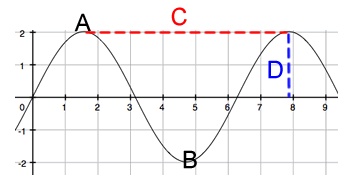
If distance C on the diagram increased, what would happen to the pitch? 
a)
The pitch would be louder. 
b)
The pitch would be softer. 
c)
The pitch would be higher. 
d)
The pitch would be lower. 
34.
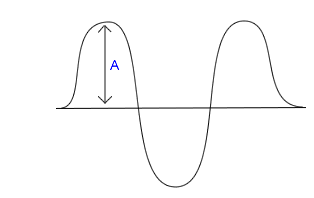
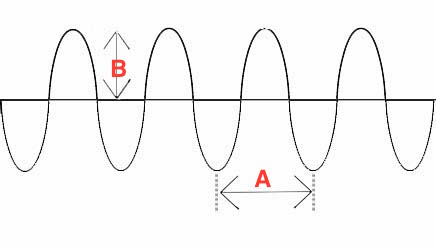
If the distance represented by the letter A were increased, how would it change the way the sound was heard?
a)
The sound would be higher. 
b)
The sound would be lower. 
c)
The sound would be softer. 
d)
The sound would be louder. 
35.
A soft, low pitch sound would have which of the following....
a)
low frequency 
high amplitude 
b)
high frequency 
high amplitude 
c)
low frequency 
low wavelength  
d)
low frequency
low amplitude 
36.
When comparing the two waves that are shown, how would Wave A (green wave) differ than Wave B (black wave)?
a)
Wave A and B have the same amplitude, but wave B (black) has a lower pitch.
b)
Wave A and B have the same amplitude, but Wave A has a lower pitch. 
c)
Wave A and B have the same pitch, but Wave A is a softer sound. 
d)
Wave A and B have the same pitch, but Wave B is a softer sound. 
37.
A reflected sound wave is know as a/an ___________.
a)
frequency
b)
pitch
c)
echo
d)
rarefaction
38.
A wave that requires a medium through which to travel
a)
mechanical wave
b)
chemical wave
c)
electromagnetic wave
d)
pitch
39.
A soft, high pitch sound would have which of the following....
a)
low frequency 
high amplitude
b)
low frequency 
low wavelength 
c)
high frequency 
low amplitude
d)
high frequency 
high amplitude 
40.
When does sound refract?
a)
When it travels in a vacuum.
b)
When it moves through cold air.
c)
When it travels in only one medium.
d)
When it moves from one medium to another.
41.
How are light waves and sound waves similar?
a)
The both carry matter & energy
b)
They both carry energy.
c)
They both travel in vacuums.
d)
They both carry matter.
42.

The highest point on a wave is:

a)

the crest

b)

the trough

c)

the top

d)

the coast

43.

Which word is used to identify the distance between points C & G?

a)

Amplitude

b)

Crest

c)

Frequency

d)

Wavelength

44.

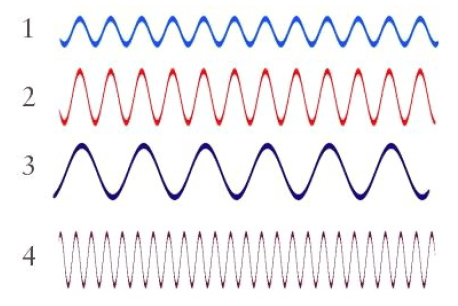
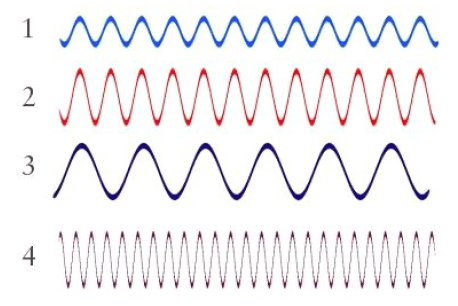
Which wave in the diagram has the greatest frequency?

a)

1

b)

2

c)

3

d)

4

45.

Which wave in the diagram has the greatest wavelength?

a)

1

b)

2

c)

3

d)

4

46.
What property of the wave is represented by the letter "B"?
a)
amplitude
b)
crest
c)
trough
d)
wavelength
47.
The lowest point on a wave is the:
a)
Amplitude
b)
Crest
c)
Trough
d)
Wavelength
48.
The type of waves that require medium to pass:
a)
Mechanical Waves
b)
Electromagnetic Waves
49.
What types of waves carry energy at a right angle or perpendicular to the direction of the energy flow?
a)
Longitudinal waves
b)
Transverse waves
c)
Sound waves
d)
P-waves
50.
What are the parts of a longitudinal wave?
a)
Compressions and rarefactions
b)
Crests and troughs
c)
Compressions and crests
d)
Rarefactions and troughs