
 Worksheets
Topic 3: Dynamics of liner motion
Total questions: 40
Worksheet time: 1hrs 5mins

Momentum is defined as the product of mass, m and the
Impulse, J
Acceleration, a
Velocity, v
Distance, s
The units of Impulse is
N/s
Ns
N
m/s
Impulse =
Shaded area under F-t graph
Area of shaded region
Shaded area under a-t graph
None of these
The equation to calculate momentum is
p = 1/2 mv2
p = mgh
p = mg
p = mv
What is a system called when there is no external force on it?
integral
unified
isolated
closed
A mass has a momentum of 50 kg*m/s, when its velocity doubles what happens to its momentum?
The momentum doubles.
The momentum quadruples.
The momentum is halved.
The momentum stays the same.
The area under the curve on a Force versus time ( F vs t) graph represents
Impulse
Momentum
Work
Kinetic energy
In an elastic collision, if the momentum is conserved, then which of the following statements is true about kinetic energy?
Kinetic energy is also conserved
Kinetic energy is gained
Kinetic energy is lost
None of the above
Change in momentum is called:
Force
Impulse
Acceleration
Torque
If a momentum of a ball is doubled, then the kinetic energy is
0.5 times larger
2 times larger
3 times larger
4 times larger
Two objects collide and stick together. Kinetic energy
Is definitely conserved.
Is definitely not conserved.
Is conserved only if the collision is elastic.
Is conserved only if the environment is friction less
When is kinetic energy conserved?
In elastic collisions
In inelastic collisions
In any collision in which the objects do not stick together
In all collisions
The physical quantity “impulse” has the same dimensions as that of:
Force
Power
Momentum
Energy
An inelastic collision is one in which:
Momentum is not conserved but kinetic energy is conserved
Total mass is not conserved but momentum is conserved
Neither kinetic energy nor momentum is conserved
Momentum is conserved but kinetic energy is not conserved
Which one of the following statements concerning momentum is true?
Momentum is a force
Momentum is a scalar quantity.
Momentum and impulse are measured in the same units
The momentum of an object is always positive.
Two objects constitute an isolated system. In an inelastic collision between the two objects, which one of the following statements is a false statement?
The total kinetic energy is conserved.
The kinetic energy of each object is not the same before and after the collision
The total momentum is conserved.
The magnitude of the force exerted by each object on the other object is equal
Two objects constitute an isolated system. In an elastic collision between the two objects, which one of the following statements is a false statement?
The total kinetic energy is conserved
The kinetic energy of each object is not the same before and after the collision.
The total momentum is conserved
The magnitude of the force exerted by each object on the other object is equal.
What is a Free Body Diagram?
Visual representation of force
Visual representation of objects
Visual representation of force and objects interactions
Visual representation of gravity
The free body diagram of four boxes are shown below. Which box is in equilibrium?
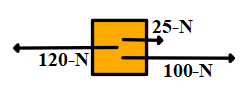
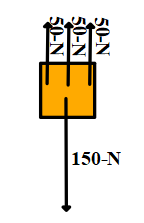
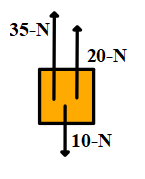
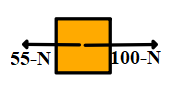
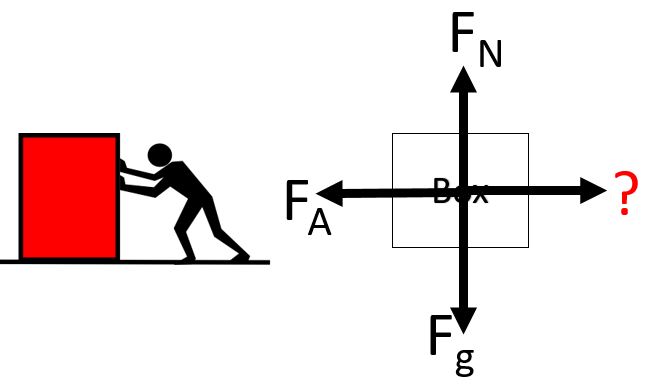
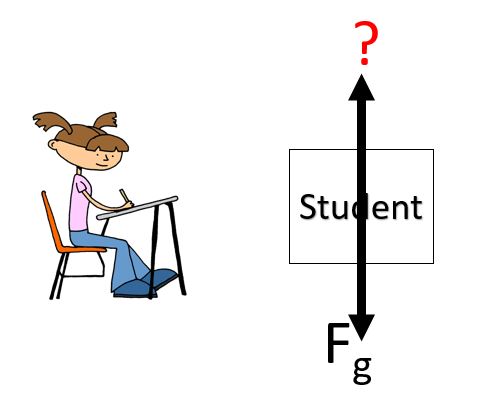
How is a force represented in a Free Body Diagram?
A straight line with an arrowhead
A curved line with an arrowhead
An arc with an arrowhead
Multiple lines with arrowheads

Which equation would accurately describe the forces on this cup of coffee?
Fn − Fg = 0
Fn×Fg = 0
Fn−10Fg
Fn−Fg = −10
Acceleration is always in the direction:
Of the displacement
Of the initial velocity
Of the final velocity
Of the net force

A block of mass m is pulled at constant velocity along a rough horizontal floor by an applied force 𝑇⃗ as shown. The magnitude of the frictional force is:
T cos θ
T sin θ
Zero
mg
The inertia of a body tends to cause the body to:
Speed up
Slow down
Resist any change in motion
Fall towards earth
A block of mass M slides down a frictionless plane inclined at an angle q with the horizontal. The normal reaction force exerted by the plane on the block is
Mg
mg sin θ
mg cos θ
Zero, Since the plane is frictionless
An object of mass m is hanging by a string from the ceiling of an elevator. The elevator is moving upward, but slowing down. What is the tension in the string? (decelerating)
less than mg
exactly mg
greater than mg
zero
An object of mass m is hanging by a string from the ceiling of an elevator. The elevator is moving up at constant speed. What is the tension in the string?
Less than mg
Exactly mg
Greater than mg
Cannot be determined without knowing the speed
Two cars collide head-on. At every moment during the collision, the magnitude of the force the first car exerts on the second is exactly equal to the magnitude of the force the second car exerts on the first. This is an example of
Newton's first law
Newton's second law
Newton's third law
Newton's law of gravitation
Inertia of an object is quantitative measure of its
Volume
Density
Mass
Temperature
The acceleration of an object is inversely proportional to
The net force acting on it.
Its position.
Its velocity.
Its mass
It's more difficult to start moving a heavy carton from rest than it is to keep pushing it with constant velocity, because
The normal force is greater when the carton is at rest.
μs < μ k
Initially, the normal force is not perpendicular to the applied force.
μs > μ k

A block of mass m is pulled along a rough horizontal floor by an applied force Tn as shown. The vertical component of the force exerted on the block by the floor is:
mg
mg − Tcosθ
mg + T sin θ
mg − T sin θ
A block of mass M slides down a frictionless plane inclined at an angle q with the horizontal. The gravitational force is directed
Parallel to the plane in the same direction as the movement of the block
Parallel to the plane in the opposite direction as the movement of the block
Perpendicular to the plane
Toward the center of the Earth.
A car travels east at constant velocity. The net force on the car is:
East
West
Up
Zero

