wayground logo

Free Printable Worksheets

Font size

S
M
L
XL
Worksheets

Musculoskeletal system

Total questions: 48

Worksheet time: 24mins

Name
Class
Date
1.

Which part of the skeletal system protects the brain?

a)

pelvis

b)

ribs

c)

scapula

d)

cranium/skull

2.

Identify the function of the Axial skeletal structure.

a)

Locomotion

b)

Movement

c)

Protection

d)

Stature

3.

Identify any of the 126 Appendicular Bones

a)

Humerus, Radius, Ulna, Carpals, Metacarpals, Phalanges,

b)

cranial, sternum, thorax, ossicles

c)

metacarpals, phalanges, sacrum, coccyx

d)

hyoid, humerus, sacrum, sternum

4.

Identify the function(s) of the axial skeleton

a)

to provide support and protection for the brain, the spinal cord, and the organs in the ventral body cavity

b)

to support core of limbs

c)

to provides a surface for the attachment of muscles that move the head, neck, and trunk

d)

to performs respiratory movements

5.

The appendicular skeleton consists of the limbs and girdles. Identify the girdles that are matched correctly to attached limbs.

a)

pelvic girdle is the attachment point for our thigh bone

b)

pectoral girdle is formed by the clavicle and scapula

c)

pectoral girdle serves as the attachment point for humerus and consists of ilium, icshium, and pubis

d)

pelvic girdle is the attachment point for femur
6.

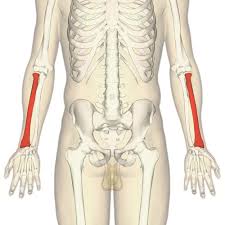
Which bone is highlighted

a)

humerus

b)

radius

c)

ulna

d)

femur

e)

fibula

7.

Each shoulder girdle, or pectoral girdle consists of two bones, a clavicle and a ___.

a)

tibia

b)

scapula

c)

sternum

d)

carpal

8.

Found attached to bones throughout the body

a)

smooth

b)

cardiac

c)

skeletal

d)

all

9.

Found in the heart

a)

smooth

b)

cardiac

c)

skeletal

d)

all

10.

Found in the walls of hollow organs; also called visceral

a)

smooth

b)

cardiac

c)

skeletal

d)

all

11.
What are the 3 types of muscles?
a)
Skeletal, muscular, ligament
b)
Skeletal, smooth, cardiac
c)
Smooth, Cellular, Cerebrum
d)
Cardiac, smooth, brain stem
12.
Smooth muscle and cardiac muscle are considered _____ muscles because we can’t control them consciously.
a)
Immovable
b)
Involuntary
c)
Skeletal
d)
none of the above
13.
A ______________________ attach bones to each other at joints.
a)
Ligament
b)
Bone
c)
Joint
d)
Cell
14.
A ______ is a strong connective tissue that attaches muscle to bone.
a)
Tendon
b)
Ligament
c)
Cartilage
15.

What muscle is the arrow pointing to?

a)

Pectoralis (Pecs)

b)

Biceps

c)

Triceps

d)

Lats

16.

What muscle is the arrow pointing toward?

a)

biceps

b)

traps

c)

pecs

d)

triceps

17.

What muscle is the arrow pointing to?

a)

Biceps

b)

Triceps

c)

Lats

d)

Quads

18.
a)
Quadriceps
b)
Satorius
c)
Hamstring
d)
Gastronecmius
19.
a)
Hamstrin
b)
Quadricep
c)
Tibialis Anterior
d)
Gastrocenmius
20.
a)
Trapezius
b)
Gluteals
c)
Deltoid
d)
Hamstring
21.
a)
Glutueal
b)
Hamstring
c)
Quadricep
d)
External Oblique
22.
a)
Hamstring
b)
Quadriceps
c)
Gastronecmius
d)
Satorius
23.
a)
Latissimius Dorsi
b)
Trapezius
c)
Triceps
d)
Erectors
24.
Flexion...
a)
Decreases angle of the joint
b)
Increases angle at the joint
c)
Moves limb away from midline
d)
Moves limb toward midline
25.

The following is NOT one of the 3 Joint Classifications..

a)

Cartilaginous

b)

Cartilage

c)

Fibrous

d)

Synovial

26.

Examples of a Ball & Socket Joint are found in the

a)

Shoulder

b)

Knee

c)

Hip

d)

Ankle

27.

A hinge joint allows

a)

A wide range of movements

b)

Circumduction

c)

Rotation

d)

Movement in only one direction (ie. backwards & forwards)

28.
Identify the joint action being performed.
a)
Extension
b)
Flexion
c)
Abduction
d)
Adduction
29.
Identify the joint action being performed.
a)
Extension
b)
Flexion
c)
Abduction
d)
Adduction
30.
Identify the joint action being performed.
a)
Circumduction
b)
Lateral Rotation
c)
Medial Rotation
d)
Eversion
31.
This type of joint allows the your first two vertebrate to rotate as in shaking your head no
a)
condyloid
b)
gliding
c)
pivot
d)
saddle
32.
The knee joint is
a)
Hinge
b)
Gliding
c)
Ball and socket
d)
Pivot
33.
Fibrous joints are?
a)
freely moveable
b)
partially moveable
c)
immovable
34.
Bones that begin as masses of cartilage later replaced by bone tissue.
a)
intramembranous bones
b)
entraspecific bones
c)
ethmodial bones
d)
endochondral bones
35.
Bone forming cells are called...
a)
osteoblasts
b)
osteocytes
c)
osteoclasts
d)
osteons
36.
In long bones, bone tissue begins to replace hyaline cartilage in the center of the diaphysis or the...
a)
secondary ossification center
b)
primary ossification center
c)
medullary ossification center
d)
transverse ossification center
37.
Most bones of the skeleton are formed by...
a)
endochondral ossification
b)
gender specific ossification
c)
intramembranous ossification
d)
hyaline ossification
38.
During endochondral ossification
a)
hyaline cartilage turns into bone 
b)
fibrocartilage turns into bone
c)
elastic cartilage turns into bone
d)
bone differentiates into cartilage
39.
The band of cartilage in the epiphysis where secondary ossification occurs.
a)
zone of ossification 
b)
ephiphyseal plate
c)
hyaline plate
d)
Z line
40.
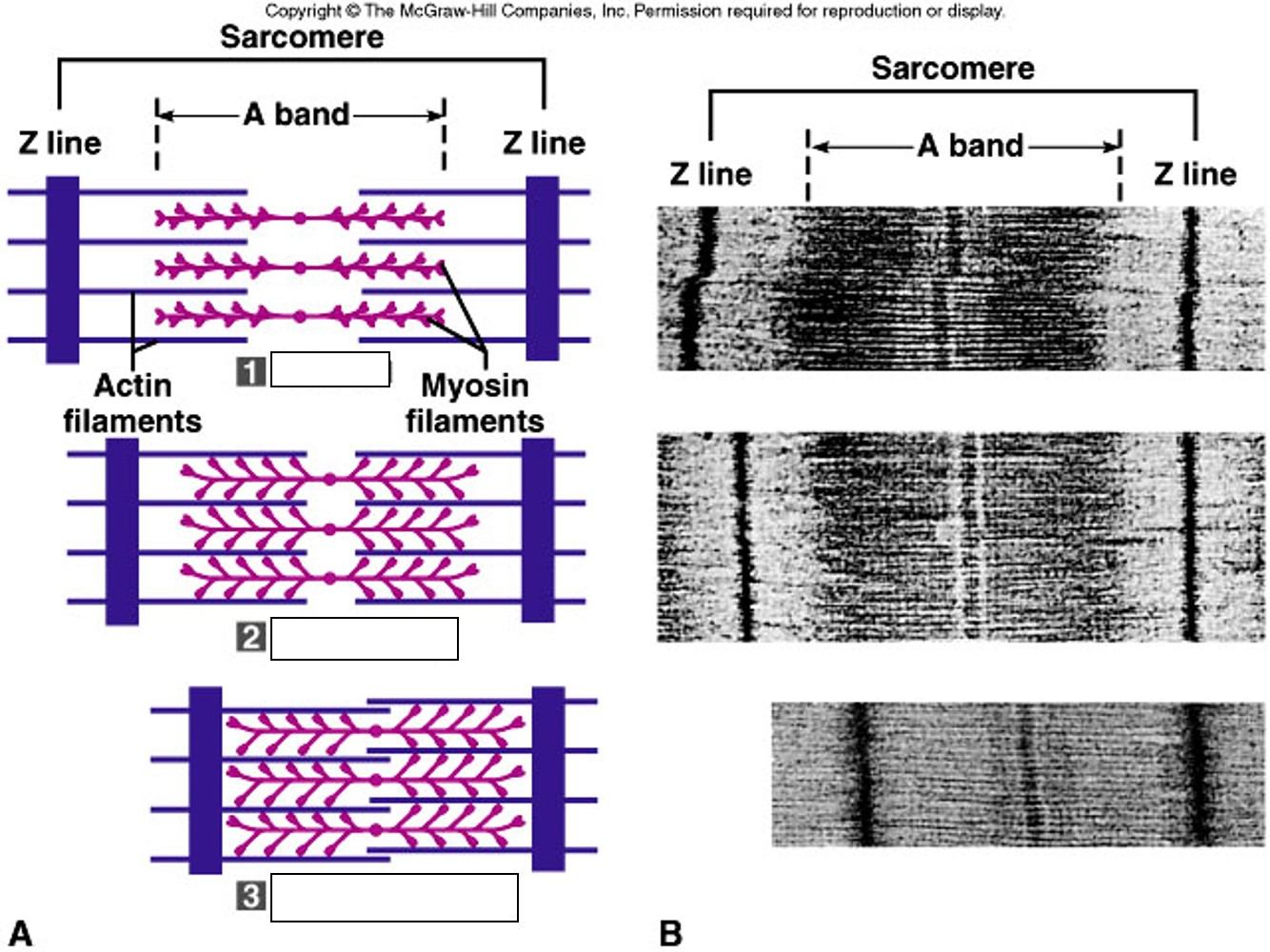
A sarcomere is
a)
A protein filament or fiber
b)
The basic contractile unit of muscle contraction
c)
An organelle
d)
An organ
41.
The part of the sarcomere that A (green) refers to is the?
a)
Z Line
b)
M Line
c)
H Line
d)
A Line
42.
The part of the sarcomere that C (Blue) refers to is the?
a)
Actin
b)
Myosin
c)
Troponin
d)
Tropomyosin
43.
The part of the sarcomere that D (Red) refers to is the?
a)
Actin
b)
Myosin
c)
Troponin
d)
Tropomyosin
44.
What state is the sarcomere in #2
a)
Relaxed
b)
Contracting
c)
Fully Contracted
d)
None of the above
45.
What state is the sarcomere in #3
a)
Relaxed
b)
Contracting
c)
Fully Contracted
d)
None of the above
46.
What happens to the Z lines during a sarcomere contraction?
a)
It disappears
b)
gets closer together
c)
It gets bigger
d)
None of these
47.

Define periosteum.

a)

It's a membrane that surrounds bones.

b)

It covers the ends of a bone.

c)

It covers the part of a bone that is not covered in cartilage.

48.

Periosteum contains:

a)

Nerves.

b)

Blood vessels.

c)

Cells to produce new bone cells.

d)

Cartilage.