
 Worksheets
Chemical Reactions And Equations_LS_17
Total questions: 68
Worksheet time: 35mins
Those reactions in which one element takes the place of another element in a compound, are known as displacement reactions.
Example: CuSO4 (aq) + Zn (s) —–>ZnSO4 + Cu
displacement reaction,
double displacement reaction
Those reactions in which two compounds react by an exchange of ions to form two new compounds are called double displacement reactions.
Example: AgNO3 (aq) + NaCl (aq)
displacement reaction,
double displacement reaction
Which method is used to prepare silver chloride?
Add excess solid reactant to acid
Titration
Precipitation
Which is the most suitable method for separating the products of the reaction below:
When silver nitrate solution is added to sodium chloride solution, then a white precipitate of silver chloride is formed along with sodium nitrate solution. In this reaction, two compounds, silver nitrate and sodium chloride, react to form two new compounds, silver chloride and sodium nitrate.
NaCl (aq) + AgNO3 (aq) --> AgCl (s) + NaNO3 (aq)
chromatography
crystallisation
distillation
filtration
NaCl (aq) + AgNO3 (aq) --> AgCl (s) + NaNO3 (aq).
When silver nitrate solution is added to sodium chloride solution, then a white precipitate of silver chloride is formed along with sodium nitrate solution. In this reaction, two compounds, silver nitrate and sodium chloride, react to form two new compounds, silver chloride and sodium nitrate. Which method is used to prepare silver chloride?
Add excess solid reactant to acid
Titration
Precipitation
Why are decomposition reactions called the opposite of combination reactions ? Explain with equations of these reactions. What is the first statement of the audio clip?
Those reactions in which a compound splits up into two or more simpler substances are known as decomposition reactions.
Example: When calcium carbonate is heated, it decomposes to give calcium oxide and carbon dioxide.
They are called opposite of combination reactions because in a combination reaction, two or more substances combine to form a single substance.
Example: Magnesium and oxygen combine, when heated, to form magnesium oxide.
Why are decomposition reactions called the opposite of combination reactions ? Explain with equations of these reactions. What is the second statement of the audio clip?
Those reactions in which a compound splits up into two or more simpler substances are known as decomposition reactions.
Example: When calcium carbonate is heated, it decomposes to give calcium oxide and carbon dioxide.
They are called opposite of combination reactions because in a combination reaction, two or more substances combine to form a single substance.
Example: Magnesium and oxygen combine, when heated, to form magnesium oxide.
Why are decomposition reactions called the opposite of combination reactions? Explain with equations of these reactions. What is the third statement of the audio clip?
Those reactions in which a compound splits up into two or more simpler substances are known as decomposition reactions.
Example: When calcium carbonate is heated, it decomposes to give calcium oxide and carbon dioxide.
They are called opposite of combination reactions because in a combination reaction, two or more substances combine to form a single substance.
Example: Magnesium and oxygen combine, when heated, to form magnesium oxide.
Why are decomposition reactions called the opposite of combination reactions? Explain with equations of these reactions. What is the fourth statement of the audio clip?
Those reactions in which a compound splits up into two or more simpler substances are known as decomposition reactions.
Example: When calcium carbonate is heated, it decomposes to give calcium oxide and carbon dioxide.
They are called opposite of combination reactions because in a combination reaction, two or more substances combine to form a single substance.
Example: Magnesium and oxygen combine, when heated, to form magnesium oxide.
Express the following facts in the form of a balanced chemical equation: "When a strip of copper metal is placed in a solution of silver nitrate, metallic silver is precipitated and a solution containing copper nitrate is formed”.
Cu (s) + 2AgNO3 (aq)—–>Cu(NO3)2 (aq) + 2Ag (s)
2AgNO3→2Ag+2NO2+O2
Zn+2AgNO3→Zn(NO3)2+2Ag
What happens when a piece of iron metal is placed in copper sulphate solution ? Name the type of reaction involved.
When a piece of iron metal is placed in copper sulphate solution, then magnesium sulphate solution and copper metal are formed. This is a type of displacement reaction.
When a piece of iron metal is placed in copper sulphate solution, then ferrous sulphate solution and copper metal are formed. This is a type of displacement reaction.
Fe + CuSO₄ = FeSO₄ + Cu (iron displaces copper in the salt solution; the iron dissolves, turning into solution, and metallic copper of a reddish color is released).
What happens when a piece of iron metal is placed in copper sulphate solution ? Write a well balanced equation for the reaction
When a piece of iron metal is placed in copper sulphate solution, then magnesium sulphate solution and copper metal are formed. This is a type of displacement reaction.
When a piece of iron metal is placed in copper sulphate solution, then ferrous sulphate solution and copper metal are formed. This is a type of displacement reaction.
Fe + CuSO₄ = FeSO₄ + Cu (iron displaces copper in the salt solution; the iron dissolves, turning into solution, and metallic copper of a reddish color is released).
2AgNO3 → 2Ag + 2NO2 + O2
Pb(NO3)2 + Fe2(SO4)3 → Fe(NO3)3 + PbSO4
In the reaction represented by the following equation :CuO(s) + H2(g) ————- > Cu (s) + H20(1)
name the substance oxidised
H2
CuO
CuO
H2S
In the reaction represented by the following equation :
CuO(s) + H2(g) ————- > Cu (s) + H20(1)
name the substance reduced
H2
CuO
Cu
H2
In the reaction represented by the following equation :
CuO(s) + H2(g) ————- > Cu (s) + H20(1)
name the oxidising agent
H2
CuO
Cu
H2
In the reaction represented by the following equation :
CuO(s) + H2(g) ————- > Cu (s) + H20(1)
name the reducing agent
H2
CuO
Cu
H2
What happens when silver nitrate solution is added to sodium chloride solution ?
When silver nitrate solution is added to sodium chloride solution, then a white precipitate of silver chloride is formed along with sodium nitrate solution.
AgNO3 (aq) + HCl (aq) → AgCl (s) + HNO3 (aq). This is a precipitation reaction: AgCl is the formed precipitate. ; Colorless to slightly yellow gas with a pungent, irritating odor.
Ag+ + Cl- → AgCl (s)
What happens when silver nitrate solution is added to sodium chloride solution ?(a) Write the equation for the reaction which takes place.
AgNO3(aq) + NaCl (aq)
AgNO3 (aq) + HCl (aq) → AgCl (s) + HNO3 (aq). This is a precipitation reaction: AgCl is the formed precipitate. ; Colorless to slightly yellow gas with a pungent, irritating odor.
Ag+ + Cl- → AgCl (s)
What happens when silver nitrate solution is added to sodium chloride solution? Name the type of reaction involved
Single Displacement Reaction
Double Displacement Reaction
Combination Reaction
Precipitation Reaction.
Decomposition Reaction.
Decomposition Reaction. What is the first statement of the video clip?
Decomposition Reactions:
the reaction in which a single compound
breaks up into two or more simple substances is known as
reactions
The decomposition reaction generally takes place when energy in some form such as heat, electricity or light is
supplied to the reactants
CaCO3(s)+heat (when heated) → CaO(s) + CO2(g)
decomposition of a substance by heating is thermal decomposition
Electrolysis: the decomposition of a substance by passing electric current through it is
known as electrolysis
Decomposition Reaction. What is the second statement of the video clip?
2 NaCl(l) (electrolysis) ---> 2 Na(l) + Cl2(g)
Sodium chloride on passing electric current gives sodium 2na and chlorine cl2
The decomposition reaction generally takes place when energy in some form such as heat, electricity or light is
supplied to the reactants
CaCO3(s)+heat (when heated) → CaO(s) + CO2(g)
decomposition of a substance by heating is thermal decomposition
Electrolysis: the decomposition of a substance by passing electric current through it is
known as electrolysis
Decomposition Reaction. What is the third statement of the video clip?
2 NaCl(l) (electrolysis) ---> 2 Na(l) + Cl2(g)
Sodium chloride on passing electric current gives sodium 2na and chlorine cl2
Photolysis: the decomposition of a compound with light is called photolysis
CaCO3(s)+heat (when heated) → CaO(s) + CO2(g)
decomposition of a substance by heating is thermal decomposition
Electrolysis: the decomposition of a substance by passing electric current through it is
known as electrolysis
Decomposition Reaction. What is the fourth statement of the video clip?
2 NaCl(l) (electrolysis) ---> 2 Na(l) + Cl2(g)
Sodium chloride on passing electric current gives sodium 2na and chlorine cl2
Photolysis: the decomposition of a compound with light is called photolysis
study of decomposition of silver chloride: take about 2 grams of silver chloride in
a china dish
decomposition of a substance by heating is thermal decomposition
Electrolysis: the decomposition of a substance by passing electric current through it is
known as electrolysis
Decomposition Reaction. What is the fifth statement of the video clip?
2 NaCl(l) (electrolysis) ---> 2 Na(l) + Cl2(g)
Sodium chloride on passing electric current gives sodium 2na and chlorine cl2
Photolysis: the decomposition of a compound with light is called photolysis
study of decomposition of silver chloride: take about 2 grams of silver chloride in
a china dish
place this china dish in the sunlight for sometime
Electrolysis: the decomposition of a substance by passing electric current through it is
known as electrolysis
Decomposition Reaction. What is the sixth statement of the video clip?
2 NaCl(l) (electrolysis) ---> 2 Na(l) + Cl2(g)
Sodium chloride on passing electric current gives sodium 2na and chlorine cl2
Photolysis: the decomposition of a compound with light is called photolysis
study of decomposition of silver chloride: take about 2 grams of silver chloride in
a china dish
place this china dish in the sunlight for sometime
it is observed that the white silver chloride turns gray on exposure to sunlight
Decomposition Reaction. What is the seventh statement of the video clip?
2AgCl (on exposure to sunlight) ---- 2Ag +Cl2
Photolysis: the decomposition of a compound with light is called photolysis
study of decomposition of silver chloride: take about 2 grams of silver chloride in
a china dish
place this china dish in the sunlight for sometime
it is observed that the white silver chloride turns gray on exposure to sunlight
Decomposition Reaction. What is the eighth statement of the video clip?
2AgCl (on exposure to sunlight) ---- 2Ag +Cl2
silver bromide undergoes decomposition when exposed to light
study of decomposition of silver chloride: take about 2 grams of silver chloride in
a china dish
place this china dish in the sunlight for sometime
it is observed that the white silver chloride turns gray on exposure to sunlight
Decomposition Reaction. What is the ninth statement of the video clip?
2AgCl (on exposure to sunlight) ---- 2Ag +Cl2
silver bromide undergoes decomposition when exposed to light
2AgBr (when exposed to light) ----> 2Ag +Br2
place this china dish in the sunlight for sometime
it is observed that the white silver chloride turns gray on exposure to sunlight
Decomposition Reaction. What is the tenth statement of the video clip?
2AgCl (on exposure to sunlight) ---- 2Ag +Cl2
silver bromide undergoes decomposition when exposed to light
2AgBr (when exposed to light) ----> 2Ag +Br2
the above reactions are used in black and white photography
it is observed that the white silver chloride turns gray on exposure to sunlight
Decomposition Reaction. What is the eleventh statement of the video clip?
2AgCl (on exposure to sunlight) ---- 2Ag +Cl2
silver bromide undergoes decomposition when exposed to light
2AgBr (when exposed to light) ----> 2Ag +Br2
the above reactions are used in black and white photography
it is observed that the white silver chloride turns gray on exposure to sunlight
Decomposition Reaction. What is the Twelfth statement of the video clip?
2AgCl (on exposure to sunlight) ---- 2Ag +Cl2
silver bromide undergoes decomposition when exposed to light
2AgBr (when exposed to light) ----> 2Ag +Br2
the above reactions are used in black and white photography
it is observed that the white silver chloride turns gray on exposure to sunlight
Decomposition Reaction. What is the Thirteenth statement of the video clip?
2AgCl (on exposure to sunlight) ---- 2Ag +Cl2
silver bromide undergoes decomposition when exposed to light
2AgBr (when exposed to light) ----> 2Ag +Br2
the above reactions are used in black and white photography
it is observed that the white silver chloride turns gray on exposure to sunlight
Decomposition Reaction. What is the Fourteenth statement of the video clip?
2AgCl (on exposure to sunlight) ---- 2Ag +Cl2
silver bromide undergoes decomposition when exposed to light
2AgBr (when exposed to light) ----> 2Ag +Br2
the above reactions are used in black and white photography
it is observed that the white silver chloride turns gray on exposure to sunlight
What is corrosion?
The release of oxygen
Breakdown of a metal
Iron rust in the presence of:
Oxygen
Vacuum
Moisture
Moisture and Oxygen

Is this an example of corrosion?
Yes
No
Deterioration of metal due to the corrosive environment
Erosion
Corrosion
Both A & B
None of these
Corrosion of Metals involves
Physical reactions
chemical reactions
Both
None
Define metal corrosion.
Deterioration of metal by chemical or electrochemical attack that can occur internally & externally.
Changes smooth surface.
weakens interior, damages and/or loosens adjacent parts.
All are correct.
Explain the corrosion process.
Metal that is oxidized (loss of electron) suffers anodic change.
Corrosive agent reduced (gain of electron) undergoes cathodic change.
Both are correct.

Whats is corrosion?
Please select CORRECT answer.
Elecctrochemical process in which metals are eaten up gradually by the action of air, moisture or a chemical (such as an acid) on their surface.
The process of eroding or being eroded by wind, water, or other natural agents
Which metals rusts?
Copper
manganese
iron
potassium
What environmental element assists rusting?
nitrogen
oxygen
carbon
hydrogen

What conditions are required for rusting?
dry cold conditions
dry hot conditions
hot damp conditions
What is the chemical name given to Rust ?
Iron dioxide
Iron oxide
Steel oxide
Carbon dioxide
What prevents Rusting
Painting , Oiling , Galvinising
Washing with water
What is the chemical name given to Rust ?
hydrated iron(I) oxide
Iron (I) oxide
iron(II) hydroxide
hydrated iron(III) oxide
Which of the following does not prevent rusting of iron?
Painting , Oiling , Galvinising
Attach to a piece of copper
connect to a piece of magnesium with wire
cover entirely with copper

In which tube will the nail go rusty?
The nail in tube A will go rusty.
The nail in tube B will go rusty.
The nail in tube C will go rusty.

A rusting bicycle
physical change
chemical change

Rusting is an example of
oxidation
reduction
What two things cause Iron to Rust ?
Air and Oxygen
Water and Carbon dioxide
Oxygen and Water
Carbon dioxide and Air
A layer of reddish brown on surface of a metal is called...
red paint
red dirt
rust
brown rust
Choose an object that can rust.
Iron spoon
Straw
String
Aluminium pot
Which of the following groups consist of rusty objects?
Nail, key, board and marble
Nail, marble. needle and screw
Nail, key, needle and screw
Marble. rubber band and clothes
Two factors that cause rusting are the presence of ......... and ...........
oxygen
water
hydrogen
carbon dioxide
Which of the following can rust?


Choose the correct characteristics of rusty objects.
Strong
Stiff
Rough surface
Brittle
Looks new
Only objects that are made from iron and steel will rust.
TRUE
FALSE
Why wooden bench do not rust?
because it is made of plastic.
because it is made of wood.
because it is made of iron.

Can rust
Does not rust
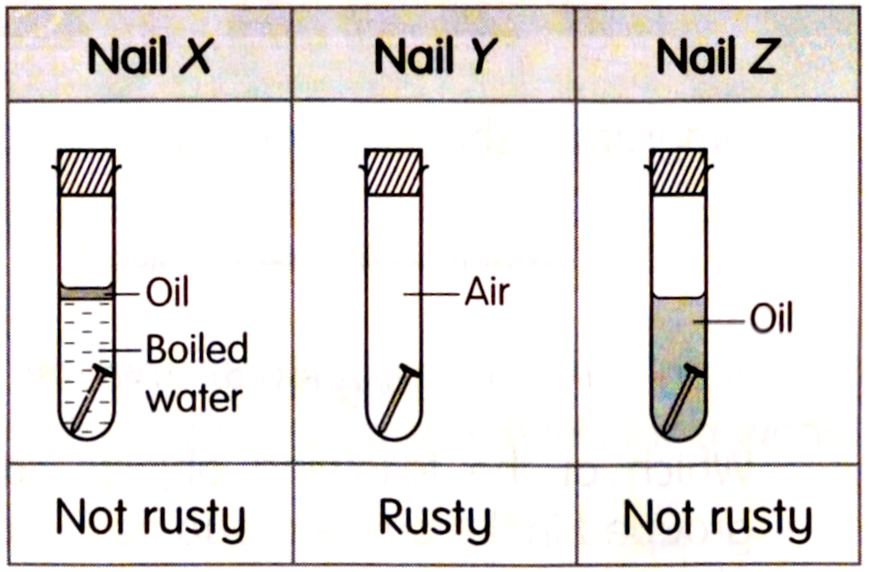
9.An experiment has been carried out by a group of pupils. The results of the
experiment are recorded in Table 2.
What can be concluded from this experiment?
Nail X did not rust because exposed to the air and water.
Nail Y rusts because exposed to the air and water
Nail X did not rust because exposed to the oil layer.
Nail Z did not rust because exposed to water.
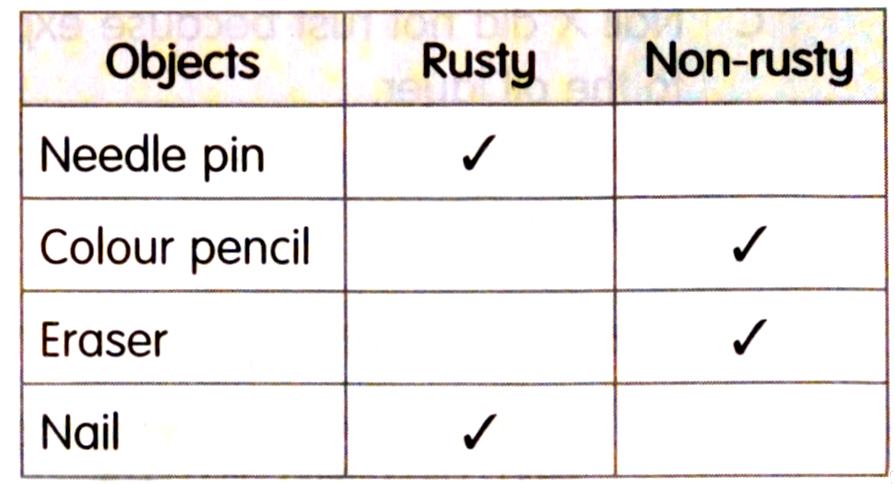
6.Table shows the results of an investigation
by a group of Year 5 Zircon pupils.
What is the conclusion that can be made
from the results of this investigation?
Rusty objects are made of iron.
Non-rusty objects are made of iron.
Rusty objects are brownish colour.
Rusty objects are made of plants.

Which nail rusts first?
Nail in test tube A
Nail in test tube C
Nail in test tube E
Nail in test tube F

How do you prevent this food can from rusting?
painting
apply oil or grease
coating with plastic
plating with non rusty metal

An investigation was carried out by year 5 pupils to study the factors that cause rusting. What is the function of anhydrous calcium chloride in this investigation?
To protect the iron nail
To increase the rate of the rusting process
To absorb the moisture in the air
To supply oxygen in the test tube
Which of the following methods can prevent rusting?
applying grease on objects made from iron
painting steel objects
cover steel and iron objects with a damp cloth
cover steel objects with non-rusty material

