
 Worksheets
Unit 2: Water, Biochemistry, & Enzymes
Total questions: 60
Worksheet time: 1hrs 21mins
What is the main function of a carbohydrate?
Store energy and provide structural support.
Store genetic information.
Store energy and provide barriers.
Controls the rate of reactions and regulates cell processes.
What is the biological function of a lipid?
Release energy.
Store genetic information.
Store energy and provide barriers.
Controls the rate of reactions and regulates cell processes.
Which type of molecule is formed from amino acids?
lipids
proteins
carbohydrates
nucleic acids
Fats, oils and cholesterol are all types of what?
cell membranes
hormones
lipids
fatty acids
RNA and DNA are which type of macromolecules?
nucleic acid
carbohydrate
lipids
protein
A sugar, a phosphate group, and a nitrogen base form the building blocks of which organic compound?
carbohydrates
nucleic acids
proteins
lipids
Which of the following properties of water enables it to move from the roots to the leaves of plants?
Water expands as it freezes.
Water is an excellent solvent.
Water exhibits cohesive behavior.
Water is able to moderate temperatures.
Large bodies of water, such as lakes and oceans, do not quickly fluctuate in temperature. What is the reason for this phenomenon?
Water is an acid.
Water is a versatile solvent.
Water acts as a buffer.
Water has a high heat capacity.
Why does ice stay at the top of oceans instead of sinking to the bottom?
Ice is colder than liquid water.
Ice is more dense than liquid water.
Ice is warmer than liquid water.
Ice is less dense than liquid water.
Water striders are an insect that gets it's name from its ability to walk on top of water. This is due to the _________________.
surface tension resulting from the polarity of water molecules
high specific heat of water of water
ability of water to act as a solvent
expansion of water upon freezing

This structure represents
carb
lipids
proteins
nucleic acids

This structure represents
Carbs
Lipids
Nucleic Acids
Proteins
Made of C,H,O
carbs and lipids
proteins
nucleic acids
nucleotides
C,H,O,N
proteins
lipids
nucleic acids
carbs
A substance made of many parts
polymer
monomer
monosaccharides
proteins
If a substance is 4 on the pH scale it would be considered
slimy
bitter
acidic
basic
A substance is 13 on the pH scale. This substance would be considered
basic
acidic
Monomer of nucleic acid
hemoglobin
monosaccharide
nucleotide
nucleolus

Which macromolecule builds muscles and immunity?
The most important element that is the backbone of all biological molecules


What is this?
Triglyceride
Guanine
Polysaccharide
Amino Acid

What type of reaction produces water?
Hydrolysis
CHONPS
Dehydration Synthesis
Organic Chemistry
What happens when lipids are mixed with water?
An exothermic reaction occurs
They do not mix, due to lipids being hydrophobic
They mix very well, due to lipids being hydrophilic
An endothermic reaction occurs
what is the lipids function?
to jump higher
provides short term energy
provides long term energy
to run faster

what goes in the white part


what goes in the white space


what goes in the white space



Which labeled part is the substrate?
letter A
letter B
letter D
letter E

Which labeled part is the enzyme?
letter A
letter B and D
letter D
letter E


Which type of fatty acid is healthy for the body?
saturated
trans fat
unsaturated
triglycerides

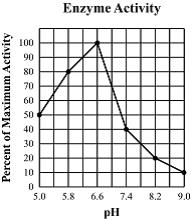
Refer to the figure above. What temperature would be considered the optimum temperature for this enzyme's activity rate?
20 Degrees Celsius
60 Degrees Celsius
40 Degrees Celsius
30 Degrees Celsius
Which of the following is an enzyme?
lipase
lactose
galactose
glucose
Changes in pH and temperature can ___________________ an enzyme which causes it to lose its shape and affects its function.
puncture
denature
double
delete
Contains the elements carbon, hydrogen, nitrogen, and phosphorous (CHONP)
carbohydrates
lipids
proteins
nucleic acids


What property of water allows water to flow against gravity?
Polarity
Cohesion
Capillary Action
Adhesion

What property of water allows for water to act as a temperature regulator for the world?
Cohesive Behavior
Expansion Upon Freezing
High Specific Heat
Universal Solvent
Why does ice stay at the top of oceans instead of sinking to the bottom?
Ice is colder than liquid water
Ice is less dense than liquid water
Ice is more dense than liquid water
Ice is warmer than liquid water

What molecule is this?
calcium
hydrogen
helium
water

A paperclip floating on water is an example of what property of water?
capillary action
surface tension
universal solvent
specific heat index
Which of the following is LEAST likely to dissolve in water?
nonpolar fats and oils
polar sugar molecules
salt made of a positive sodium ion and a negative chloride ion
all of the substances will dissolve easily in water

