wayground logo

Free Printable Worksheets

Font size

S
M
L
XL
Worksheets

Unit 5 Exam Practice

Total questions: 46

Worksheet time: 47mins

Name
Class
Date
1.

Water sticks to other substances, like this leaf. This is called...

a)

Cohesion

b)

Adhesion

2.

Weak bonds between different water molecules are called

a)

Covenant Bonds

b)

Polar / Hydrogen Bonds

c)

Ionic Bonds

d)

Van der Waals Interactions

3.

When water molecules stick to other water molecules, beads form. This is because of...

a)

Adhesion

b)

non-polarity

c)

Cohesion

d)

solution

4.

A solute is...

a)

the substance in which the solute dissolves

b)

a substance that is dissolved

c)

a compound that releases H+ ions into a solution

d)

a compound that produces hydroxide (OH-) ions in solutions

5.

When salt is dissolved in water, water is the...

a)

Solution

b)

Solvent

c)

Solute

d)

Reaction

6.
The pH scale is a range from:
a)
1-7
b)
0-14
c)
1-5
d)
1-20
7.
A(n) ______ is a substance with a pH less than 7
a)
Acid
b)
Alkaline
c)
Base
d)
Buffer
8.
A(n) _______ is a substance with a pH greater than 7.
a)
Base
b)
Acid
c)
Buffer
d)
Water
9.

In a test of pH levels, a baking soda has a pH of 9 and bleach has a pH of 12. What is true about there relationship?

a)

Both of the solution are Bases

b)

Both of the solution are Acids

c)

The Baking soda is an acid and the Bleach is a base

d)

The baking soda is a base and the Bleach is an Acid.
10.
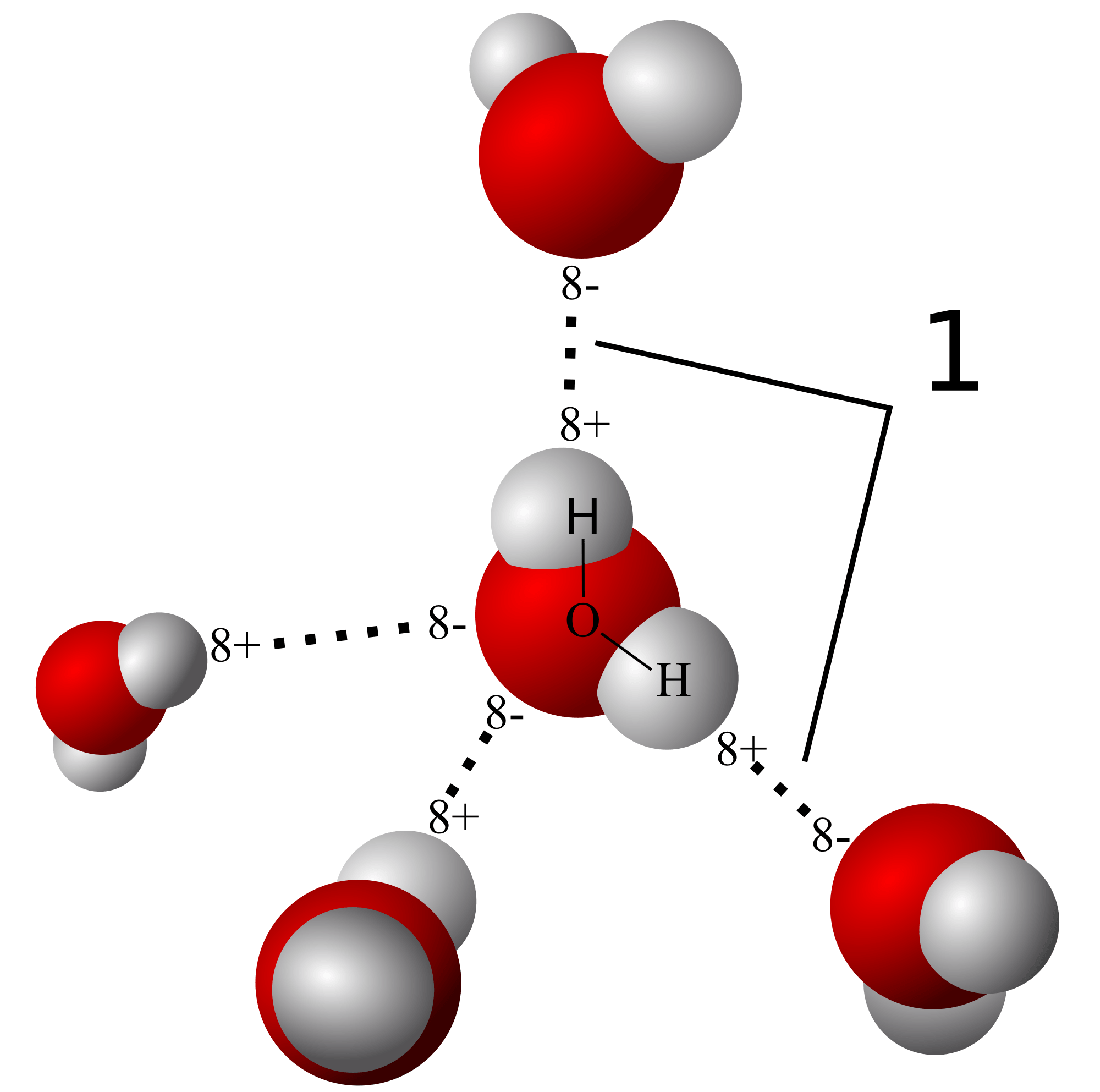
Why can water have no net charge but have slight charges in different parts of the molecule?
a)
The oxygen end is slightly negative and the hydrogen end is slightly positive
b)
The hydrogen end is slightly negative and the oxygen end is slightly positive
c)
The hydrogen and oxygen ends change in polarity
d)
Because it is hydrophobic
11.
Attractions between water molecules are called
a)
Covalent bonds
b)
Ionic bonds
c)
Polar bonds
d)
Hydrogen bonds
12.
What property of water helps to moderate earth's temperature?
a)
adhesion
b)
chohesion
c)
Specific heat capacity
d)
Latent heat of vaporization
13.
Is water a polar or a non-polar molecule? 
a)
Polar
b)
Non-polar
14.
What type of charge does oxygen have in a water molecule?
a)
negative
b)
positive
c)
neutral
15.

Evaporation is a state change from?

a)

Ice to liquid.

b)

Liquid to gas.

c)

Gas to solid.

d)

Crystals to water.

16.
Snow, sleet, hail, and rain are all examples of  ________________. 
a)
evaporation
b)
condensation
c)
accumulation
d)
precipitation
17.
What is it called when plants give off water vapor as a waste product?
a)
condensation
b)
evaporation
c)
sublimation
d)
transpiration
18.
What amount of the water on the earth is salt water?
a)
25%
b)
72%
c)
97%
d)
99%
19.
Which best explains why runoff is important?
a)
It returns water to other locations on Earth
b)
It increases the chance of flooding
c)
It makes evaporation occur faster
d)
It increases condensation
20.

What is an aquifer?

a)

a body of permeable rock which can contain or transmit groundwater.

b)

a well in which water is under pressure especially : one in which the water flows to the surface naturally.

c)

confining layer

d)

solid rock underlying loose deposits such as soil or alluvium.

21.

You left a cube of ice in a cup. In an hour the ice turned into a clear substance that took on the shape of the bottom of the cup. After a few days there appeared to be nothing in the glass at all. What states of matter did the ice cube go through?

a)

liquid- solid- gas

b)

gas-liquid-solid

c)

solid- liquid- gas

d)

solid-gas-liquid

22.

Lines running East to West, measuring distance North or South of the Equator in Degrees.

a)

Latitude

b)

Longitude

c)

Meridian

d)

Parallel

23.

90 degrees South

a)

Prime Meridian

b)

Equator

c)

South Pole

d)

North Pole

24.

0 Degrees of Latitude

a)

Equator.

b)

Prime Meridian

c)

International Date Line.

d)

Axis.

25.

0 Degrees of Longitude.

a)

Equator.

b)

Prime Meridian.

c)

Axis

d)

International Date Line.

26.
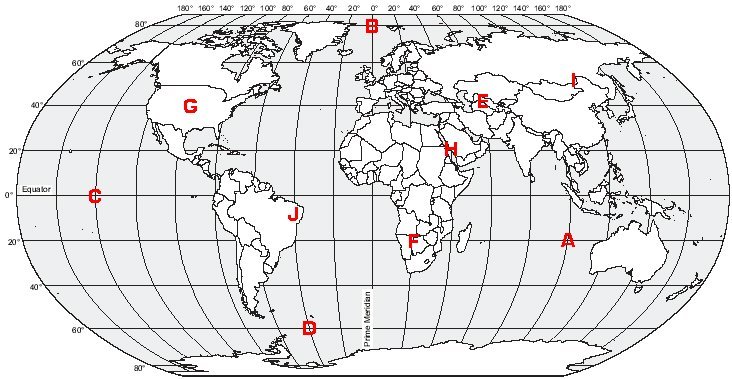
What is the approximate location of G?
a)
100oW, 40oN
b)
40oN, 100oW
c)
40oS, 100oW
d)
40oN, 100oE
27.
Which of the following letter is at approximately 60 degrees S, 40 degrees W? 
a)
A
b)
D
c)
E
d)
H
28.

Which ocean zone allows plants to grow??

a)

midnight zone

b)

photic zone

c)

twilight zone

d)

intertidal zone

29.
organisms that live on or in the bottom
a)
benthos
b)
neuston
c)
littoral
d)
heterotrophs
30.
The aphotic zone is
a)
the ocean's dark lower layer where photosynthesis cannot occur
b)
the sunlit upper layer of the ocean where photosynthesis occurs
c)
on the bottom of lakes, streams, and oceans.
d)
where benthos are found
31.

Which area has the highest salinity?

a)

North Pole

b)

areas where rivers meet the ocean

c)

equator

32.

Which layer would have the highest salinity?

a)

surface mixed zone

b)

transition zone

c)

deep zone

33.
2) What is the most abundant salt in sea water?
a)
sodium chloride
b)
magnesium chloride
c)
calcium chloride
d)
potassium chloride
34.
T4 - Which of the following is not a process that decreases the salinity of seawater?
a)
runoff from land
b)
icebergs melting
c)
precipitation
d)
evaporation
35.
A plate boundary at which two plate move parallel to each other in opposite directions
a)
convergent plate boundary
b)
divergent plate boundary
c)
transform plate boundary
d)
subduction
36.
a boundary at which two plates move away from each other
a)
convergent plate boundary
b)
divergent plate boundary
c)
transform plate boundary
d)
subduction
37.
a boundary at which two plate move toward each other
a)
convergent plate boundary
b)
divergent plate boundary
c)
transform plate boundary
d)
subduction
38.
What type of boundary is in this image?
a)
convergent plate boundary
b)
divergent plate boundary
c)
transform plate boundary
d)
subduction
39.
What type of boundary is in this image?
a)
convergent plate boundary
b)
divergent plate boundary
c)
transform plate boundary
d)
subduction
40.
What new feature forms at a convergent plate boundary where two continental plates collide?
a)
mid-ocean ridge
b)
trench
c)
mountain range
d)
none of these features form
41.
Wegener’s proposal of a supercontinent was supported by:
a)
earthquake data
b)
seafloor magnetism
c)
rock, fossil, and climate data.
d)
convection currents in the mantle.
42.
What does the theory of continental drift state?
a)
The continents were once joined in a super-continent and have moved over time
b)
Continents are stationary and do not move
c)
The Earth is broken into lithospheric plates that move due to convection currents
d)
none of the above
43.
Why did no one believe Wegener's thoery?
a)
He could not explain HOW the continents moved
b)
He didn't have evidence
c)
His data was wrong
d)
He didn't use the right technology to gather data
44.
What two specific continents fit together most noticeably?
a)
Africa and North America
b)
South America and Europe
c)
South America and Africa
d)
Antartica and Africa
45.
What are the two types of crust?
a)
continental and oceanic
b)
ocean and basin
c)
lower and upper
d)
thick and thin
46.
Who is the scientist who proposed Continental Drift Theory?
a)
Albert Einstein
b)
Alfred Wegener
c)
Isaac Newton
d)
John Dalton