
 Worksheets
Ch. 1 Newton's Laws Review
Total questions: 65
Worksheet time: 39mins

The attractive force that exists between all objects that have mass
Weight
Gravity
Mass
Magnetism
leaves blowing in the wind is an example of a
contact force
noncontact force
magnet attracting a nail
contact
noncontact
a leaf falling from a tree
contact
noncontact
lightning going through the sky
contact
noncontact
a bat hitting a baseball
contact
noncontact
pushing in a chair
contact
noncontact
All forces have what two things
strength and speed
speed and direction
strength and direction
speed and size
We represent forces by drawing what?
points
arrows
triangles
circles
What does gravity depend on?
mass and weight
speed and distance
distance and direction
mass and distance
How are mass and weight related?
proportional
inversely
they are the same thing
they are not related
The amount of gravity pushing down on an object
force
weight
mass
gravity
gravity is an example of what
contact force
noncontact force
weight
mass
How can you reduce friction?
remove a lubricant
add surface area
reduce surface area
rub your hands faster
Friction between air and a surface is called
static friction
sliding friction
fluid friction
fox friction
this type of friction keeps an object at rest
sliding
static
fluid
fake
the force that opposes motion
mass
weight
friction
speed
Newton's 1st Law is also called the Law of ...
Friction
Inertia
Unbalanced forces
Newtons
Because of inertia, a moving object will keep ________ unless acted on by an unbalanced force.
at rest
moving
in one spot
inertia

Objects tend to stay at rest unless acted upon by ______
An inside force
An outside force
A balanced Force
If the forces acting on an object are balanced, then its motion will not change
True
False

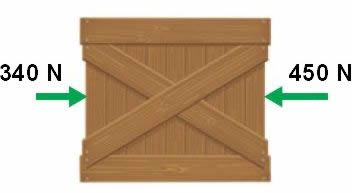
What is the net force acting on this box?
8N to the right
5N to the left
5N to the right
9N to the left

What is the net force acting on this box?
8N to the right
5N to the left
0N
6N to the left

What is the net force acting on this box?
16N to the right
4N to the left
0N
8N to the left
combine and form a net force of zero
unbalanced forces
newton's first law
balanced forces
inertia
combine and form a net force of anything but zero
unbalanced forces
newton's first law
balanced forces
inertia
Unbalanced forces change the motion of an object
True
False
If a ball is in motion, how do balanced forces effect it?
it will slow the ball down
the ball will speed up
the ball will continue to move at a constant speed & in the same direction
the ball will stop
What force causes objects that are moving to come to a stop?
gravity
inertia
friction
magnetism
A crash test dummy flying forward when the car crashes is an example of what?
friction
balanced forces
gravity
inertia
the sum of all the forces acting on an object
balanced forces
net force
unbalanced forces
friction
An object of mass 10 kg is accelerated upward at 2 m/s2. What force is required?
20 N
2 N
5 N
0 N
Newton's Second Law can be expressed as
v = d / t
E = mc2
F = ma
m1v1 = m2v2
An object accelerates 5 m/s2 when a force of 20 newtons is applied to it. What is the mass of the object?
4 kg
20 kg
0.5 kg
2 kg
An object accelerates 8 m/s2 when a force of 40 newtons is applied to it. What is the mass of the object?
4 kg
20 kg
5 kg
0.2 kg
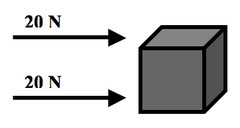
When force is 20 N, mass is 5 kg, what is acceleration?
25 m/s/s
5 m/s/s
100 m/s/s
4 m/s/s
Whenever an object exerts a force on another object, the second object exerts a force of the same magnitude, but in the opposite direction to that of the first object.
Always true
Sometimes true
Never true
Forces always occur
as single quantities
in pairs
by themselves

A dog plays with a ball. Consider the action force the dog touching the ball. What is the reaction force?
The friction of the ground on the ball.
The ball pushing the ground.
The ground pulling the dog.
The ball touching the dog.

According to Newton's third law, if you push gently on something, it will push
gently on something else.
on you only if you aren't moving.
gently on you
on something only under the right conditions.
Which law states that for every action there is an equal and opposite reaction?
Newton's First Law
Newton's Second Law
Newton's Third Law
Newton's Fourth Law
Which law states that an object in motion stays in motion & an object at rest stays at rest until an outside force acts on it?
Newton's First Law
Newton's Second Law
Newton's Third Law
Newton's Fourth Law
Which law states that a=F/m
Newton's First Law
Newton's Second Law
Newton's Third Law
Newton's Fourth Law
When two objects exert forces on each other, the two forces are called what?
balanced forces
unbalanced forces
force pair
doubled pair
The law of conservation of momentum states that the total momentum of a group of objects
increases after a collision
decreases after a collision
remains the same after a collision
increases and then decreases after the collision
What force slows down motion?
inertia
weight
friction
gravity
Which type of collision occurs when a baseball bat hits a baseball and the ball bounces off the bat?
elastic collision
inelastic collision
balanced collision
unbalanced collision
What type of collision occurs when two football players tackle each other & get "stuck"?
elastic collision
inelastic collision
balanced collision
unbalanced collision
in a circular motion, a force that acts perpendicular to the direction of motion, toward the center.
circular motion
curved motion
triangle motion
centripetal force
the forces two objects apply to each other
couple forces
force pairs
balanced forces
unbalanced forces
What is the equation for mass?
m= f x a
m = F/a
m= A/f
m= kg x N
What is the equation for force?
f= a/m
F= ma
F= m/a
F= N x S
when something is moving along a curved path
centripetal force
circular motion
triangular projection
oval orbit

