
 Worksheets
Final quiz
Total questions: 60
Worksheet time: 15hrs 0mins
What causes wind?
differences in air pressure
differences in gravity
difference in oxygen
differences in the thermosphere
Local winds blow over:
short distances
long distances
the poles
the equator

How do the heating and cooling rates of land and water compare?
Land heats and cools faster
Land and water heat and cool at the same time
Land heats faster but water cools faster
Water heats and cools faster

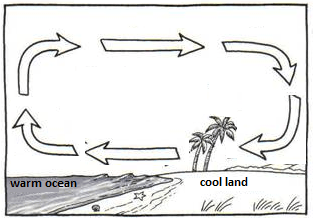
During the land breeze, what starts moving the cooler air out and warmer air in?
conduction
convection
radiation
A valley breeze occurs when air moves
up a mountain during the day
up a mountain at night
down a mountain during the day
down a mountain at night
A mountain breeze occurs when air moves
up a mountain during the day
up a mountain at night
down a mountain during the day
down a mountain at night
When do valley breezes occur?
During the day when the warmer air moves up the mountains
During the day when colder air moves down the mountains
During the night when warmer air moves up the mountains
During the night when colder air moves down the mountains
Which of the following is often associated with the Santa Ana winds?
sea breezes
chinook winds
wild fires
flash flooding
A warm, dry wind moving down a mountain slope in Southern California is called a:
Chinooks
Santa Ana Wind
Wind vane
Prevailing wind
Cup anemometer

What is a front?
when something is in front of you
where two air masses meet

How does a cold front form?
cold air mass meets a warm air mass
warm air mass meets a cold air mass

How does a warm front form?
a cold air mass meets a warm air mass
a warm air mass meets a cold air mass
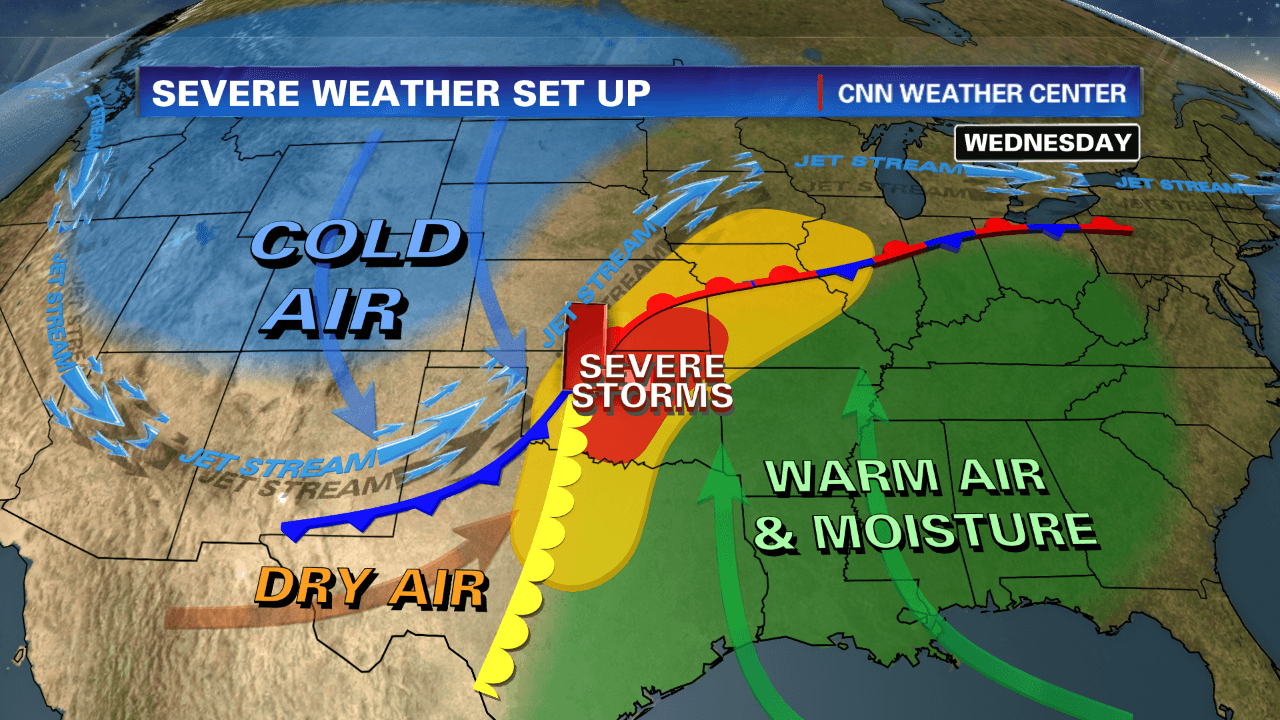

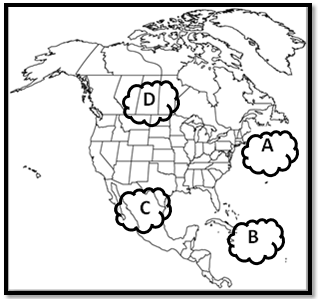
Most weather comes from -
water
temperature
air masses
very large area
The temperature and humidity in an air mass stays about -
different
the same
100* C
An air mass gets its ____________ and __________ from the water or land it came from.
humidity, temperatue
size, shape
color, weight
weather, animals
The word that means water is ___________ .
polar
tropical
continental
maritime
The word that means land is -
polar
tropical
continental
maritime
The first part of the name of an air mass tells us-
polar or continental
tropical or polar
continental or maritime
maritime or tropical
The second part of the name of an air mass tells us-
polar or continental
tropical or polar
continental or maritime
maritime or tropical
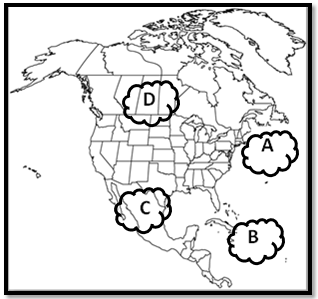
Which type of air would you find at air mass C?
mT
mP
cT
cP
Which type of front will most likely give you longer periods of light precipitation, with low clouds?
Warm front
Cold front
Stationary front
Occluded front
Which type of front will most likely give you short periods of heavy precipitation with tall, towering clouds?
Warm front
Cold front
Stationary front
Occluded front
Which type of front will have the most complex weather associated with it?
Warm front
Cold front
Stationary front
Occluded front
What type of clouds do tornadoes form from?
Stratus
Cumulus
Cirrus
Cumulonimbus
Where do 80% of the world's tornadoes occur?
Europe
North America
Asia
Africa
What type of air masses need to meet for a tornado to form?
Warm and cold air
Warm dry and cold moist air
Cold and cold air
Warm moist and cold dry air
Tornado winds can reach what speeds?
100mph
200mph
300mph
400mph
Which of these is not a hazard of a tornado
Intense pressure imbalance
Storm surge
Intense precipitation
Hail
What is the name of the scale used to measure tornadoes?
Fujita Scale
Enhanced Fujita Scale
Saffir-Simpson Scale
Richter Scale
Which of the following is a method of predicting tornadoes?
Building storm shelters in homes
Having home insurance
Cloud seeding
Monitoring storms with doppler radar
What is the shape of a tornado?
funnel
spiral
rectangular
What is the shape of a hurricane?
funnel
spiral
rectangular
triangular
How many categories are hurricanes classified into?
2
3
4
5
Violently rising, warm air forming cumulonimbus clouds.
Updrafts continue and downdrafts begin as rain starts to fall.
Thunder and lightning begin.
Strong updrafts blow warm, moist air higher until the vapor condenses, forming a cumulus cloud.
How fast must the winds be, in order for a storm to be classified as a hurricane?
50 mph
74 mph
100 mph
150 mph
When is peak hurricane season?
May 1 until June 1
June 1 until November 30
June 1 until September 1
December 1 until January 30
Japan in is located in the West Pacific. What term do they use for hurricanes?
Typhoons
Cyclones
Tornadoes
What causes the air to begin circulating, higher in the atmosphere?
Gravity
The Tyndall Effect
The Coriolis Effect
What term is used to describe the center of a hurricane?
Heart
Head
Eye
What type of weather is associated with the eye of the hurricane?
Calm, dry weather
Stormy, windy weather
What causes a storm surge?
Pressure and wind
Tides and wind
Rain and pressure
When are storm surges the most dangerous?
During low tide
During high tide
During the spring
Which of the following hazards can hurricanes produce?
High winds
Storm surges
Flooding
Tornadoes
All of the previous
When do hurricanes weaken?
When they travel over land or cool waters
When they travel over warm waters
All of the previous
What should you look out for, after a hurricane?
Downed power lines
Gas leaks
Snakes
All of the previous
Standing near a tree is the safest thing to do during a lightning storm.
True
False
What should you do if caught outside during an electrical storm? Select all correct answers.
Don't be the tallest object.
Stay away from isolated trees, towers, and utility poles.
Try to outrun the storm
If with a group of people spread out.

