
 Worksheets
Matter Homework
Total questions: 30
Worksheet time: 17mins
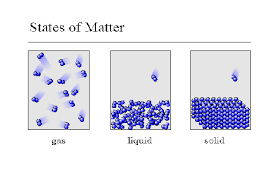

Freezing
Solid to gas
Liquid to solid
Gas to solid

Boiling
liquid to gas
gas to solid
gas to liquid

The state of matter that has no definite size or shape is
Solid
Liquid
Gas
The slower the particles in a substance move,
the colder it is.
the warmer it is.
the more energy it has.
It refers to the space that matter occupies.
volume
mass
weight
density
It is the amount of matter in an object.
volume
mass
weight
density
Which of the following determines an object’s ability to float in water?
volume
mass
weight
density
Matter is
Anything that has volume
Anything that has mass
Anything that has mass and volume

The diagram shows arrangement of particles in a
Solid
Liquid
Gas

What state of matter does the picture below represent?
solid
liquid
gas
plasma

What state is represented in the gif?
Solid
Liquid
Gas
Cooking an egg
Chemical
Physical
Melting Chocolate
Chemical
Physical
Evaporating Water
Chemical
Physical
No new substance created
Chemical
Physical
New substance created
Chemical
Physical
Breaking a glass
Chemical
Physical
Burning wood
Chemical
Physical
Eugene describes the physical property of a material as “sweet and floral.” What physical property of the material is Eugene most likely observing?
boiling point
shape
hardness
odor
What happens when a substance undergoes a physical change?
Some physical properties change, but the substance keeps its identity.
No physical properties change, and the substance keeps its identity.
Some physical properties change, and the substance changes its identity.
No physical properties change, but the substance changes its identity.
What is an example of a physical change?
having less ash than the paper that was burned to form it
ice forming and then melting back into water
rust having a different identity than the iron it forms on
the irreversible reaction of vinegar and baking soda
The Statue of Liberty is made of copper that has turned green because it has undergone a change. What can be said about this change?
The change is a physical change because the copper in the statue is still there.
The change is a physical change because a new chemical is formed on the outside of the statue.
The change is not a physical change because the color of the statue has changed.
The change is not a physical change because a new chemical is formed on the outside of the statue.
Which scenario is an example of a physical change?
Wood is burned in a campfire and is turned into ash and smoke.
A piece of metal is left in the rain and forms rust.
Lead is melted into a liquid to form pellets.
Yeast turns sugar into energy, water, and carbon dioxide gas.
The three states of matter are solid, liquid, and
air.
water.
gas.
ice.
What is the volume of a toy car that displaces water from 25 ml to 50 ml?
20 ml
25 ml
75 ml
1000 ml
What is the density of object with a volume of 35 ml and a mass of 140 grams?
105 grams/ml
4900 grams/ml
0.25 grams/ml
4 grams/ml



