NEW
Font size
 Worksheets
Q1 Test 2 Honors
Total questions: 44
Worksheet time: 29mins

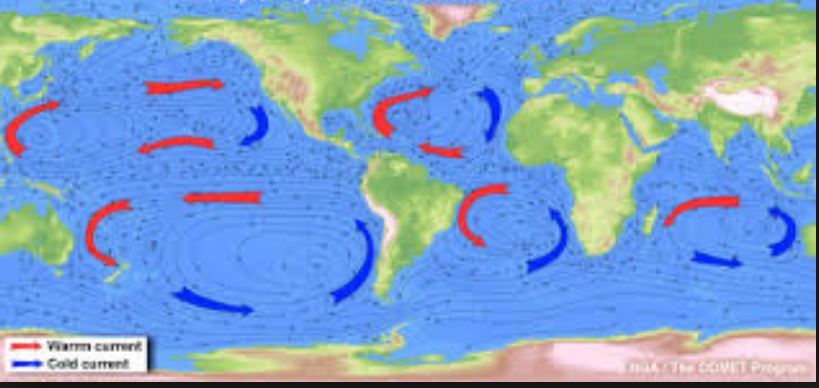
The movement of deep, cold, nutrient filled water to the surface of the ocean after the winds move the warmer water away is called _______.
Ocean Current
Upwelling
Deep Currents
Surface Currents

Surface currents are mainly formed by and driven by the ______.
Winds
Ocean water is more dense than fresh water at the same temperature due to differences in _________.
Deep Ocean currents are primarily caused by ________.
temperature and salinity
wind
gravity
precipitation

The warm, strong current off the coast of Florida is the ____________.
Gulf Stream
Current

When surface currents meet continents they ___?
Stop moving
Are deflected (change paths)
Continue in the direction they were going

Salt water is ____________ fresh water.
more dense than
less dense than
the same density as
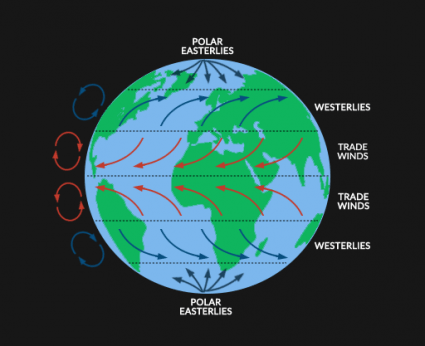
what is the coriolis effect?
change in location of warm and cold surface water every 2-7 years
tendency of objects moving large distances on Earth’s surface to bend to the right in the northern hemisphere & to the left in the southern hemisphere
winds in northern Indian ocean that blow from the southwest in the summer & from the northeast in winter
two layers of horizontal winds moving in opposite directions
Objects in the SOUTHERN Hemisphere deflect to which direction due to the Coriolis Effect?
Left
Up
Down
Right
Objects in the NORTHERN Hemisphere deflect to which direction due to the Coriolis Effect?
Left
Up
Down
Right
During a(n) ____ event, trade winds are much stronger than usual.
El Nino
La Nina
Normal
Partly sunny
Both El Nino and La Nina have this in common
Influence birds that migrate over the ocean
Influence rainy / dry weather world wide
The weather at the polar regions
The directions that ships travel in the oceans
During an El Nino, trade winds are typically...
about average
stronger
weaker

The picture below is of a(n) ____ event.
Non-El Nino (Normal)
El Nino
La Nina
Why do the fisherman of Peru and South America not welcome a strong El Nino?
El Nino poisons the fish
El Nino causes strong winds and currents which move fish westward
El Nino bring cold water to the surface which kills the base of the food chain
El Nino shuts off upwelling and nutrients needed for the marine food chain do not rise to the surface
In El Nino, rain moves east with the warm pool causing rainy/stormy weather in Florida and less hurricanes in the Atlantic Ocean.
True
False
Which of the following is an INCORRECT statement about El Niño and La Niña?
Both occur every 2-7 years
Both occur in the Atlantic Ocean
El Nino is a warming and La Nina is a cooling of the Pacific Ocean
Neither are considered "storms"

Which region would likely experience a drought during El Nino?
South America
Indonesia
The prefix "bio" comes from a Greek word that means what?
LIFE
WATER
AIR
GROUND

Plants (__________) draw water (___________) and nutrients from the soil (___________) and release water vapor into the atmosphere.
biosphere; hydrosphere; geosphere
hydrosphere; biosphere; geosphere
biosphere; atmosphere; hydrosphere
cryosphere; biosphere; hydrosphere


This sphere includes not only the landforms on Earth’s surface (e.g. mountains, volcanoes, sand dunes), but all the matter in the Earth’s interior as well.
Geosphere
Biosphere
Plants reduce soil erosion by protecting the land.
Biosphere & Atmosphere
Biosphere & Geosphere
Hydrosphere & Geosphere
Hydrosphere & Atmosphere
Strong winds can change the shape of sand dunes by blowing the sand to other places.
Atmosphere & Hydrosphere
Biosphere & Geosphere
Geosphere and Cryosphere
Atmosphere & Geosphere
When animals decompose, which two spheres are interacting?
Biosphere & Atmosphere
Hydrosphere & Atmosphere
Biosphere & Geosphere
Atmosphere & Cryosphere

A bird in the sky is which 2 sphere?
Hydrosphere and cryosphere
Geosphere and Biosphere
Biosphere and atmosphere
Hydrosphere and Biosphere

A glacier melting in the ocean is which 2 spheres?
Atmosphere and biosphere
Geosphere and hydrosphere
Hydrosphere and biosphere
Cryosphere and hydrosphere

A person drinking water is which 2 spheres?
Biosphere and hydrosphere
Atmosphere and geosphere
Cryosphere and atmosphere
Biosphere and geosphere
When water vapor is cooled and forms droplets of liquid water
Condensation
Evaporation
Transpiration
Runoff
__________________ is the process by which moisture is carried through plants from roots to small pores on the underside of leaves, where it changes to vapor and is released to the atmosphere. It is essentially evaporation of water from plant leaves.
Transpiration
Percolation
Infiltration
Plant Uptake
Which process removes carbon dioxide from the atmosphere?
deforestation
tree farms
burning fossil fuels
cellular respiration