
 Worksheets
Unit 3 - Solar Bodies Review
Total questions: 105
Worksheet time: 55mins
Has the largest moon in the Solar System
Jupiter
Saturn
Uranus
Neptune
Has the shortest day of all planets
Jupiter
Saturn
Uranus
Neptune
Largest planet
Jupiter
Saturn
Uranus
Neptune
Has a Great Red spot
Jupiter
Saturn
Uranus
Neptune
Has the coldest temperatures of all planets
Jupiter
Saturn
Uranus
Neptune
smallest gas giant
Jupiter
Saturn
Uranus
Neptune
Which planet is closest to the asteroid belt?
Jupiter
Saturn
Uranus
Neptune
Which planet is know for its huge storm that can be seen as a big red spot?
Neptune
Mars
Jupiter
Juniper
Which two planets can only be be viewed through a telescope, not by using the naked eye?
Jupiter & Saturn
Neptune & Uranus
Jupiter & Neptune
Saturn & Uranus

Which planets have rings?
Saturn because it's visible
Jupiter and neptune have thin unseen rings and saturn has a huge ring.
The sun has the biggest visible ring.
Earth has the biggest ring.
Scientists removed pluto from the planet category:
True
False

why are Uranus and Neptune blue?
Because they chose to be.
Because they're very cold.
Because their atmosphere includes methane.
Because they are.

Which Outer Planets are also known as ice giants?
Neptune and Uranus
Jupiter and Saturn
The Sun and Mars
Earth and Uranus
What are the outer planets?
Jupiter, Saturn, Earth, Neptune
Saturn, Neptune, Mars, Uranus
Uranus, Saturn, Neptune, Jupiter
Mercury, Venus, Earth, Mars
Select all that apply to the GAS GIANTS
They all have rings
They are all made of gas
They have a rocky surface
They are very small

What is the correct order of the inner planets?
Mars, Venus, Mercury, and Earth
Mercury, Venus, Earth, and Mars
Venus, Mercury, Earth, and Mars
Venus, Mercury, Mars, and Earth


6th planet from the sun. Known for its rings.
Saturn
Uranus
Neptune
Jupiter

Which gas giant has the Great Dark Spot?
Jupiter
Saturn
Uranus
Neptune
This planet has the most moons in our solar system.
Jupiter
Saturn
Uranus
Neptune

Uranus has a turquoise-ish color to it because of traces of ______ in its atmosphere.
Oxygen (O2)
Nitrogen (N2)
Helium (He)
Methane (CH4)

The Great Red Spot is a ...
Cyclone
Impact Crater
Black Hole
Volcano

Which of the outer planets has the lowest density?
Saturn
Uranus
Neptune
Jupiter

What is Pluto now classified as?
A Hobbit Planet
A Worf Planet
A Dwarf Planet
A Moon

Despite being made of the lightest and fluffiest elements, the Outer Planets have more mass and stronger gravity than earth.
True
False

Which planet takes the longest to orbit the Sun?
Neptune
Saturn
Jupiter
Uranus

Saturn has rings that are made up of mostly
Ice
Asteroids
Gases
Pokemon

Which of the following falls between the Inner & Outer Planets?
Asteroid Belt
3rd Degree Black Belt
Kuiper Belt
Oort Cloud
_____________ planets are solid, dense, and rocky.
Gas giants
Terrestrial
Extraterrestrial
Alien
The satellites of Mars, Phobos and Deimos are named after the demigods of ____________.
fear & panic
love & beauty
war & anger
peace & nature
_______________________ planets are gaseous, less dense and very large.
Gas Giants
Terrestrial
Extraterrestrial
Alien
Most planets revolve ___________________________________.
Clockwise
Counterclockwise
Extremely Slowly
Extremely Fast
_______________________ planets are those orbiting other stars
Exoplanets
Endoplanets
Dwarf planets
Dead planets
The average distance from the Earth to the Sun is known as the _______________ ____
(full name – no abbreviation)
Astronomical Unit
Light Year
Astronomical Year
Light Unit
The 2 main elements in the Sun are _______________ and
_______________.
Hydrogen & Gold
Hydrogen & Neon
Hydrogen & Helium
Hydrogen & Oxygen
The third grouping of planetary bodies that Pluto is a part of is known as
Exoplanets
Endoplanets
Dwarf Planets
Dead Planets
When an object rotates backwards compared to the majority it is said to have
Centrifugal Motion
Orbital Motion
Retrograde Motion
Rotational Motion
Which planet is rusty?
Mercury
Venus
Earth
Mars
Which planet has no atmosphere?
Mercury
Venus
Earth
Mars
Which planet has two satellites (moons)?
Mercury
Venus
Earth
Mars
Which planet rotates backwards compared to others?
Mercury
Venus
Earth
Mars
Which planet is named after the god of roads and travel?
Mercury
Venus
Earth
Mars
Which planet has the most circular orbit?
Mercury
Venus
Earth
Mars
Which planet is named after the goddess of beauty and love?
Mercury
Venus
Earth
Mars
Which planet is named after the god of war?
Mercury
Venus
Earth
Mars
Which planet has the greatest temperature range?
Mercury
Venus
Earth
Mars
Which planet has polar ice caps made up of frozen water and carbon dioxide?
Mercury
Venus
Earth
Mars
Which planet is the closest planet to the Sun?
Mercury
Venus
Earth
Mars
Which planet suffers from a runaway greenhouse effect?
Mercury
Venus
Earth
Mars
Which planet has a tilt similar to Earth?
Mercury
Venus
Earth
Mars
Which planet has a size and density is very similar to Earth’s?
Mercury
Venus
Earth
Mars
Which planet has cliffs called scarps?
Mercury
Venus
Earth
Mars
Which planet has two satellites named Phobos and Deimos?
Mercury
Venus
Earth
Mars
Which planet has the most elliptical orbit?
Mercury
Venus
Earth
Mars
Which planet has sulfuric acid clouds?
Mercury
Venus
Earth
Mars
Which planet has a day that is longer than a year?
Mercury
Venus
Earth
Mars
Which of the following is NOT a requirement to be classified as a planet?
Be in orbit
around a star
Have enough mass to be spherical
Be larger than Earth’s moon
Dominate its orbit
Which planet is closest to the Sun?
Mercury
Venus
Earth
Mars
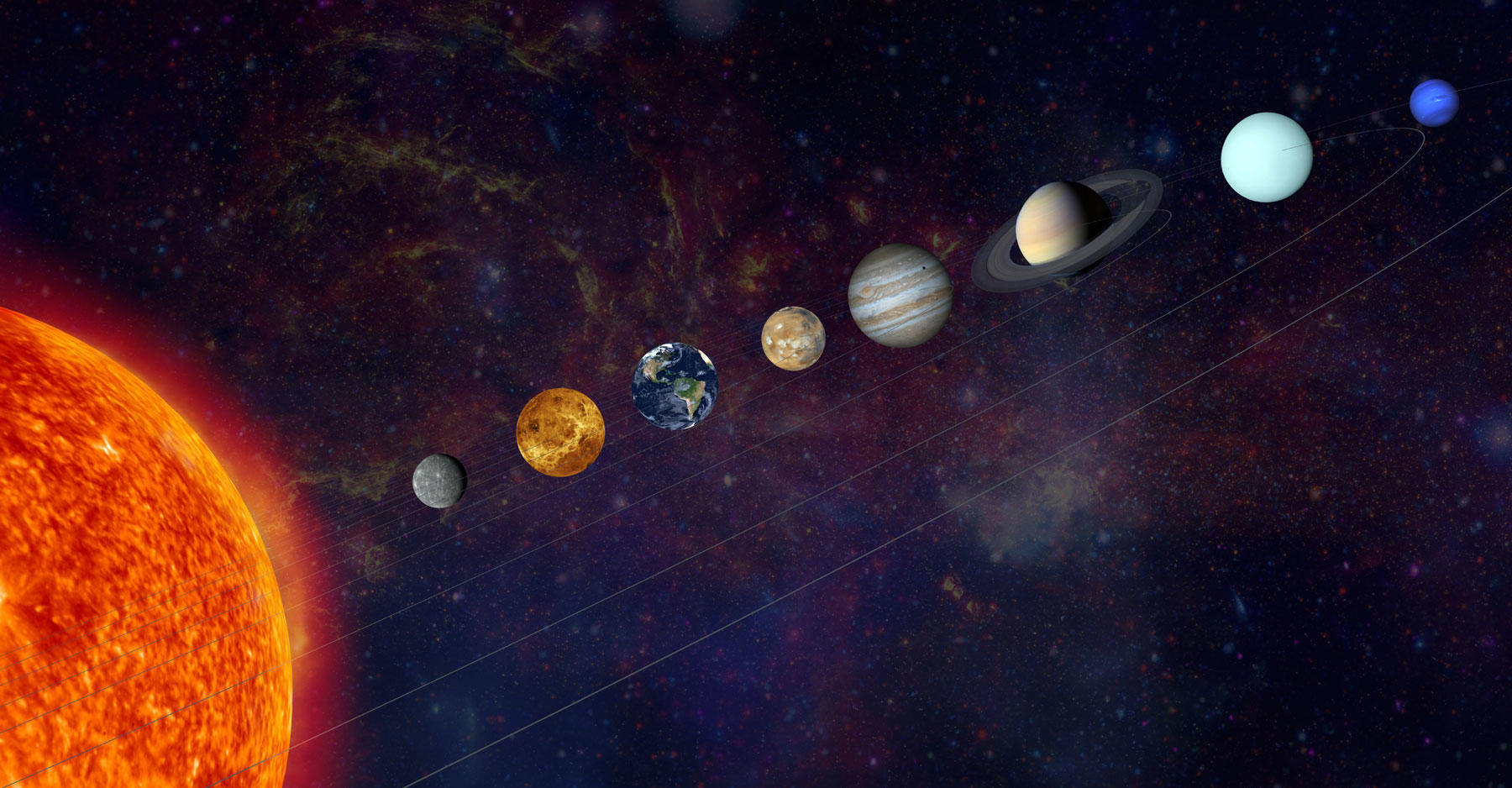
The planets are all equally distanced from each other.
Which is the farthest planet to the Sun?
Uranus
Neptune
Saturn
Jupiter
Which is the closest planet to the Sun?
Earth
Mars
Mercury
Venus
Which is the smallest planet?
Mars
Venus
Neptune
Mercury
What are large chunks of rocks and metal in space?
Earth
comet
asteroids
gibbous
The fourth planet from the Sun; also known as the "red planet."
Neptune
Mercury
Earth
Mars
These are the four planets the Sun; Jupiter, Saturn, Uranus, and Neptune are classified as
terrestrial planets
gas giants
solar planets
the best planets
The actual orbits of the planets are
elliptical, with Earth at the center
elliptical, with the Sun at the center
circular, with Earth at the center
circular, with the Sun at the center
What Galaxy is Earth located?
Andromeda
Milky Way
Sagittarius
Snickers
Which term defines a small, irregularly shaped body made of icy material that orbits the sun?
comet
meteor
asteroid
meteorite
Where is the Oort cloud located?
between the sun and Mercury
within the asteroid belt
between the asteroid belt and the Kuiper Belt
beyond the orbit of Pluto
When an asteroid or comet reaches the Earth’s atmosphere it becomes a _____?
Meteor
Meteorite
Meteoroid
Asteroid
People sometimes talk about seeing shooting stars. What do they actually see?
a meteoroid traveling through space
a star that is moving through the galaxy
a meteoroid that burns up in Earth’s atmosphere
a comet that has come close enough to Earth’s atmosphere to be seen
Which term defines a small, irregularly shaped body made of rocky material?
Comet
Meteor
Asteroid
None are correct
This part of a comet blows away from it based on the solar wind direction.
Coma
Tail
Trail
Cap
When an object enters the atmosphere and burns up creating light.
Meteor
Meteorite
Meteoroid
Asteroid
An object enters the atmosphere and makes it to the ground.
Meteor
Meteorite
Meteoroid
Asteroid
In which of the following parts of the solar system are most comets likely to be located?
Oort cloud
Kuiper belt
crossing Earth's orbit
in the orbits of Jupiter and Neptune
Which of the following consists mostly of small bodies of ice located just beyond Neptune's orbit?
the asteroid belt
the Kuiper belt
a meteor shower
the Oort cloud
Satellite photos of Neptune and Uranus show that both planets have a bluish color. Which gas in their atmosphere gives them this color?
water
helium
methane
hydrogen
How many planets are in our solar system?
10
9
8
5
Which planets are considered the Terrestrial Planets or the Inner Planets?
Mercury, Venus, Earth, Mars
Jupiter, Saturn, Uranus, Neptune

Why are all the planets round in the solar system?
They are not round.
The planets spin and that makes them round.
The planets are round because of gravity.
The planets are round because they orbit the sun.
What is the Kuiper Belt?
a massive asteroid belt between Mars and Jupiter
A massive asteroid belt past Neptune
a small asteroid belt between Mars and Jupiter
a small asteroid belt past Pluto
Where is the asteroid belt located in our solar system?
Between Mars and Jupiter
Outside of Neptune
Between Saturn and Uranus
Between the Sun and Mercury

A comet’s tail
Is gas and dust pulled off the comet by the Sun's gravity
Always trails behind the comet.
Is gas & dust expelled from the comet's nucleus by the Sun's heat & radiation pressure, & always points away from the Sun
Is composed mainly of captured particles from the solar win

Which of the following is not icy in composition?
Comet nuclei
Kuiper Belt Objects
The polar cap of Mars
Asteroids

A meteorite is:
A chunk of space debris that has struck the ground.
A streak of light in the atmosphere.
An icy body with a long tail extending from it.
A chunk of space debris orbiting the Earth

