
 Worksheets
Environmental Science Final Examination – Period 3
Total questions: 100
Worksheet time: 50mins
After a heavy rain, Isabella notices that pesticides from nearby farms have washed into a local river, affecting the fish and other aquatic organisms. Which Earth system is most directly involved with how pesticide runoff affects aquatic organisms?
Geosphere
Atmosphere
Hydrosphere
Cryosphere
Which of the following best describes the nitrogen cycle?
Nitrogen only cycles only through the atmosphere
Nitrogen moves from the atmosphere to organisms via nitrogen-fixing bacteria and returns through waste and decomposition
Atmospheric nitrogen is fixed in the roots of legumes, which is how it is made available to all plants on Earth
Animals release nitrogen into the air via respiration in a form that is usable by plants.
During a biology class, Jaime and his friends are discussing factors that affect animal populations. Which of these is a density-independent factor?
Competition
Natural disasters
Predation
Food shortages
Which of the following is an example of a density-dependent limiting factor?
Increased competition for resources as population grows
Volcanic eruptions
Earthquakes
Sunlight availability
Atalia is studying a local forest ecosystem and notices that different animals seem to have their own specific roles and places where they live and find food. Why is understanding the concept of a niche important in environmental science?
It helps locate endangered species based on their preferred resources
It explains how organisms interact with their environment and avoid competition by occupying specific roles
It is used to design national parks in such a way as to include organisms that won't fight for resources when placed together
It identifies which species are producers and allows scientists to calculate the NPP of the ecosystem
In a forest ecosystem, a researcher studies a group of eastern gray squirrels (Sciurus carolinensis) living in the same oak grove. Which term best describes this group, and why?
A population, because they are the same species living and interacting in one area
A community, because multiple species live together in an ecosystem
An ecosystem, because living things interact with the environment
A habitat, because it is the place where organisms live
A forest ecosystem is recovering from wildfire damage. Which ecological process is taking place, and what would be expected first?
Primary succession; lichens appear first and begin breaking down the rocks
Secondary succession; grasses and herbaceous plants
Climax community succession; mature trees were there before the fire and continue to grow strong in the newly carbonized
Invasive recolonization; predatory birds with few natural predators arrive from the mainland and quickly become apex

Multiple woodpecker species have evolved to occupy slightly different roles on the same tree as reduce direct competition, this is called _?
Niche overlap reduction
Character displacement
Competitive exclusion
Niche succession
Which of the following best describes the role of a carbon sink in the global carbon cycle, and why is it considered critical in mitigating climate change?
A carbon sink is a natural or artificial reservoir that releases carbon dioxide into the atmosphere, helping to regulate plant growth.
A carbon sink is a system that stores carbon compounds and converts them into fossil fuels, increasing atmospheric carbon levels.
A carbon sink is a natural or artificial system that absorbs more carbon from the atmosphere than it releases, helping to reduce greenhouse gas concentrations.
A carbon sink is a process by which carbon is emitted from industrial sources and stored in the upper atmosphere to prevent surface warming.
After fertilizer is applied to nearby agricultural fields, a lake becomes covered in algae and emits a foul odor. Which ecological process is most likely responsible for this phenomenon?
Eutrophication – the excessive enrichment of water by nutrients, leading to dense algal growth and oxygen depletion.
Biomagnification – the accumulation of toxins in organisms at higher levels of the food chain.
Acidification – the lowering of pH in aquatic systems due to increased carbon dioxide absorption.
Sedimentation – the accumulation of soil and debris in water bodies, reducing water clarity and depth.
Valerie is conducting a study on air quality in her city. She collects a large set of data over several months. Why is graphing her data important in environmental science?
It allows her to visually identify patterns, trends, and outliers that are not obvious from raw data
It makes her final report look more professional so it will be taken seriously by other scientists
A well made graph replaces the need for statistical analysis in order to draw statistically significant conclusions
It discourages replication because everybody makes graphs in their own style
If Earth’s average yearly surface temperatures continue to rise due to greenhouse gas emissions, which of the following is a likely consequence?
Biome locations will shift and extinction risk will increase for sensitive species
The ozone layer will become thicker due to the increase in O2 levels
Reduced photosynthesis since CO2 gas will increase in the atmosphere
Air quality will immediate improve
Which of the following best describes Net Primary Production (NPP)?
The total amount of energy produced by plants through photosynthesis
The energy remaining in plants after accounting for their own respiration
The energy transferred from producers to primary consumers
The sum of all energy lost as heat in an ecosystem
How does environmental justice address inequalities in environmental policy?
It ensures that every community, regardless of race, income, or location, receives equal protection from environmental risks and has a voice in environmental decisions.
It supports policies that often align with corporate goals, emphasizing economic growth even when it may conflict with environmental or community concerns.
It concentrates primarily on the conservation of endangered species, often overlooking broader social and environmental equity issues.
It promotes urban expansion and infrastructure development, sometimes at the expense of preserving natural ecosystems and community health.
Kymani and Kaleb are discussing the rules of traffic lights. Kymani says, "The rule that red means stop is just a guess, but the explanation of why we use red is proven." Kaleb replies, "Actually, the rule describes what happens consistently, while the explanation tells us why." Which aspect of a scientific law differs most from a scientific theory?
A law is a guess; a theory is proven
A theory explains why; a law describes what happens consistently
Laws are accepted by the scientific community but are untestable; theories are testable
Laws apply only in chemistry and physics
Which situation best illustrates an organism's niche?
How quickly a plant grows
What is a plants job in the ecosystem where it lives
The ecosystem in which a plant lives
Where the plant evolved
The burning of fossil fuels contributes to increased atmospheric concentrations of greenhouse gases. Which of the following is most directly linked to this process?
Stratospheric ozone depletion
Global warming
The formation of secondary pollutants from primary pollutants
The formation of primary pollutants from secondary pollutants
Janelly is working on a project to reduce air pollution in her city. She finds that secondary air pollutants are more difficult to regulate than primary ones. Why is this the case?
They are heavier and settle more slowly in the lower atmosphere
They are released in larger quantities by natural ecosystems
They form through chemical reactions after emission occurs
They are less harmful and often ignored in environmental policy
A population of howler monkeys arrive on an uninhabited island. Initially, their population grows, but as population increases competition for resources also increases, and the population levels off. The maximum population size an environment can sustainably support is known as _?
The maximum sustainable yield
An ecosystem's carrying capacity
Survival of the fittest
The community's sustainable age-structure
How does a fundamental niche differ from a realized niche?
A fundamental niche is the full range of conditions a species can tolerate; a realized niche is where it actually lives due to biotic interactions like competition
A realized niche is a theoretical concept used in models but doesn't always reflect real-world ecological dynamics.
A fundamental niche is shaped primarily by human influence, such as habitat modification and resource management.
They are considered functionally the same in most ecological studies, with little distinction between potential and actual habitat use.
Overpopulation can impact both natural resources and human health by:
Increasing demand for resources and spreading diseases
Decreasing pollution and improving health
Reducing resource consumption and disease risk
Promoting sustainable resource use and better health
How has the composition of Earth’s atmosphere changed most recently?
Due to biological activity and industrial emissions, greenhouse gases have increased, especially carbon dioxide and methane
Earth's atmosphere has always been close to 100% oxygen and has changed little since earth's formation
At Earth's formation, there was no atmosphere. Now, Earth has an atmosphere
The atmosphere is constantly changing, so it is impossible to pinpoint any recent changes
Nitrogen is essential for life on Earth. Atmospheric Nitrogen, N2, is held together by a triple bond that needs to be broken in order to create a molecule that plants can use. The breaking is done by soil bacteria. Which type of soil bacteria is responsible for breaking N2's triple bond?
Nitrogen Fixing Bacteria
Nitrifying Bacteria
Denitrifying Bacteria
Nitrogen Breaking Bacteria
You are concerned that citizens in your town are using too much fertilizer on their lawns. This fertilizer runs off into the local water system and causes massive algae blooms that devastate the organisms that live in the stream. You decide to attend a city council meeting and give a empassioned speech about the need for a law that prohibits the use of fertilizers on lawns. In this role, you are _?
An Environmental Advocate
An Environmental Scientist
Just a concerned citizen
A pain in your neighbor's butt
White-tailed deer move into the neighborhoods in Englewood, NJ. Initially, their population is low, but their population quickly begins to grow exponentially. What shape does a graph of exponential growth look like?
Straight Line
Zigzag-shaped
S-shaped
J-shaped
Simone is testing a new type of plant fertilizer in her garden. She applies different amounts of fertilizer to spinach seedlings to see how it affects their growth. What would make her experimental results “valid”?
She must conduct the experiment once and have a surprising outcome
The experiment must support her original hypothesis
The design must control variables and be reproducible with consistent results
It must be conducted by a government agency
What are the components of an ecological community?
All the interacting groups of different species living in the same geographic area at the same time
All the populations of different species living in the same geographic area at the same time, as well as all of the abiotic features of the environment
All the individuals of the same species living in the same geographic area at the same time
An individual of a particular species that lives in a an area at a specific time.
How do abiotic factors shape the structure and function of ecosystems?
They determine the evolutionary origin of dominant species through historical climate shifts
They reduce biodiversity by eliminating species unable to adapt to rapid environmental changes
They influence species distribution, survival, and reproduction by altering conditions like temperature, pH, and nutrient availability
They have minimal impact compared to biotic interactions such as predation and competition
While discussing air pollution, Airy mentions that some pollutants are not directly released into the air but are formed when other substances interact in the atmosphere. Which of the following pollutants is primarily formed through atmospheric interactions rather than being directly emitted from a source?
Sulfur dioxide (SO₂) associated with fossil fuel combustion
Ground-level ozone (O₃) resulting from photochemical reactions involving precursor emissions
Carbon monoxide (CO) linked to incomplete oxidation of carbon-based fuels
Lead (Pb) compounds originating from industrial and vehicular sources
Why do scientists use the mark-recapture method rather than counting every individual in a population?
Because it's more practical for large or mobile populations and provides an estimate based on statistical inference
Because it helps train animals to avoid predators
To remove invasive species
Because it leads to more accurate birth rate measurements
A tropical rainforest is cleared for agriculture. The fear is that by clearing the trees, which provide water vapor to the surrounding air through evapotranspiration, (1) rainfall will become less frequent and (2) those trees will not be available to photosynthesize. Which two biogeochemical cycles are most immediately affected in this scenario?
Sulfur and nitrogen
Carbon and water
Oxygen and phosphorus
Nitrogen and potassium
DeAndre is planning a trip and wants to understand why some places are warmer than others. How is climate affected by both latitude and atmospheric composition?
Latitude controls solar energy input; greenhouse gases trap that heat, creating temperature patterns globally
Only ocean currents matter when it comes to latitude and climate
Clouds block sunlight at mid-latitudes, creating atmospheric conditions that result in deserts
Pollution increases day length close to the equator
Gianna is studying for her environmental science exam and comes across a question about important environmental laws. She wants to know: What does the Clean Air Act of 1970 primarily regulate?
Safe drinking water quality
Wildlife conservation areas
Air pollution
Soil erosion
How does global climate influence the location of major biomes?
Patterns of temperature and rainfall shape biome locations globally
Climate only affects short-term weather, not biome placement
Biomes appear randomly without any climate-related pattern
Only the type of soil determines where biomes are found
A volcanic eruption creates a new land surface made entirely of hardened lava with no existing soil. What type of ecological process will most likely follow, and why?
Primary succession, because the area lacks soil and any preexisting organisms
Secondary succession, because the lava will quickly break down into soil
Secondary succession, because the eruption temporarily displaces species
The area will remain barren, as succession cannot occur without human intervention
What is the impact of invasive species on native biodiversity?
They usually have no effect
They reduce biodiversity by driving native species extinct or out of the ecosystem
They increase available food
They promote natural succession
Which of the following organisms possesses chlorophyll and is a principal primary producer in most aquatic food chains and food webs?
Algae - phytoplankton
Seaweed – water plants
Sea mosses – water mosses
Marine lichens
David is interested in understanding how his choices affect the world. He decides to take an online Ecological Footprint assessment. Which of the following best explains what David's result is trying to measure?
The total number of species in an ecosystem
The land area required to provide the resources and absorb the wastes of an individual or population
The environmental impact of only agricultural activities
The carbon emissions produced by factories
Which of the following is a major human-caused contributor to increased greenhouse gas levels?
Sulfur oxides released by buring impure coal for energy
Carbon Dioxide from the burning of all fossil fuels
Photosynthesis pulling carbon dioxide from the atmosphere and using it to make glucose
Ammonia and Ammonium created by nitrogen fixation by soil bacteria
Gabby conducts an experiment, receives some surprising results, and really wants to publish her results. Why is it important that other scientists are able to repeat and replicate Gabby's study?
To increase the fame of the original researcher
To reduce the need for peer review
To ensure validity and reduce bias
To make the studies easier for non scientists to understand
How do natural and manmade pollutants differ?
Natural ones form without people; human-made come from industry and cities
Human-made pollutants are always heavier than natural ones
Natural pollutants are found only in desert environments
Both types of pollutants are created by animals alone
What does a skewed sex ratio in a population most directly affect?
Reproductive potential
Resource availability
Predator-prey balance
Individual lifespan
What is the role of primary consumers in a food web?
They create energy used by all other organisms
They eat producers and pass energy to higher levels
They break down waste and recycle nutrients
They help control the temperature of ecosystems
What is the difference between immigration and emigration in population ecology?
Immigration is entering a population; emigration is leaving a population — both affect population size and gene flow.
Immigration and emigration are the same, so they don’t affect population size and gene flow at all
Immigration reduces population size while emigration decreases it
Emigration always increases biodiversity but adding more species to the community, while immigration decreases biodiversity
In the nitrogen cycle, various bacterially mediated processes transform nitrogen into different chemical forms. Which of the following processes directly converts nitrogen into a form that plants can absorb from the soil?
Nitrogen fixation, because specialized bacteria convert atmospheric nitrogen (N₂) into ammonia (NH₃), making nitrogen available to plants
Ammonification, because bacteria decompose organic nitrogen into ammonia, which plants absorb directly, unlike nitrogen fixation which occurs only in the atmosphere.
Nitrification, because nitrifying bacteria only exist in the roots of legumes and give this type of plant an edge over its competitors
Denitrification, because bacteria denitrify the different oxides of nitrogen, making the nitrogen available for plant absorption
Flora is studying the impact of different human activities on natural cycles. She wants to know which activity most directly disrupts the phosphorus cycle. Which should she focus on?
Combustion of fossil fuels
Use of nitrogen-based fertilizers
Mining and overuse of phosphate fertilizers
Deforestation in tropical regions
Which process in the carbon cycle directly uses carbon dioxide from the air to make energy-rich molecules, and how is it different from other carbon-releasing processes?
Photosynthesis, because plants use CO₂ and sunlight to make glucose, unlike respiration, decay, or burning fuels which release CO₂
Cellular respiration, because it stores carbon dioxide in sugars for later use by organisms
Decomposition, because it turns dead matter into carbon dioxide for plants to absorb
Fossil fuel burning, because it traps carbon dioxide deep underground for long periods
During a science class discussion, Kelly asks which gas is most responsible for the formation of acid deposition. What is the correct answer?
Carbon monoxide that binds with hemoglobin in the blood to form blood acids
Sulfur dioxide that reacts with water to form sulfuric acid
Methane that traps heat and creates hydrocarbonic acid
Ozone that oxidizes organic matter, forming oxicidic acid

Which of the following is most likely to cause uniform population distribution in a natural population?
Fierce territorial behavior among individuals
The beginning of the mating season
Uneven food availability
The introduction of a new predator into the area where the population lives
In an ecological pyramid, which trophic level typically contains the most energy?
Apex predators
Primary producers
Secondary consumers
Decomposers
Which of the following statements about the biosphere is most accurate?
The biosphere includes all living organisms and their physical environment on Earth.
The biosphere is limited to land ecosystems only.
The biosphere consists only of plants and animals.
The biosphere excludes aquatic environments.
How do the biosphere and atmosphere interact during deforestation?
Trees release carbon into the air, lowering oxygen and raising climate risks
Trees absorb water vapor, which changes local weather patterns
Deforestation reduces Earth’s gravity by removing mass from forests
The atmosphere removes toxins from soil during forest clearing
Which pollutant is a heavy metal that was once used in both paint and as an performance additive in gasoline, and that can cause neurological damage, especially in children?
Lead (Pb)
Iron (Ir)
Mercury (Hg)
Magnesium (Mg)
How do environmental scientists use age structure diagrams to make predictions?
They show trends in birth rates, future growth, and social needs by age
They are used only to track how many people die each year
They help scientists model pollution levels in different regions
They are mainly used to explain patterns of human migration
Why are food webs considered a more accurate model of energy transfer in ecosystems than food chains?
They simplify complex interactions by focusing on the most dominant predator-prey relationships within a habitat
They illustrate the multiple feeding connections among organisms, showing how species often occupy more than one trophic level
They exclude producers and decomposers to better highlight consumer dynamics in an ecosystem
They assume energy flows in a single direction without accounting for feedback loops or detritus-based pathways
Kelly is studying different nutrient cycles for her environmental science project. She notices that the phosphorus cycles is vastly different from the others. Which makes the phosphorus cycle significantly different from the nitrogen and carbon cycles?
It involves bacteria in atmospheric reactions
It primarily takes place in living tissue
It lacks a significant atmospheric component
It is faster and more dynamic than the others
When birds fly south for the winter and return in the spring, they are demonstrating:
Immigration
Emigration
Migration
Conflagration
Which of the following biomes has the highest year-round biodiversity?
Temperate forest
Subtropical desert
Tropical forest
Subtropical grassland
What is the primary characteristic of the stratosphere?
It Contains the ozone layer that protects against UV radiation
It Contains most clouds and storms
It is the coldest layer of the atmosphere
It is where 90% of all weather takes place
In a forest, two closely related bird species, observed by Genevie, develop different beak shapes even though they live in the same environment. Why might these birds develop different traits?
To reduce competition and occupy different ecological roles
To mimic other predators so that their own predators will not attempt to eat them
To mimic poisonous organism so that their own predators will not attempt to eat them
Since they are related, eventually they will converge into a single species

Which of the following is most likely to cause clumped population distribution?
Clumped distribution of food resources
Introduction of an invasive species
The organisms are all hiding from a predator in a cave
Because the organisms are social and like being close to each other all the time
A student designs an investigation to test the effect of soil pH on plant growth. To ensure a valid conclusion, what step must the student take after analyzing the results and drawing a conclusion?
Share results only with classmates
Change the hypothesis to match the data
Publish the data without review
Submit the work for peer review
Which of the following best explains why a country with high renewable energy use might still have an unsustainable ecological footprint?
Renewable energy sources can still emit greenhouse gases if used inefficiently
High energy use, overconsumption, and land degradation can outweigh clean energy benefits
Renewable energy always leads to lower ecological footprints regardless of other factors
Countries with renewable energy do not need to manage water, waste, or agriculture
Which of the following scenarios best illustrates an interaction between the geosphere and atmosphere?
A volcanic eruption releases gases and ash into the air
A river carries nutrients into a nearby lake ecosystem
A bird migrates south for the winter season
A city builds new roads to reduce traffic congestion
After a glacier retreats and exposes bare rock, mosses and lichens begin growing, followed by grasses and eventually trees. This is an example of:
Secondary succession
Primary succession
Climax community restoration
Biodiversity collapse
Which of the following is know as the most versatile pioneer species when discussing ecological succession?
Lichens - they break down rock
Mosses - they break down rock and make primitive soil
Grasses - they make primitive and mature soil
Shrubs - the break down rock and make mature soil
Diana is working on a community project to protect a local wetland. She wants to explain to her neighbors why wetlands are considered valuable ecosystems. Which of the following reasons should Diana give?
They filter pollution, prevent flooding, support wildlife, and recharge groundwater
They dry out quickly and are not useful for long-term conservation
They produce ozone that helps protect the Earth from solar radiation
They are important mainly because they contain underground oil reserves
In a diverse forest ecosystem, several bird species feed on insects living in the same group of trees. Over time, one species begins feeding only in the upper canopy during the morning, while another feeds in the lower branches in the afternoon. A third species specializes in bark-dwelling insects. What ecological principle does this behavior illustrate, and why is it important for species coexistence?
Resource partitioning
Random Genetic drift
Keystone predation
Ecological succession
Which of the following correctly shows the order of ecological organization from most general (largest) to the most specific (smallest)?
Ecosystem → Community → Population → Biome → Organism → Biome
Community → Population → Biome → Organism → Ecosystem → Biome
Biosphere → Biome → Ecosystem → Community → Population → Organism
Biome → Organism → Population → Ecosystem → Biosphere → Community
Which of the following is a significant human-made contributor to the emission of volatile organic compounds (VOCs) into the atmosphere?
Volcanic eruptions releasing gases
Automobile exhaust and industrial processes
Wind-blown pollen from plants
Evaporation from lakes and rivers
Which of the following changes is most likely observed as you move from the poles toward the equator?
Climate becomes colder
Biodiversity decreases
Day length becomes constant throughout the year
Temperature increases and climate becomes warmer
Which of the following best illustrates exponential population growth?
A bacterial colony that doubles every few hours under ideal conditions
A deer population that remains stable over years
A predator-prey cycle
A tree population growing at a steady rate
When acid rain enters a freshwater lake, it alters the lake’s chemistry. What is one major ecological consequence of this change for aquatic organisms?
It lowers pH, impairing enzyme activity and harming aquatic life
It increases oxygen levels, boosting aquatic biodiversity
It raises temperature, speeding up water evaporation
Promotes algal blooms that increase food for fish species
When examining the environmental consequences of the Agricultural Revolution, which of the following best identifies an important impact still influencing global systems today?
Increased use of fossil fuels
Decreased fossil fuel use due to the use of horses to pull plows
Abundant food reserves encouraging an increase in population
Reduction in human lifespan
A developing nation is facing severe depletion of its forests due to agricultural expansion and lacks proper conservation policies. Soon there will be no trees left. Which environmental issue does this most directly exemplify?
Diminishing ecological footprint
Tragedy of the commons
Climate zone misclassification
Secondary succession
Despite being an invasive species from Europe, the honeybee (Apis mellifera) was intentionally introduced and allowed to thrive in North America. Which of the following best explains why this species was not only tolerated but supported?
Honeybees quickly outcompeted native pollinators, making them the dominant species in forest ecosystems
Their pollination services were economically valuable to agriculture, outweighing ecological concerns about competition with native species
Honeybees adapted to native plant species more effectively than native pollinators, increasing overall biodiversity
What is the purpose of using a controlled experiment in environmental science?
To isolate the effect of a single independent variable while minimizing confounding influences
To ensure that the dependent variable remains fixed
To test multiple hypotheses in one trial
To limit the number of participants
What is the Air Quality Index (AQI), and why is it important?
It is a public information system that measures and reports daily levels of air pollutants, helping people minimize exposure to unhealthy air conditions
It predicts earthquakes
It tracks CO₂ only
It determines weather
What are the health risks of prolonged exposure to particulate matter (PM2.5)?
Increased risk of respiratory diseases, heart attacks, strokes, and premature death
Muscle soreness – the result of PM attaching to hemoglobin and blocking oxygen from attaching
Sunburn resulting from microparticles of silica acting as tiny lenses and amplifying sunlight at earth’s surface
Both Type I and Type II Diabetes
What is generally meant by the term “scientific method” in the context of scientific investigation?
A flexible, step-by-step process used by scientists to explore questions, gather evidence, and draw conclusions, though the steps may vary depending on the field or situation
A strict and unchanging list of procedures that all scientists must follow exactly the same way in every experiment, regardless of the topic or goal
A way to prove personal beliefs using experiments that support a specific outcome, often without needing to test alternative explanations
A method used mainly in school labs that doesn’t apply to real-world science or professional research settings
In a coastal estuary, several species of crabs, fish, and birds interact in a dynamic food web. One species of crab relies heavily on detritus for food, while another competes for the same resource but is more efficient at locating it. Over time, the less efficient species shifts to feeding on small invertebrates instead. What type of species interaction does this shift best represent, and what ecological principle is illustrated by this change in feeding behavior?
Competition
Mutualism
Parasitism
Commensalism
What is the relationship between biodiversity and resilience in an ecosystem?
Higher biodiversity increases resilience by providing more species that can fill ecological roles if others are lost
Biodiversity has no effect on resilience because ecosystems function the same regardless of species variety
Lower biodiversity improves resilience by reducing competition and simplifying food webs
Biodiversity only affects how attractive an ecosystem is, not how it responds to disturbances
During a class field trip to a local park, Jasson notices that the grass and trees seem to be everywhere, while animals like rabbits and birds are less common. Jasson wonders (1) why the plants are so important to the park's ecosystem and (2) why are producers essential to all ecosystems?
They consume waste materials from other organisms
They convert solar energy into chemical energy that supports all other trophic levels
They recycle carbon dioxide into the soil for decomposers
They help maintain constant oxygen levels without affecting food chains
Which of the following best describes why scientists use control groups in environmental experiments?
To eliminate the need for replication
To observe the effects of multiple variables
To serve as a baseline for comparison against experimental conditions
To ensure faster results
What factor contributes most to the variety of plant and animal species found in tropical rainforests?
The consistent climate and plentiful resources allow many species to thrive
The presence of frequent wildfires
The lack of rainfall
The extremely cold temperatures
What is the primary distinction between renewable and nonrenewable resources?
Renewable resources regenerate naturally within a human lifespan; nonrenewable ones do not
Renewable resources cannot be used by industry
Nonrenewable resources are always cleaner
Renewable resources never cause environmental damage
Angel is planning a picnic and checks the forecast for the weekend. He also wants to know what the typical weather is like in June in his city. How does climate differ from weather in this situation?
Climate is long-term average conditions; weather is short-term atmospheric changes
Climate refers only to temperature
Weather is more predictable
Climate involves only extreme events
Which of the following best defines a habitat?
The physical job of a species
The environment where a species lives
The species' food source
The population size of an organism
Which gas is the most abundant in Earth's atmosphere?
Oxygen (O₂)
Carbon dioxide (CO₂)
Nitrogen (N₂)
Nitrogen (NO₂)
How does latitude affect climate zones on Earth?
Latitude affects sunlight angles, making equatorial regions warmer and polar regions colder
Latitude influences only ocean patterns, not land-based climate zones
Latitude changes oxygen levels, which alters how climates form globally
Latitude controls gravity strength, which shapes weather and temperature
After a factory opens upstream, a local community notices a sudden drop in the quality of water in their river. What is the most likely relationship between the two events?
The events are a coincidence with no proof of causation
The events indicate proof of government cover-up of a long-term environmental issue
The events show potential causation that requires further testing
The events confirm that pollution is naturally occurring and not caused by the factory
Mr. Ebersole is teaching students how nutrients like carbon and nitrogen move through forests, rivers, and the atmosphere. He says that when people cut down trees or use fertilizers, it changes how these elements cycle in nature. Why are biogeochemical cycles important in environmental science?
They show how key elements move through ecosystems and how human actions can disrupt natural balance
They describe how gravitational forces influence the movement of matter across Earth's systems
They explain how atmospheric changes shape short-term weather and seasonal climate patterns
They illustrate how energy flow affects predator-prey relationships and population stability
How does ground-level ozone form, and what health effects can it cause?
It forms when sunlight reacts with pollutants like nitrogen oxides and VOCs, leading to respiratory problems such as asthma and reduced lung function
It forms when sunlight reacts with pollutants like photochemical smoge and Particulate Matter, leading to eye and respiratory problems such as emphasima and black lung
It forms naturally in forests and causes mild allergies but has no serious health effects
It is created by the ozone layer breaking down and falling to Earth, causing skin irritation and sunburn
In an experiment to study algal growth, a student changes the light intensity but keeps temperature, water volume, and nutrient levels constant. What is the independent variable?
Algal growth rate
Light intensity
Water temperature
Nutrient levels
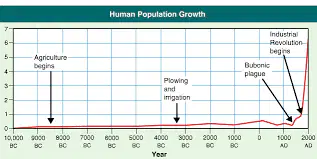
The attached graph shows human population growth for the past 10-thousand years. According to the population growth curve, for most of human history, population _?
Increased slowly in a linear fashion
Reached its carrying capacity and leveled off at around 8 billion people
Remained pretty much constant at around 1 billion people
Has increased exponentially
Has begun to slowly decrease
In which layer of the atmosphere would you most likely find commercial airplanes flying and weather occurring?
Thermosphere
Exosphere
Stratosphere
Troposphere
A “closed loop” refers to a process that can take place independently of other processes in a biogeochemical process. Which of the following best represents a closed-loop process within a biogeochemical cycle?
Wind erosion forming sand dunes
Trees absorbing carbon dioxide and later releasing it through decomposition
Rivers depositing sediment in estuaries
Animals excreting nitrogen into rivers
What role does sustainability play in environmental decision-making?
It ensures current resource use doesn't compromise future generations' ability to meet their needs
It supports fast growth without considering long-term environmental impacts
It bans all forms of development to protect nature completely
It replaces scientific research with ethical opinions about nature
If a population of deer in a forest grows rapidly until food resources become scarce, and then stabilizes, what population growth model does this illustrate?
Linear population growth
Logarithmic population growth
Exponential population growth
Logistical population growth
What is the main reason carbon is considered a part of both biological and geological systems on Earth?
Carbon is often found only in rocks containing fossils and fossil fuels
Unlike the other biogeochemical cycles, it cycles through only abiotic processes
It moves between organisms, air, and rocks
It is unreactive and stable in all systems, so it is part of all systems

