wayground logo

Free Printable Worksheets

Font size

S
M
L
XL
Worksheets

Unit 7 Nervous System Review

Total questions: 100

Worksheet time: 1hrs 7mins

Name
Class
Date
1.
Which are the main divisions of the nervous system?
a)
afferent and efferent
b)
peripheral and central
c)
somatic and autonomic
d)
sympathetic and parasympathetic
2.
What is the central nervous system made up of?
a)
brain and spinal cord
b)
cranial and spinal nerves
c)
sensory and motor systems
d)
sympathetic and parasympathetic systems
3.
Which neurons carry messages from the brain to the body?
a)
sensory neuron
b)
motor neuron
c)
interneuron
d)
afferent
4.
Which system controls involuntary responses?
a)
somatic
b)
autonomic
c)
sympathetic
d)
parasympthetic
5.
What is number 1?
a)
dendrite 
b)
axon
c)
cell body
d)
myelin sheath
6.
What is number 4?
a)
dendrite
b)
axon 
c)
cell body
d)
myelin sheath
7.
What is number 5?
a)
cell body
b)
nucleus
c)
axon terminal
d)
synapes
8.
What is number 2?
a)
Cerebrum
b)
Cerebellum
c)
brain stem
d)
spinal cord
9.
What is number 6?
a)
Cerebrum
b)
Cerebellum
c)
brain stem
d)
spinal cord
10.

What does the axon carry?

a)

Impulses away from the cell body

b)

Impulses to the cell body

c)

chemicals

d)

messages

11.
What are the two main parts of the Peripheral Nervous System?
a)
Spinal Nerves & Receptors
b)
Arms & Legs
c)
Brain & Spinal Cord
d)
Optic Nerves & Receptors
12.
What are the divisions of the Peripheral Nervous System?
a)
Somatic & Motor
b)
Brake & Motor
c)
Somatic & Autonomic
d)
Sensory & Motor
13.
Afferent nerves are called
a)
efferent
b)
sensory
c)
motor
d)
peripheral
14.
Motor nerves are called
a)
afferent
b)
peripheral
c)
sensory
d)
efferent
15.
The "fight or flight" response during threatening situations in the role of the:
a)
sympathetic nervous system
b)
parasympathetic system
c)
somatic nervous system
d)
cerebellum
16.
_____ neurons carry messages to the central nervous system
a)
Motor
b)
Inter
c)
Sensory
d)
Fun
17.
The _____part of the autonomic nervous system is active during resting.
a)
sympathetic
b)
parasympathetic
c)
somatic
d)
peripheral
18.

When your parasympathetic nervous system is very active, which of the following would happen?

a)

heart rate decreases

b)

sweat increases

c)

immune system response decreases

d)

digestion decreases

19.

Which of the following is TRUE regarding the somatic nervous system?

a)

it controls involuntary actions

b)

it controls voluntary actions

c)

it activates the “rest or digest” response

d)

it actives the “fight or flight” response

20.
Which of the following is the correct order of the direction of a message?
a)
Dendrite-Cell Body-Axon-Synapse
b)
Synapse-Cell Body-Axon-Dendrite
c)
Dendrite-Synapse-Cell Body-Axon
d)
Axon-Cell Body-Dendrite-Synapse
21.
Label the Neuron-What does the letter "C" represent?
a)
Dendrite
b)
Axon
c)
Axon Terminal
d)
Cell Body
22.

part of a neuron that receives information from other neurons

a)

axon

b)

dendrites

c)

myelin sheath

d)

synapse

23.

Myelinated neurons are _____________ unmyelinated neurons are ______________?

a)

white mater, gray mater

b)

pink mater, gray mater

c)

gray mater, white mater

d)

blue mater, pink mater

24.
When a neuron is resting, the inside of the axon has a ____________ charge.
a)
positive
b)
negative
25.
What is the final component of a reflex arc?
a)
Effector
b)
Receptor
c)
Integrating Centre
d)
Afferent Pathway
26.
Which of the following is NOT an example of a reflex?
a)
Catching a ball
b)
Blinking when an object flies at your face
c)
Jumping at a loud nosie
d)
Coughing when something irritates your throat
27.

Easton's heart is beating rapidly, his pupils are dialated, and his mouth is dry. This response was triggered by which division of his nervous system?

a)

Sympathetic

b)

Parasympathetic

c)

Somatic

d)

Afferent

e)

Peripheral

28.
A nerve cell that is the basic working unit of the brain and nervous system which processes and transmits information
a)
axon
b)
neuron
c)
dendrite
d)
neurotransmitter
29.
What is the insulating membrane that surrounds parts of the axon that helps to protect & propagate action potential?
a)
Axon
b)
Dendrites
c)
Node of Ranvier
d)
Myelin Sheath
30.

What is the function of the nerve cells?

a)

They are responsable of your defense mechanism.

b)

They transmit signals or messages to other neurons, organs or glands.

c)

They transmit substances to your endocrine system to produce hormones.

31.

What is the name of the part of the neuron that is pointed out in the image?

a)

Myelin Sheats

b)

Cell Body (Soma)

c)

Dendrites

d)

Axon

32.

The protective fatty tissue that speeds up the transmission of messages is:

a)

Myelin Sheaths

b)

Axon

c)

Dendrites

d)

Soma

33.

Type of neuron located only in the brain and spinal cord that pass impulses from one neuron to another.

a)

Motor Neuron

b)

Interneuron

c)

Sensory Neuron

34.

Which of these best describes glial cells?

a)

The cells that send signals to the brain

b)

Cells that support the neurons

c)

Any cell in the nervous system

d)

Cells that make muscles move

35.

If we did not have this type of cell, bacteria could more easily infiltrate our brain tissue:

a)

Satellite cells

b)

Oligodendrocytes

c)

Microglia

d)

Schwann cells

36.

Which type of cell is located between neurons and capillaries to control what enters the cells from the blood?

a)

Astrocytes

b)

Oligodendrocytes

c)

Schwann cells

d)

Satellite cells

37.

Which type of cell is circled?

a)

Schwann cells

b)

Astrocytes

c)

Microglia

d)

Ependymal cells

38.

Which type of cell is circled?

a)

Microglia

b)

Astrocytes

c)

Oligodendrocytes

d)

Satellite cells

39.

Which two types of cells produce myelin coverings around the nerves?

a)

Microglia and astrocytes

b)

Schwann cells and satellite cells

c)

Schwann cells and oligodendrocytes

d)

Oligodendrocytes and astrocytes

40.

Which type of cell is circled?

a)

Oligodendrocytes

b)

Satellite cells

c)

Astrocytes

d)

Ependymal cells

41.

Which type of glial cells are found in the Peripheral Nervous System (PNS)?

a)

Astrocytes

b)

Microglia

c)

Schwann cells

d)

Oligodendrocytes

42.

Which type of cells are found in the Central Nervous System (CNS)?

a)

Astrocytes

b)

Microglia

c)

Ependymal cells

d)

All of these

43.
The function of the ependymal cells is ___________.
a)
Protection of the delicate neuron axon
b)
Maintain the health of the neuron
c)
Circulates the cerebrospinal fluid
d)
Insulate the electrical impulse
44.

Small cells that engulf and destroy microbes and cellular debris in the CNS

a)

microglia

b)

horns

c)

neuroglia

d)

astrocytes

45.

Rare in adults, these neurons are only found in sense organs like the eye and nose:

a)

unipolar

b)

bipolar

c)

multipolar

46.

All motor and association neurons are:

a)

unipolar

b)

bipolar

c)

multipolar

47.
Neurotransmitters are released from the
a)
Dendrites
b)
Post-synaptic neuron
c)
Presynaptic neuron
d)
Axon
48.
Excess neurotransmitters in the synapse that goes back into the presynaptic neuron.
a)
Resting potential
b)
Reuptake
c)
Retroactivity
d)
Repolarization
49.
What is the chemical used by a neuron to transmit an impulse across a synapse to another nerve cell?
a)
Neurotransmitters
b)
Synapse
c)
Threshold
d)
Impulse
50.
-70 mV is the measure of a
a)
Threshold Potential
b)
Action Potential
c)
Resting Potential
d)
End Point Potential
51.
The area between the pre-synaptic cell and the post-synaptic cell is termed the synaptic cleft.
a)
True
b)
False
52.
Nerve impulses within the neuron are sent in _____ form
a)
Electrical
b)
Chemical
c)
Electro-chemical
d)
Petrochemical
53.

What happens in an axon terminal when an action potential arrives at the presynaptic membrane?

a)

sodium ions diffuse in

b)

sodium ions diffuse out

c)

calcium ions diffuse in

d)

calcium ions diffuse out

54.

The blue nerve in the image represents a

a)

sensory neurone

b)

motor neurone

c)

relay neurone

55.

In resting potential, neurons have more _________ on the outside of the cell membrane.

a)

K+

b)

NaCl

c)

Na+

d)

Cl-

56.

When a membrane potential reach +30mV, ________ channels open, ________ occurs, and ________ channels close.


a)

Sodium, depolarization, potassium

b)

Potassium, depolarization, sodium

c)

Sodium, repolarization, potassium

d)

Potassium, repolarization, sodium

57.
The sodium potassium pump restores the resting potential. By which process does this work? 
a)
Osmosis
b)
Diffusion
c)
Facilitated diffusion
d)
Active transport
58.
Why is hyperpolarization important?
a)
It makes sure the neuron is healthy
b)
It prevents a second, unwanted signal from being sent
c)
It makes sure the neurons are in the correct space
d)
It makes sure the charge is back at -70 mV
59.
For a neuron with a resting membrane potential at -70mv, an increase in the movement of sodium ions into the neuron's cytoplasm would result in:
a)
the depolarization of the neuron.
b)
the repolarization of the neuron 
c)
the replacement of potassium ions with sodium ions.
d)
the replacement of potassium ions with calcium ions.
60.
What number on the graph represents the Repolarization phase?
a)
1
b)
2
c)
3
d)
4
61.
What number on the graph represents the Hyperpolarization phase?
a)
1
b)
2
c)
3
d)
4
62.
What number on the graph represents the Depolarization phase?
a)
1
b)
2
c)
3
d)
4
63.

What structure is labelled 1?

a)

Medulla

b)

Cerebrum

c)

Cerebellum

64.

What structure is labelled 2?

a)

Medulla

b)

Cerebrum

c)

Cerebellum

65.

What is the function of the cerebellum?

a)

Controls conscious thought

b)

Controls balance and muscle coordination

c)

Controls breathing rate and heart rate

66.

What is the function of the cerebrum?

a)

Controls conscious thought

b)

Controls balance and muscle coordination

c)

Controls breathing rate and heart rate

67.

What is the function of the medulla?

a)

Controls conscious thought

b)

Controls balance and muscle coordination

c)

Controls breathing rate and heart rate

68.

What sort of message diffuses across the synapse?

a)

Electrical

b)

Chemical

c)

Physical

d)

Mental

69.

Function: Integration

a)

Stimulus

b)

Effector

c)

Sensory Neuron

d)

Motor Neuron

e)

Interneuron

70.

Function: Motor Output

a)

Stimulus

b)

Effector

c)

Sensory Neuron

d)

Motor Neuron

e)

Interneuron

71.

Function: Sensory Input

a)

Stimulus

b)

Effector

c)

Sensory Neuron

d)

Motor Neuron

e)

Interneuron

72.

Muscles and/or glands

a)

Stimulus

b)

Effector

c)

Sensory Neuron

d)

Motor Neuron

e)

Interneuron

73.

In which order is a signal sent from stimulus to response?

a)

Sensory Organ, Sensory Neuron, Interneuron, Motor Neuron, Effector

b)

Sensory Neuron, Sensory Organ, Interneuron, Motor Neuron, Effector

c)

Interneuron, Sensory Neuron, Sensory Organ, Motor Neuron, Effector

d)

Motor Neuron, Effector, Interneuron, Sensory Neuron, Sensory Organ

e)

Effector, Motor Neuron, Interneuron, Sensory Neuron, Sensory Organ

74.

Reflex actions are important because

a)

They provide a quick, involuntary response

b)

They prevent injury

c)

They are essential to the survival of organisms

d)

All of the above

75.
Which letter on the illustration represents the frontal lobe
a)
A
b)
B
c)
C
d)
D
76.
Which letter on the illustration represents the temporal lobe
a)
A
b)
B
c)
C
d)
D
77.
Which letter on the illustration represents the occipital lobe
a)
A
b)
B
c)
C
d)
D
78.
Which letter on the illustration represents the parietal lobe
a)
A
b)
B
c)
C
d)
D
79.
Makes decisions, plans, reasons, and carries out behaviors
a)
Frontal Lobe
b)
Parietal Lobe
c)
Occipital Lobe
d)
Temporal Lobe
80.
Controls hearing, and language comprehension
a)
Frontal Lobe
b)
Temporal Lobe
c)
Occipital Lobe
d)
Parietal Lobe
81.

Which controls personality, short term memory, & speech

a)

frontal lobe

b)

parietal lobe

c)

temporal lobe

d)

occipital lobe

82.
The visual cortex is located in the
a)
occipital lobe
b)
temporal lobe
c)
frontal lobe
d)
parietal lobe
83.
Area of the frontal lobe that is responsible for speech production.
a)
Broca's Area
b)
Wernicke's Area
c)
Amygdala 
d)
Central Gyrus
84.
Area of the temporal lobe involved in language comprehension.
a)
Broca's Area
b)
Wernicke's Area
c)
Central Sulcus
d)
Somatosensory Cortex
85.

What does the blue lobe do?

a)

Processes your hearing

b)

Processes your vision

c)

Contains your personality

d)

Processes your sense of touch

86.

What does the green lobe do?

a)

Processes your hearing

b)

Processes your vision

c)

Contains your personality

d)

Processes your sense of touch

87.

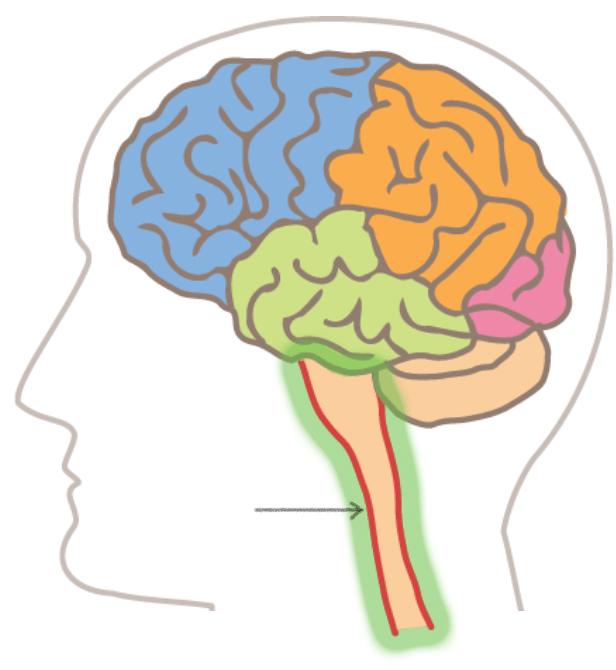
Identify the area of the brain highlighted.

a)

Brain stem

b)

Cerebellum

c)

Spine

d)

Medulla oblongata

88.

Which of the following is not a component of the diencephalon?

a)

Midbrain

b)

Thalamus

c)

Hypothalamus

d)

Epithalamus

89.

Which part of the diencephalon relays sensory impulses to the sensory cortex and helps with memory?

a)

Thalamus

b)

Hypothalamus

c)

Epithalamus

90.

Which part of the diencephalon is the chief integration center for the autonomic NS?

a)

Thalamus

b)

Hypothalamus

c)

Epithalamus

91.

Which of the following is not a component of the brain stem?

a)

Midbrain

b)

Pons

c)

Medulla oblongata

d)

Thalamus

92.

Which part of the brain stem relays information from the cerebrum to the cerebellum and is also called the bridge?

a)

Midbrain

b)

Pons

c)

Medulla oblongata

d)

Thalamus

93.

Which part of the brain stem merges into the spinal cord?

a)

Midbrain

b)

Pons

c)

Medulla oblongata

94.

Which part of the brain is known as the language comprehension center?

a)

Broca's

b)

Wernicke's

95.

Which part of the brain controls the physical ability to speak?

a)

Broca's

b)

Wernicke's

96.

What are the deep grooves that separate the lobes of the brain called?

a)

Gyri

b)

Sulci

c)

Fissures

d)

Convolutions

97.

What are the ridges on the cerebrum called?

a)

Gyri

b)

Sulci

c)

Fissure

d)

White matter

98.

What are the grooves in the cerebrum called?

a)

Gyri

b)

Sulci

c)

White matter

d)

Ridges

99.

Largest part of the brain, that is so big it covers most of the rest of the brain:

a)

telencephalon

b)

ventricles

c)

cerebrum

d)

cerebellum

100.

The "large body" that connects the left and right cerebral hemispheres:

a)

mamillary body

b)

frontal lobe

c)

corpus callosum

d)

temporal lobe