
 Worksheets
Protein Synthesis and Mutations
Total questions: 30
Worksheet time: 36mins
Which Two Processes are part of Protein Synthesis?
Transmodification
Transcription
Transfiguration
Translation
I carry amino acids from the cytoplasm to the ribosomes. Who Am I?
mRNA
tRNA
rRNA
DNA
I carry a copy of the Genetic info from the nucleus to the ribosome. Who Am I?
mRNA
tRNA
rRNA
DNA
Which Nitrogen Base is only found in RNA?
Thymine
Uracil
Guanine
Adenine
Which below are causes for mutations?
Random Chance
Radiation
Chemical
Too Much Dust
ATG GGA ACT
Where does TRANSCRIPTION occur?
Nucleus
Ribosome
Cytoplasm
Mitochondria


ATTGAGCC - Mutated
The example above is an example of a

The following image represents which type of mutation?
Insertion
Deletion
Spontaneous
Point
Sometimes, during replication, nucleotide pairs are added or lost. These errors have serious effects on the protein that is supposed to be created. They can affect the ordering of the codon sequence, causing the creation of a non-functional protein. What type of mutation do these insertions or deletions lead to?
An insertion mutation
A deletion mutation
A frameshift mutation
A point mutation
During TRANSCRIPTION, a DNA strand that has the bases CTAGGT produces a strand with the bases
GAUCCA
GATCCA.
AGCTTG.
GAGCAC.
Which of the following is NEVER a frameshift mutation?
substitution
translocation
deletion
duplication
Which enzyme is used SPECIFICALLY for RNA transcription from DNA in the nucleus of a cell?
helicase
catalase
DNA polymerase
RNA polymerase
What term describes when mRNA is read 3 consecutive letters (bases) at a time and it codes for a single amino acid?
Codon
Anticodon
Polypeptide
Gene

the tRNA carries an
Amino Acid
Polysaccaride
Lipid
DNA
Use your codon chart to figure out what amino acid codes for the mRNA codon AUG
START
(Met)
Ile
Val
Leu
How many nucleotides equal 1 amino acid?
1
2
3
4
Why must transcription occur where DNA can be found?
Ribosomes are in the nucleus
Helicase unzips the DNA
DNA cannot leave the nucleus
DNA polymerase is found there
How do know when to STOP translating a strand of mRNA?
you don't
stop at the end of the strand
when Metz tells you to
the codon will read STOP on the codon chart

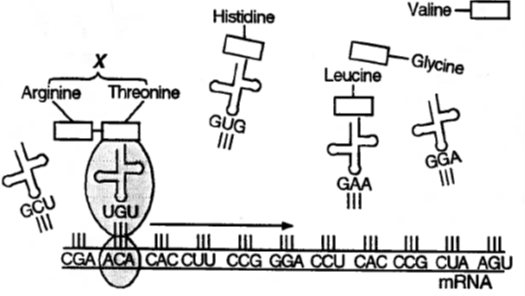
What process is going on in this photo?
DNA Replication
Transcription
Translation
Mitosis

