Worksheets
ray diagrams
Total questions: 136
Worksheet time: 3hrs 36mins
An image behind the mirror is...
virtual
real
inverted
upright
An image that points below the principal axis is (choose 2)...
virtual
real
upright
inverted
If the object is beyond C (2F)...
image is real, smaller and inverted
image is real, smaller and upright
image is virtual, smaller and inverted
image is real, bigger and upright
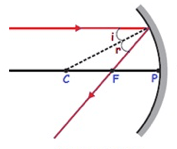
This ray diagram is for which mirror?
concave
convex
plane
window
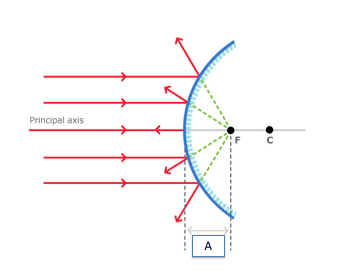
In the image, all the rays meet at F, What is F
focal length
focal point
center of curvature
reflection
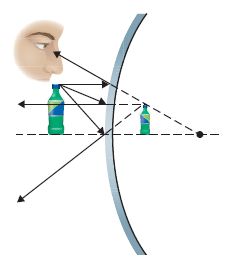
This image is showing a convex mirror because the image is (choose 2 answers)
real light rays meet behind the mirror
real light rays don't meet
the focal point is in front of the mirror
the focal point is behind the mirror
This type of mirror is used in supermarkets to see around bends
concave
convex
plane
window
Real images are :
Always inverted
can be larger or smaller than the object
can be obtained on screen
all the above
A dentist uses a small dental mirror to help magnify teeth in your mouth. What type of mirror is this?
a convex mirror
a concave mirror
a convex lens
a concave lens
The side view mirrors on your car help shrink the image on both sides of the car, allowing you to see a larger field of view. What type of mirror is this?
a convex mirror
a concave mirror
a convex lens
a concave lens
An image that forms when light rays actually meet
virtual image
real image
diffuse reflection
regular reflection
Virtual images are
always upright
can be obtained on screen
always smaller
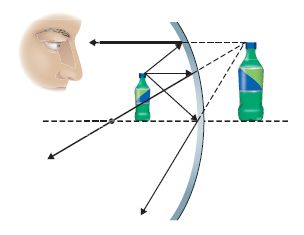
If the object is between C and f, the image is ...
image is real, smaller, and inverted
image is real, smaller, and upright
image is virtual, smaller, and inverted
image is real, bigger, and inverted
If the object is between f and the mirror, the image is ...
image is real, smaller, and inverted
image is virtual, larger, and upright
image is virtual, smaller, and inverted
image is real, bigger, and inverted

Which is the angle of Incidence?
A
B
C
D
Can reflected ray and incident ray be on the same side of the normal?
Yes
No
I'm not sure
Can reflected ray and incident ray be on the normal?
Yes
No
I'm not sure
An image ...
Can be touched
Can't be touched
I'm not sure
The normal is ____ to the mirror
Perpendicular
Parallel
Perpendicular and Parallel
None of the above
What is reflection?
Light bouncing off a smooth surface
Light absorbing into a smooth surface
Light bending off a smooth surface
Light scattering off a smooth surface
How do light waves travel in air?
Slowly
It curves
In straight lines
Different colours have different speeds
What uses reflection


Which is right ?


I'm not sure
Which is not a light source?


An image behind the mirror is...
virtual
real
inverted
upright
If the object is beyond C (2F)...
image is real, smaller and inverted
image is real, smaller and upright
image is virtual, smaller and inverted
image is real, bigger and upright
This ray diagram is for which mirror?
concave
convex
plane
window
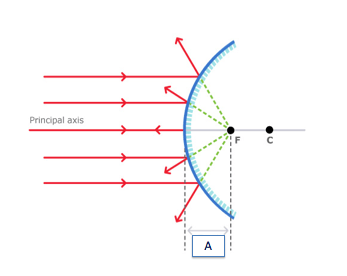
In the image, all the rays meet at F, What is F
focal length
focal point
center of curvature
reflection
This image is showing a convex mirror because the image is (choose 2 answers)
real light rays meet behind the mirror
real light rays don't meet
the focal point is in front of the mirror
the focal point is behind the mirror
This type of mirror is used in supermarkets to see around bends
concave
convex
plane
window
A dentist uses a small dental mirror to help magnify teeth in your mouth. What type of mirror is this?
a convex mirror
a concave mirror
a convex lens
a concave lens
An object is at a distance of 36cm from a concave mirror of focal length 12 cm. Find the image distance
18cm
-18cm
12 cm
-12 cm
22. An object is placed at the centre of curvature of a concave mirror. The distance between its image and the pole is
(a) equal to f
(b) between f and 2f
(c) equal to 2f
greater than 2f

In the given figure, which of the following holds TRUE?
The angle of incidence is 10°.
The angle of incidence is 80°.
The angle of reflection is 10°.
The angle of reflection is 90°.
In the given figure, which of the following holds TRUE?
The angle of incidence is 10°.
The angle of incidence is 80°.
The angle of reflection is 10°.
The angle of reflection is 90°.
Which of the following is TRUE about spherical mirrors?
They don't obey the Law of Reflection.
They have a flat, planar surface.
Their surface either bulges outward or inward.
They always give images that are of the same size as the object.
In a ray diagram, which term refers to the distance from the vertex to the center of curvature?
focal point
focal length
radius of curvature
diameter

In the ray diagram shown, which set of descriptions of the image formed is completely accurate?
The image is minimized, inverted, and real.
The image is magnified, inverted, and real.
The image is minimized, inverted, and virtual.
The image is magnified, inverted, and virtual.

In the ray diagram shown, which set of descriptions of the image formed is completely accurate?
The image is minimized, upright, and real.
The image is magnified, inverted, and real.
The image is minimized, upright, and virtual.
The image is magnified, inverted, and virtual.
In ray diagram for concave mirrors, if an incident ray passes through the focal point, how does the reflected ray look like?
It reflects back on itself.
The reflected ray bounces vertically upward.
The reflected ray will be parallel to the principal axis.
The reflected ray gets projected vertically downward.
Which of the following correctly describes the image characteristics formed in plane mirrors?
virtual, upright, diminished
virtual, upright, same size
real, inverted, diminished
real, upright, same size
In ray diagrams for spherical mirrors, which term refers to the distance between the mirror and the focal point?
focal length
principal axis
radius of curvature
vertex
For convex mirrors, what will be the resulting reflected ray an incident ray that that travels parallel to the principal axis?
The reflected ray will pass through the focal point.
The extension of the reflected ray will pass through the focal point.
The reflected ray will pass through the center of curvature.
The extension of the reflected ray will pass through the center of curvature.

For concave mirrors, what are the image characteristics for an object placed between the center of curvature and focal point?
enlarged, inverted, real
enlarged, inverted, virtual
diminished, inverted, real
diminished, upright, virtual


A tree 20 m high is located 40 m from the converging lens of focal length 0.08 m.Calculate the distance from the lens to the image.
0.08 m
0.01 m
0.10 m
0.20 m

The above lens is a type of ___.
diverging lens
converging lens
divergent lens
convergent lens
Which lens represents the path light takes through a diverging lens?


Which figure represents the path light takes through a converging lens?
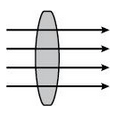
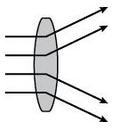
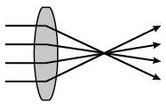
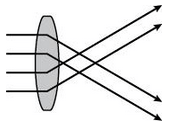
The above lens is a type of ___.
diverging lens
converging lens
divergent lens
convergent lens
Which lens represents the path light takes through a diverging lens?
Which figure represents the path light takes through a converging lens?


what is A on the diagram?
center of curviture
focal length
reflected ray
focal point

The diagram represents a converging lens forming an image of an object. Which of the following lines show the focal length of the lens?
PQ
PR
QR
QS

A student draws three rays of light from point P through a converging lens. Each point labelled F is a principal focus of the lens. Which of the rays are drawn correctly?
ray Y only
ray Z only
ray X and ray Y
ray X and ray Z
The side view mirrors on your car help shrink the image on both sides of the car, allowing you to see a larger field of view. What type of mirror is this?
a convex mirror
a concave mirror
a convex lens
a concave lens

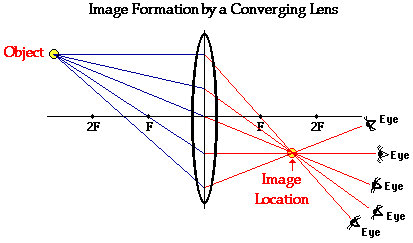
Which of the following is a correct ray diagram for convex lens?


Which ray diagram is correct for convex lens?


Which of the diagram shows the correct refraction of light ray after passing through a concave lens?


Which of the lens diagrams have Virtual Images? (choose all)


Which of the lens diagrams have Inverted Images? (choose all)

Which description matches the image formed in this lens diagram?
Real Inverted Reduced
Virtual Upright Enlarged
Virtual Upright Reduced
Real Upright Enlarged
An image that points below the principal axis is (choose 2)...
virtual
real
upright
inverted
If the object is beyond C (2F)...
image is real, smaller and inverted
image is real, smaller and upright
image is virtual, smaller and inverted
image is real, bigger and upright
Real images are :
Always inverted
can be larger or smaller than the object
can be obtained on screen
all the above
Virtual images are
always upright
can be obtained on screen
always smaller
If the object is between C and f, the image is ...
image is real, smaller, and inverted
image is real, smaller, and upright
image is virtual, smaller, and inverted
image is real, bigger, and inverted
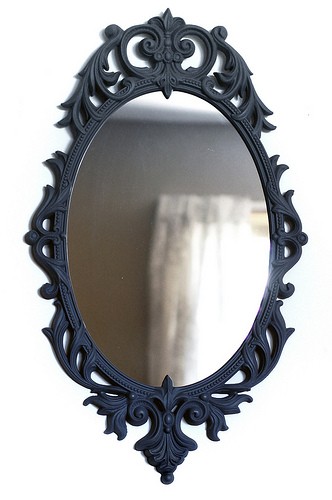

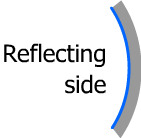

Which ray diagram shows a real image?


None of the above
Four ray diagrams show the images formed in mirrors and lenses. Which shows a virtual image?


All of the above.

Which of the following is evidence that this is a virtual image?
Virtual images are always upright.
Virtual images are always larger than the original object.
Virtual images always have converging rays.
Virtual images always have positive focal lengths.
An image is created whose di = -5 cm. What does this indicate?
The image is virtual.
The image is smaller than the original object.
The image is inverted.
The image is larger than the original object.
The straight line that joins between the two centers of curvature of the lens and passes
through its its optical center is called
the focal length.
the principal axis.
the secondary axis.
the radius of curvature.


Which lens represents the path light takes through a diverging lens?
What word means to bend light rays toward each other?
Converging light
Diverging light
Virtual Light
Real Light
A light ray, travelling parallel to a concave mirror's axis, strikes the mirror's surface. The reflected ray _________.
passes through the mirror's focal point
again travels parallel to the mirror's axis
travels at right angles to the mirror's axis
passes through the mirror's center of curvature
1. converging lens is (a) .


Describe the image formed by the converging lens.
between F and 2F; real
between F and 2F; virtual
to the right of 2F; virtual
to the right of 2F; real
Two light rays from a common point are refracted by a lens. A real image is formed when these two refracted rays
travel in parallel paths.
totally reflect inside the lens.
diverge and appear to come from a single point.
converge to a single point.
Which type of lens brings light rays to single point after exiting the lens?
polarized
diverging
prism
converging
What is the distance between the the center of the lens and the focal points called?
principal axis
focal length
focal distance
lens radial line
True or False: All real images are are inverted (upside down)?
True
False
Where is the location of the object on a ray diagram if the lens is used as a magnifying glass?
outside of the focal point
on the focal point
between the focal point and the center of the lens

What kind of lens is this?
concave
an eyepiece
convex
a cornea
What do we use ray diagrams to determine?
the location of the object
the focal length
the location of the image
the type of lens being used
What do lenses do?
separate white light into a rainbow
bend rays of light to form an image
reflect light similarly to a mirror
absorb all light
How many rays MUST you use in a ray diagram?
3
4
2
1
Which of the following instruments is most similar to the eye?
microscope
projector
telescope
camera
This ray diagram is for which mirror?
concave
convex
plane
window
In the image, all the rays meet at F, What is F
focal length
focal point
center of curvature
reflection

Which of the following ray diagrams is correct for the ray of light incident on a concave mirror as shown in below Figure?


A child is standing in front of a magic mirror. She finds the image of her head bigger, the middle portion of her body of the same size and that of the legs smaller. The following is the order of combinations for the magic mirror from the
top.
Plane, convex and concave
Convex, concave and plane
Concave, plane and convex
Convex, plane and concave
An image behind the mirror is...
virtual
real
inverted
upright