
 Worksheets
Geometry Benchmark 1 Review
Total questions: 60
Worksheet time: 2hrs 0mins
Given the conditional statement;
"If I am hungry, then I eat."
Which of the following is the inverse?
If I eat, then I am hungry.
If I don't eat then I am not hungry
If I am not hungry, then I don't eat.
If I am not hungry, then I eat.
Given the conditional statement;
"If Max gets good grade, then he won't be grounded"
Which of the following is the contrapositive?
If Max isn't grounded then he gets good grades.
If Max doesn't get good grade then he will be grounded.
If Max gets grounded then he doesn't get good grades.
If Max gets good grades, the he will get grounded.
Given the conditional;
"If Jose eats fish, then he has an allergic reaction"
Which of the following is the converse?
None of these
If Jose doesn't have an allergic reaction, then he didn't eat fish.
If Jose doesn't eat fish, then he doesn't have an allergic reaction.
If Jose has an allergic reaction, then he ate fish.
Given the conditional "If I study, then I will do well on the quiz" and what is the statement "If I don't study then I won't do well on the quiz"?
Converse
Inverse
Contrapositive
Contrainverse
Select the conditional statement(s) of the biconditional statement.
Points are collinear if and only if they all lie in one line.
If collinear points lie in one line, then they are a line.
If points all lie in one line, then they are collinear.
Collinear points lie in one line.
If points are collinear, then they all lie in one line.


Which of the following is the CONVERSE of the statement below?
If an object is a bird, then it can fly.
If an object can fly, then it is a bird.
If an object is not a bird, then it cannot fly
If an object cannot fly, then it is not a bird
There is no converse of the statement
Which of the following is the INVERSE of the statement below?
If an object is a computer, then it
has a hard drive.
If an object is not a computer, then it does not have a hard drive.
If an object does not have a hard drive, then it is not a computer.
If an object has a hard drive, then it is a computer.
There is no inverse of the statement.

Which of the following is the CONTRAPOSITIVE of the statement below?
If a species walks on two feet, then
it is human.
If a species is not human, then it does not walk on two feet.
If a species is human, then it walks on two feet.
If a species does not walk on two feet, then it is not human.
There is no contrapositive of the statement.

Which of the following is the CONTRAPOSITIVE of the statement below?
If a species is a fish, then it lives in
water.
If a species does not live in water, then it is not a fish.
If a species is not a fish, then it does not live in water.
If a species lives in water, then it is a fish.
There is not contrapositive of the statement.
If the conditional statement was "If an angle is acute, then it has a measure less than 90°.", which type of statement is the following?
If an angle does not have a measure less than 90°, then it is not acute.
Contrapositive
Converse
Biconditional
Inverse

What is this statement called: If it rains today, then we will not have practice.


If lines are parallel with a transversal, then these two angles are...
Supplementary Angles
Corresponding Angles
Alternate Exterior Angles
Parallel Angles
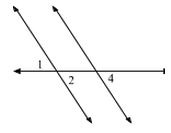
Find the measure of angle 4

Which could be used to prove the lines are parallel?
Converse of Alternate Interior Angles Theorem
Converse of Same-Side Interior Angles Theorem
Converse of Corresponding Angles Postulate
Cannot be proved parallel
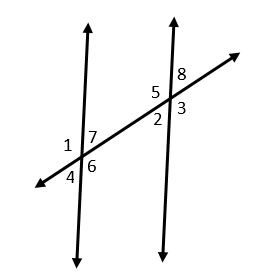
2) Given the following two parallel lines cut by a transversal.
Which pair of angles represents corresponding angles?
∠1 and ∠6
∠6 and ∠5
∠7 and ∠8
∠4 and ∠8

9) Given the following two parallel lines that have been cut by a transversal.
Choose all the options that represent corresponding angles.
∠3 and ∠8
∠2 and ∠7
∠6 and ∠4

8) Given the following two parallel lines that have been cut by a transversal.
∠1 and which angle make up Alternate Interior angles?
∠6
∠5
∠3
7) Given the following two parallel lines that have been cut by a transversal.
True or False, ∠6 and ∠4 are vertical angles?
False
2) Given the following two parallel lines cut by a transversal.
Which pair of angles represents corresponding angles?
∠1 and ∠6
∠6 and ∠5
∠7 and ∠8
∠4 and ∠8

m∥n because Alternate Interior angles are congruent
p∥q because Alternate Interior angles are congruent
m∥n because Consecutive Interior angles are congruent
Neither pair of lines is parallel

m∥n because Alternate Exterior angles are congruent
p∥q because Alternate Exterior angles are congruent
p∥q because Corresponding angles are congruent
Neither pair of lines is parallel

m∥n because Corresponding angles are congruent
m∥n because Consecutive Interior angles are congruent
p∥q because Corresponding angles are congruent
Neither pair of lines is parallel

71° - Alternate Exterior Angles are congruent
109° - Alternate Exterior Angles are supplementary
71° - Alternate Interior Angles are congruent

Find the midpoint:
(−23,−25)
(−1,−3)
(−21,−25)
(−3,−1)
Find the other endpoint of the line segment with the given endpoint (1,-9) and midpoint (-9,3)
(-19,15)
(5,-6)
(-4,-3)
(6,2)
In the standard (x,y) coordinate plane, what is the length of RS given R=(8,5) and S=(-1,3)?
11
4 21
61
85
7 2
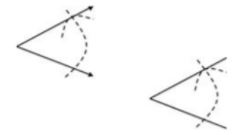
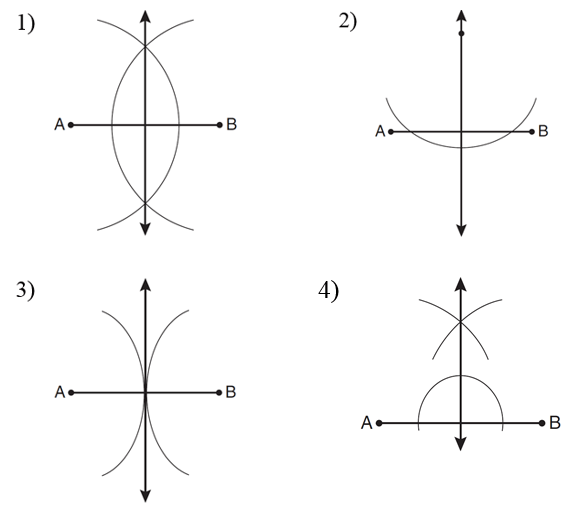
Which geometric construction is shown in the diagram?
Perpendicular bisector
Congruent angles
Angle bisector
Congruent line segments
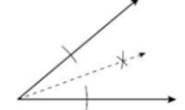
The drawing shows a compass and straight edge construction of...what?
the bisector of a given angle
a perpendicular to a given line at a point on the line
a perpendicular to a given line from a point NOT on the line
an angle congruent to a given angle
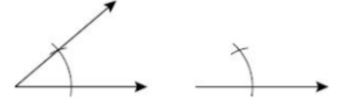
The drawing shows the arcs used to construct...what?
a bisector of a given line
a bisector of a given angle
a perpendicular of a given line at a point on the line
an angle congruent to a given angle
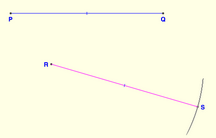
What was duplicated?
line
line segment
ray
angle
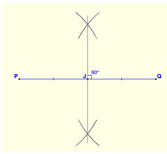
What type of construction do you see?
midpoint
angle bisector
perpendicular bisector
altitude

If the quadrilateral is translated 4 units to the left and 5 units down what is the coordinates for Point A'?
A is at (4, 9)
(4,0)
(0,4)
(-1,5)
(5,-1)


Select all the lines of symmetry
y-axis
x-axis
y = -1
x = -1

Select all lines of symmetry
y-axis
x-axis
y = x
y = -x


Point A = (3,-6) , Scale Factor 1/3, Point A' = ______
(1,2)
(-1,-2)
(1,-2)
(-2,1)

Triangle ABC has vertices at A(2,3) B(-5,-1) C(0,5). Its image, Triangle A'B'C', has vertices at A'(4,6) B'(-10,-2) and C'(0,10). What is the scale factor?
1/2
1
2
4
y = 3x - 3
These lines are...
6x + y = 2
These lines are...

