
 Worksheets
CNS QUIZ
Total questions: 50
Worksheet time: 27mins
The largest part of the brain that is divided into left and right hemispheres.
Limbic System
Cerebrum
Spinal Cord
Brainstem
This region of the brain is superior to the temporal lobe and plays a role in language processing.
Frontal Lobe
Parietal Lobe
Occipital Lobe
Ventricle
Includes the medulla oblongata, midbrain, and pons.
Limbic System
Cerebrum
Spinal Cord
Brainstem
Located near the forehead, this part of the CNS is essential for memory, motivation, and problem solving.
Frontal Lobe
Temporal Lobe
Parietal Lobe
Occipital Lobe
This is considered the visual processing center of the brain.
Frontal Lobe
Temporal Lobe
Parietal Lobe
Occipital Lobe
Located on the posterior side of the brain, this structure is critical for maintaining posture, balance, and coordinating timing of smooth movements.
Ventricle
Cerebellum
Limbic System
Cerebrum
Located behind the ears, this structure is key for language and speech.
Frontal Lobe
Temporal Lobe
Parietal Lobe
Occipital Lobe
main two-way conduction pathway to and from the brain
corpus callosum
spinal cord
cranial nerves
plexuses


Which body system coordinates all of the systems by controlling every activity that takes place?
The Nervous System
The Digestive System
The Endocrine System
The Circulatory System
The Immune System

Which organ is represented by letter A?
Brain
Spinal Cord
Nerves
Which organ is represented by letter B?
Brain
Spinal Cord
Nerves
The Nervous System is divided into two parts called
The Central Nervous System & The Peripheral Nervous System
The Central Nervous System & The Paradigm Nervous System
The Corollary Nervous System & The Paradigm Nervous System
The Corollary Nervous System & The Peripheral Nervous System
Anything that occurs automatically and without thought.
Voluntary Processes
Involuntary Processes
Digestion, Heartbeat, and Reflexes are examples of
Voluntary Processes
Involuntary Processes
Speaking, Running, and Karate Chopping are examples of
Voluntary Processes
Involuntary Processes
The Peripheral Nervous System is entirely made of
Nerves outside of the Central Nervous System
Nerves inside of the Central Nervous System
Muscle Tissues inside of the Central Nervous System
Muscle Tissues outside of the Central Nervous System
Which structure connects the Brain to the Peripheral Nervous System, while also directing some of the body's reflexes?
Spinal Cord
Esophagus
Pharynx
Larynx
Trachea
What is the function of Nervous system?
to control & coordinate body functions and system
to protect the body from heart
to identify pain and begin healing
to break down food
What is the function of the nerve cells?
They are responsable of your defense mechanism.
They transmit signals or messages to other neurons, organs or glands.
They transmit substances to your endocrine system to produce hormones.
they coordinate the exchange of gases

What is the name of the part of the neuron that is pointed out in the image?
Myelin Sheats
Cell Body (Soma)
Dendrites
Axon
Type of neuron detects information about your environment
Motor Neuron
Interneuron
Sensory Neuron
efferent neuron
Type of neuron that sends nerve impulses to muscles and glands
Motor Neurons
Interneurons
Sensory Neurons
blood neurons
In a reflex arc, the sensory neuron leads to the ___________ and the motor neuron leads to the __________
Spinal cord, CNS
CNS, muscle
Spinal cord, muscle
Muscle, CNS
Endocrine glands secrete _
Hormones
Neurotransmitters
A wide range of chemical substances
What is the endocrine system?
A system of vessels that circulates blood around the body.
A group of bones and tissue that provides support and structure for the body.
A group of glands that work together with the nervous system to coordinate all body functions
A group of organs that is responsible for eliminating wastes.
What is the main function of the endocrine system?
It creates chemicals, or hormones, that are sent around the body to maintain homeostasis.
It creates electrical messages that are sent around the body to maintain homeostasis.
It maintains the correct level of oxygen in the body to maintain homeostasis.
It releases waste from the body to maintain homeostasis.
The "master gland" is known as the __________________.
thyroid gland.
adrenal gland.
pancreas.
pituitary gland.
The adrenal glands release adrenaline to help the body regulate _________________.
diseases
body temperature.
stress.
hormones.
Which term refers to the body's use of energy for energy and growth?
Excretion
Metabolism
Digestion
Respiration
Where is insulin produced
Liver
Heart
Pancreas
Pineal gland

#3
pituitary
thyroid
thymus
adrenals

#1
pituitary
thyroid
thymus
pancreas
Controls your blood sugar
thyroid
pancreas
adrenals
kidneys
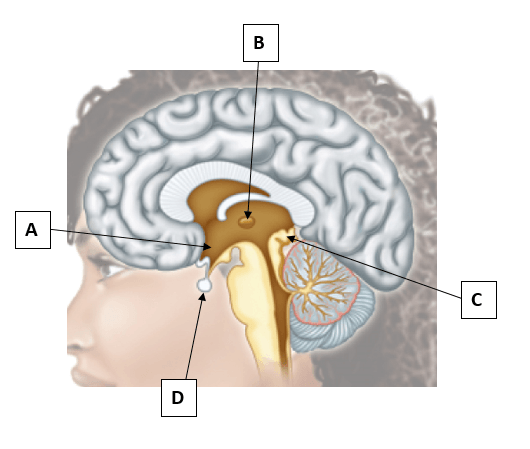
Identify the Pituitary gland.
A
B
C
D
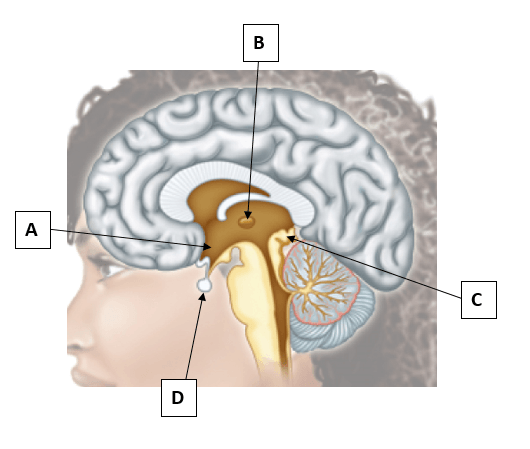
Identify the Hypothalamus.
A
B
C
D
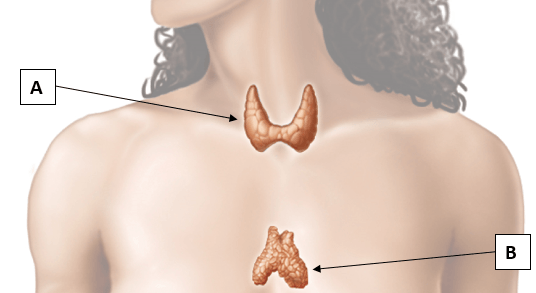
Name gland A.
Pineal gland
Thymus
Adrenal gland
Thyroid
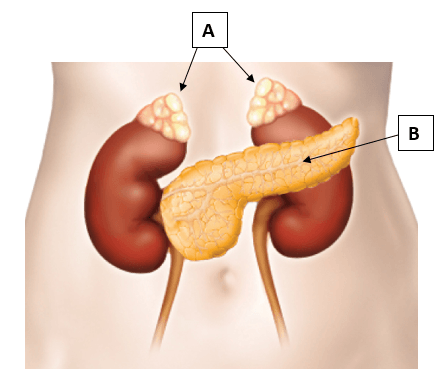
Name gland B
Pancreas
Adrenal glands
Spleen
Thymus
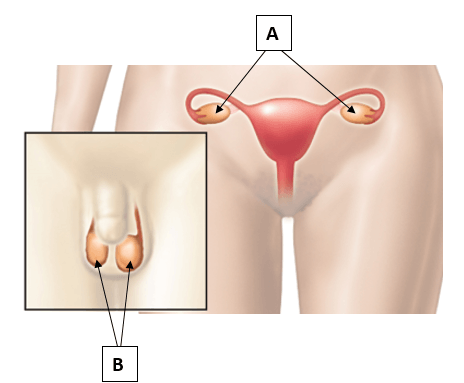
Name glands A
Uterus
Ovaries
Adrenal glands
Fallopian glands
Which Endocrine gland plays a role in the digestive system?
Thymus
Pancreas
Adrenal glands
Ovaries

is an organ that creates and releases substances that the body needs to function.
Heart
Gland
Kidney
Stomach
is a messenger system comprising feedback loops of the hormones released by internal glands of an organism directly into the circulatory system, regulating distant target organs.
Circulatory System
Endocrine System
Digestive System
Nervous System
· Its endocrine function involves controlling blood sugar levels.
Pancreas
Pineal.
Parathyroid
Pituitary

