
Font size
 Worksheets
SI9ECNC ÔN
Total questions: 77
Worksheet time: 1hrs 10mins
Which organelle is a jelly-like substance that helps fill out the cell
Chloroplast
Lysosomes
Mitochondria
Cytoplasm
This organelle controls what goes in and out of plant and animal cells.
Cell Wall
Cell Membrane
Chloroplasts
Cytoplasm
The _____________ holds the DNA, and controls the functions of eukaryotic cells.
Nucleus
Nuclear Membrane
Mitochondria
Chloroplast
What can only be found in plant cells?
Cell membrane
Vacuole
Chloroplast
Mitochondria
The basic building blocks from which all living organisms are made are
cells
DNA
chromosomes
Amoeba

In what organelle is the genetic material (DNA) found inside?
Endoplasmic Reticulum
Golgi Complex
Nucleolus
Nucleus

What organelle is called the "powerhouse" of a cell because it breaks down food and converts it to energy.
Endoplasmic Reticulum
Nucleus
Mitochondria
Nucleolus

This organelles stores water, nutrients, and waste products
Vacuole
Mitochondria
Ribosomes
Cell membrane

The two kinds of cells are Prokaryotes and Eukaryotes. How are they different?
Prokaryotes have a nucleus.
Eukaryotes have a nucleus.
There is no difference.
Only eukaryotes have DNA
Which organelle surrounds a cell and holds it together?
Cell Wall
Nucleus
Cell Membrane
Ribosome
The _____________ is a gel-like fluid that fills plant and animal cells. It holds the organelles in place and gives each cell its shape.
Cytoplasm
Cell Membrane
Cell Wall
Chloroplast

The arrow is showing the fluid inside the cell that surrounds the cell organelles. What is the arrow pointing to in the cell?
cytoplasm
mitochondria
ribosomes
nucleus

Name organelle X is pointing to.
Mitochondria
Chloroplast
Vacuole
Nucleus

What type of cell is this?
Animal
Plant
Both
Neither
What is the structure labeled C?
Lysosome
Ribosome
Vacuole
Mitochondria
What is the structure labeled E?
Nucleolus
Ribosome
Vacuole
Lysosome
What is the structure labeled F?
Endoplasmic Reticulum
Golgi Apparatus (Body)
Mitochondria
Cytoplasm
What is the structure labeled G?
Vacuole
Golgi Apparatus (Body)
Lysosome
Ribosome
What is the structure labeled I?
Nucleus
Vacuole
Endoplasmic Reticulum
Nucleolus
What is the structure labeled J?
Nucleus
Vacuole
Endoplasmic Reticulum
Nucleolus

What type of cell is this?
Animal
Plant
Both
Neither

What is the structure labeled #1?
Golgi Apparatus (Body)
Cell Wall
What is the structure labeled #2?
Golgi Apparatus (Body)
Ribosome
What is the structure labeled #3?
Golgi Apparatus (Body)
Cell Wall

What is the structure labeled #4?
Rough Endoplasmic Reticulum
Cell Membrane
Smooth Endoplasmic Reticulum
What is the structure labeled #6?
Rough Endoplasmic Reticulum
Smooth Endoplasmic Reticulum
What is the structure labeled #7?
Rough Endoplasmic Reticulum
Smooth Endoplasmic Reticulum
Golgi Apparatus (Body)
Smooth Endoplasmic Reticulum

What bone protects your brain?
Humerus
Cranium
Tibia


What are the two bones in the lower leg?
Femur and Ulna
Fibula and Femur
Tibia and Fibula
Clavicle and Sternum

What is the job of the Sternum?
protect heart and lungs
make you taller
protect your brain
make you shorter


What are the 4 types of bones?
Flat, Long, Irregular, Short
Flat, Irregular, Clumped, Long
Irregular, Raised, Long, Flat
Long, Flat, Irregular, Small
Bones give your body ___________
Shape
Posture
Flexibility
Weakness
Bones give your body ___________
Shape
Posture
Flexibility
Weakness
the rubbery, flexible material that sometimes connects bones and provides shape for some body part, including the nose and ears.
Skeleton
Cartilage
Bones
Skull
where separate bones come together and allow the body (arms, legs, fingers, etc.) to bend
joints
torso
cartilage
skull
the system that includes all of the bones in the body
Bones
Skeleton
Skull
Joints


What is the function of the mitochondria?
Structure that manufactures ribosomes
Structures that converts nutrients to energy
Stack of membranes that packages chemicals
Structure that contains DNA and directs the cell


I make proteins for the cell. What am I?
ribosome
mitochondria
chloroplast
lysosome
I make proteins for the cell. What am I?
ribosome
mitochondria
chloroplast
lysosome

Structures that transport and ship proteins like UPS,
Ribosomes
Lysosomes
Organelles
Golgi Bodies


What connects muscle to bone?
Ligament
Tendon
Cartilage
Joint Capsule

Cells of the nervous system are called
Erythrocites
Neurons
Osteocytes
Osteoblasts
The agonist and antagonist work in __________ to create movement
tandem
random
opposition
synchronization


What is illustrated with #2?
Bronchi
Bronchioles
Trachea
Alveoli
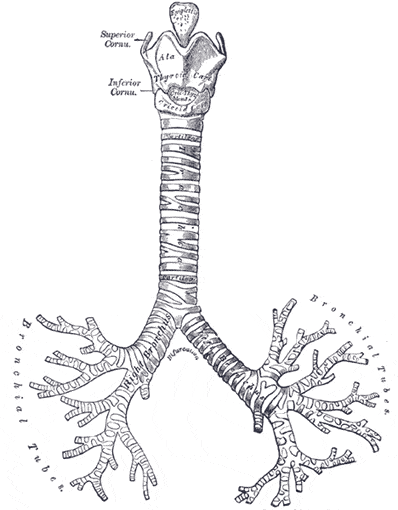
The two main branches from the trachea are called the __________________.
bronchi
alveoli
capillaries
bronchioles

What is D pointing to in this diagram?
nasal cavity
pharynx
trachea
alveoli

What is A pointing to in this diagram?
nasal cavity
lung
diaphragm
trachea

#6
Lungs
Alveoli
Trachea
Diaphragm
What is F pointing to in this diagram?
bronchiole
lung
bronchi
alveoli
What is E pointing to in this diagram?
bronchioles
lung
trachea
alveoli

