
 Worksheets
Science 7-Practice Test
Total questions: 75
Worksheet time: 3600secs
1. What is the logical and organized steps in solving a problem?
A. Experimental method
B. Investigation method
C. Research method
D. Scientific method
2. A grade 7 student wants to know if tomato seeds grow faster than mongo seeds. His teacher reminds him to follow the steps in scientific methods in planning his work. How will he perform the correct order of steps in scientific method?
I. Gathering preliminary data
II. Formulating a hypothesis
III. Identifying the problem
IV. Conducting an experiment
V. Verifying the conclusion
VI. Drawing a conclusion
VII. Collecting and interpreting the data
A. I, II, III, IV, V, VI, VII
B. IV, I, II, V, VI, III, VII
C. III, I, II, IV, VII, VI, V
D. II, V, VII, III, I, IV, VI
3. What type of substance is water?
A. It is a solution
B. It is a mixture
C. It is an element.
D. It is a compound.
4. The teacher gave a sample of a material to her student. The student was asked to determine whether it is an element, compound, or mixture. The student found out that she cannot separate the components of the sample through physical means. However, she can separate the sample by chemical means into three different pure substances. How would you classify the given sample material?
A. a compound
B. an element
C. a mixture
D. a solution
5. Water is vital for all known forms of life, even though it provides no calories or organic nutrients. Which of the following describes water?
A. It is a solution.
B. It is a mixture.
C. It is an element.
D. It is a compound.
6. Why does carbon is considered an element while carbon dioxide is considered a compound?
A. Carbon dioxide is a gas at room temperature.
B. Carbon dioxide is made of two different elements.
C. Carbon dioxide is given off by humans and animals.
D. Carbon dioxide is taken in by plants.
7. When Iron (Fe) nails are exposed to the environment, they get rusty. What is Iron (Fe)?
A. It is a solution.
B. It is a mixture.
C. It is an element.
D. It is a compound.
8. Which of the following explains why saltwater is considered a mixture?
A. It is composed of one element.
B. It is composed of one compound.
C. It is composed of two or more substances and has new chemical properties.
D. It is composed of two or more substances and retains its own chemical properties.
9. Which of the following BEST describes an unknown solid substance?
A. The solid material melts completely/smoothly.
B. The solid material takes a long time to completely melt.
C. The solid material has a constant boiling temperature.
D. The solid material boils at a temperature range.
10. Your classmate John is absent due to cough and colds, if you are to recommend, what kind of solution is suited for him?
A. Calamansi juice
B. Coffee
C. Iced tea
D. Powder juice
11. What abiotic factor affects the marine ecosystems?
A. Pressure
B. Predators
C. Algae
D. FoodWeb
12. What optical instrument consists of a lens or a combination of lenses for making enlarged images of minute objects?
A. Microscope
B. Mirror
C. Projector
D. Telescope
13. Identify the level of organization that this statement pertains to: The brain, the spinal cord, and the nerves all together play a vital role in the way humans respond to stimuli or changes in the environment.
A. Organ
B. Organism
C. Tissue
D. Organ system
14. Your teacher asked you to focus on a sample specimen. How will you perform the chronological steps in focusing a specimen?
I. Move the slide until it is focused on the center.
II. Rotate the revolving nosepiece to the lowest magnification power objective lens.
III. Adjust the mirror, illuminator, and or diaphragm for maximum light exposure.
IV. Adjust the coarse and fine adjustment knobs until the image is focused.
V. Mount the specimen into the stage using metal clips.
A. I, II, III, IV, V
B. V, IV, III, II, I
C. I, V, II, IV, III
D. II, III, V, I, IV
15. Which of the following shows the proper order of levels in a biological organization?
A. Cell à Organ à Organism à Ecosystem à Population
B. Cell à Organ à Tissue à Population à Community
C. Cell à Tissue à Organ à Organism à Population
D. Cell à Tissue à Population à Organism à Organ
16. Which of the following is not a unique feature of plant cell?
A. Cell wall
B. Vacuoles
C. Chloroplasts
D. Flagella
17. Hummingbirds feed on nectar from flowers. The flowers are pollinated by hummingbirds as they move from flower to flower. This type of symbiosis is called mutualism. Do you agree?
A. Yes, because both species benefit.
B. Yes, because one species benefit and the other species is not harmed.
C. Yes, because one species benefit and the other species is harmed.
D. Yes, because one species is being eaten by the other species.
18. Setting up an aquarium that represents a mini ecosystem has to have which of the following requirements?
A. Fish and water only
B. Water, sand, soil, and light only
C. Populations of fish, snails, and plants only
D. Communities of different species of organisms, water, soil, and sunlight
19. Which of the following best describes biotic factor?
A. Any living component that has a population.
B. Any living component that affects the population of another country.
C. Any living component that affects the population of another organism, or the environment.
D. Any living component that sometimes affects the population of another organism, or the environment.
20. Producers are organisms that can manufacture their own food. Which of the following is an example of a producer?
A. Eagle
B. Earthworm
C. Grasshopper
D. Grass
21. Which among the given set of quantities are considered as scalar quantities?
A. distance, displacement
B. mass, displacement
C. speed, distance
D. time, displacement
22. A bus is slowing down before it comes to a stop. Which of the following describes motion?
A. Accelerating
B. Decelerating
C. No movement
D. Zero acceleration
23. Which of the following statements is TRUE about an object that travels 5 meters to the left, then 2 meters up, then 5 meters right?
A. The displacement of the object is equal to 12 meters.
B. The displacement of the object is equal to 12 meters down.
C. The total distance travelled by the object is equal to 12 meters.
D. The total distance travelled by the object is equal to 12 meters down.
24. A grade 7 student was tasked by his teacher to draw a wave that carries a greater amount of energy. Which of the following illustrations will he likely draw?


25. Your mom bought an air conditioner for your room. She is wondering where to place the aircon. Where would you suggest placing it?
A. Knee level
B. Overhead
C. Shoulder level
D. Anywhere is applicable.
26. If you comb your hair and the comb becomes positively charged, then what will happen to your hair?
A. It will remain uncharged.
B. It will be repelled by the comb.
C. It will become positively charged.
D. It will become negatively charged.
27. Which of the following would most likely transmit sound best?
A. Air in your classroom
B. Steel in cabinet
C. Water in the ocean
D. Water in a swimming pool
28. What is the reciprocal period?
A. Speed
B. Frequency
C. Amplitude
D. Wavelength
29. What type of heat transfer occurs when two objects touch each other?
A. Conduction
B. Convection
C. Radiation
D. Transmission
30. Which of the following describes the usual way by which a material can gain a positive charge?
A. By gaining protons
B. By gaining electrons
C. By losing protons
D. By losing electrons
31. What is the concentration of a solution if it has a small amount of dissolved solute in comparison to the amount of solvent?
A. Concentrated
B. Dilute
C. Solute
D. Solvent
32. Your youngest brother was diagnosed with lactose intolerance. How will you plan to buy his milk based on his diagnosis?
A. Buy the cheapest brand of milk.
B. Buy the most expensive brand of milk.
C. Buy milk with added lactase ingredient.
D. Buy milk that contains butter, milk sugar, and milk solids.
33. Decide what chemical compounds is used as an antiseptic liquid to treat cuts and other skin wounds.
A. Calcium carbonate
B. Hydrogen peroxide
C. Nitric acid
D. Sodium hydroxide
34. Which of the following does not affect the solubility of solids?
A. Pressure
B. Stirring
C. Surface area
D. Temperature
35. What do you think will happen when we increase the amount of solute in a solution, but does not add more water?
A. The concentration will go up
B. The concentration will go down.
C. The concentration will stay the same.
D. The concentration will go up and down.
36. Which of the following options is an example of qualitative data?
A. The adult human body has 206 bones.
B. The colors of the cars in the parking lot.
C. There are 21 cupcakes during his 21st birthday
D. The distance of the Earth from the sun is 148.68 million km.
37. Gold is yellow, shiny smooth and is found in the ground. A geologist finds a material that she thinks may be gold.
Which of the following tests would she plan to do to reveal that the material is not gold.
A. Check its density if it is different from that of gold.
B. Determine if the material is composed of two different substances.
C. Observe the melting point if it is different from that of gold.
D. Observe its boiling point if it is different from that of gold.
38. Which of the following steps is not applicable in dissolving sugar in water?
A. Add salt to the water
B. Grind the sugar to make it finer
C. Heat the water and sugar
D. Stir the water and sugar
39. What is the characteristics of most metals?
A. Brittle
B. Good conductor
C. Low tensile strength
D. Poor conductor of both heat and electricity
40. What should be done when the result of the experiment do not support the hypothesis?
I. Stop performing the experiment.
II. Identify different problem and perform different experiment.
III. Repeat the experiment and stick with your original hypothesis.
IV. Formulate another hypothesis based on the information obtained from the experiment then perform the experiment
with similar condition.
A. I only
B. II only
C. III only
D. IV only
41. The nutrition facts is a list of the different nutrients provided by the food product with their corresponding percentage on the daily recommended dietary allowance. Why is it important to read product or food labels?
A. It is much to know how much the item is.
B. It is important for us to know how many pieces are inside the food product.
C. It is important to read food labels to check if you know how to read.
D. It is a must that we check the labels of the food we ingest to know if it is safe to eat or not.
42. Which of the following is an example of a concentrated solution?
A. 250 mL of water with 100g of salt.
B. 250 mL of water with 10g of sugar.
C. 500 mL of water with 25g of salt.
D. 500 mL of water with 15g of sugar.
43. Which of the following is the basis of naming the element Thorium?
A. Latin or Greek roots
B. Mythological concepts or character
C. Person who discovered it.
D. Place it was discovered.
44. You are tasked to create a simple heterogeneous mixture. Which of the following materials will you prepare?
A. Oil and water
B. Salt and water
C. Sugar and water
D. Vinegar and water
45. Which statement identifies why oxygen is classified as a pure substance and air is classified as a mixture?>
A. Oxygen is more reactive than air.
B. Oxygen has a higher density than air.
C. Oxygen goes under a phase change, whereas air is always a gas.
D. Oxygen contains only one substance, but air contains several substances
46. Calculate the total magnification if the ocular lens has 15x magnification and the objective lens has 10x magnification.
A. 5x
B. 25x
C.150x
D. 1500x
47. Your father is a farmer and plans to propagate a good variety of a crop in a way which maintained all its desirable traits. Which of the following methods should be used?
A. Self-pollination
B. Vegetative propagation
C. Growing seeds produced from this variety.
D. Cross-pollinating this crop with another good variety and growing the seeds resulting from the cross.
48. How do changes in abiotic factors affect an ecosystem?
A. They have no impact on the ecosystem.
B. They only affect the biotic factors in the ecosystem.
C. They only affect the abiotic factors in the ecosystem.
D. They can have both positive and negative effects on the organisms in the ecosystem.
49. How do you call the animal in an ecological relationship that results in another animal being hunted, killed, and eaten?
A. Autotroph
B. Habitat
C. Herbivore
D. Prey
50. The heart pumps blood that carries oxygen and nutrients to the different parts of the body. To which organ system does the heart belong?
A. Circulatory
B. Digestive
C. Excretory
D. Reproductive
51. Which type of symbiotic relationship is when one organism benefits, while the other is not harmed?
A. Commensalism
B. Competition
C. Mutualism
D. Predator
52. Which of the following is an abiotic factor that plants depend on?
A. Ants building their nests in trees
B. Insect pollinators
C. Nutrients in the soil
D. Seed-eating birds
53. Cancer starts from cells that start to grow uncontrollably fast. They destroy tissues and organs. What does this say about the effects of diseased cells on the higher levels of organization in an organism?
A. Cancer involves only certain kinds of cells and does not affect any other kind of cell.
B. Diseased cells affect only the next higher levels of organization that they make up – the tissues.
C. Diseased cells damage the higher levels of organization they make up: tissues, organs, organ systems, and eventually, the whole organism.
D. Diseased cells do not affect the other parts of an organism.
54. Why are plants considered as producers?
A. Plants produce fruits that can be eaten by animals.
B. Plants produce root crops that supply carbohydrates to animals.
C. Plants provide vegetables for animals and human consumption.
D. Plants convert energy from the Sun into chemical energy in the form of glucose (food).
55. Which of the following parts can only be found in animal cells that functions during cell division?
A. Centrioles
B. Cytoplasm
C. Lysosome
D. Nucleus
56. A loaf of bread was left on the cabinet and stayed there for days. Atasha got hungry and looked for something to eat in the kitchen. She found the loaf of bread covered with greenish thread and smelled foul. What could have happened to the loaf bread?
A. It was covered with algae causing it to spoil.
B. It was covered with molds causing it to spoil.
C. It was covered with bacteria causing it to spoil.
D. It was covered with seaweed causing it to spoil.
57. Which species can produce offspring that are genetically different from their parents?
A. A species that has few variations.
B. A species that reproduces sexually.
C. A species that reproduces asexually
D. A species that competes with a similar species.
58. In a given environment, which of the following refers to a population?
A. Any organisms that live together and eat in one place.
B. Several numbers of organisms living in the same place.
C. Different organisms live together in the same place and at the same time.
D. Group of organisms of the same kind living in the same place and at the same time.
59. What type of asexual reproduction in which the organism is capable of regrowing certain body parts?
A. Budding
B. Binary fission
C. Regeneration
D. Parthenogenesis
60. Which of the following is a biotic factor in an ocean ecosystem?
A. The fish in the water.
B. The oxygen in the water.
C. The salt content of the water.
D. The temperature of the water.
61. Pans A and B have been on a hot stove for 10 minutes. Pan A has a metal handle and pan B
has a plastic-coated handle. Which handle would be hotter and why?
A. Pan A because the metal handle is a good conductor of heat.
B. Pan A because the metal handle is a good insulator.
C. Pan B because it has a plastic-coated handle.
D. Pan B because it is made of metal.
62. Arrange the visible light colors in order from longest wavelength to shortest wavelength.
A. Violet, Indigo, Blue, Green, Orange, Yellow, Red
B. Red, Orange, Yellow, Green, Blue, Indigo, Violet
C. Red, Yellow, Green, Orange, Violet, Blue, Indigo
D. Indigo, Yellow, Red, Blue, Orange, Yellow, Violet
63. Heat transfer by convection occurs only in _______.
A. gases
B. liquids
C. fluids
D. gases, liquids, and solids
64. Which of the following is an example of a longitudinal wave?
A. infrared
B. x-ray
C. microwave
D. P wave
65. Sound energy cannot travel through________.
A. air
B. mirror
C. water
D. vacuum
66. A bus covers 160 km in 4 hours. What is the speed of a car?
A. 160 k/h
B. 40 km/h
C. 120 km/h
D. 20 km/h
67. How do you compute the speed of the cyclist?
A. divide 200 meters distance by the recorded time of travel.
B. divide the recorded time of travel by 200 meters.
C. multiply 200 meters divided by the recorded time of travel.
D. divide 200 meters by twice the recorded time of travel.
68. The objects you use for comparison become your ______ of __________.
A. position of motion
B. frame of reference
C. motion of velocity
D. speed of direction
69. The word "acceleration" means to___________.
A. change the speed or direction.
B. create a balanced force on another object.
C. exert a force on another object.
D. create an unbalanced force on another object.
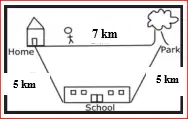
70. Jennie walked from home to school, and then from school to
the park. What is her total displacement?
A. 7 km to the right
B. 7 km
C. 7 km to the left
D. 10km north
71. A stretched spring is compressed on one end and released. The resulting wave travels back and forth between the two ends of the spring until it comes to a stop. This mechanical wave is an example of a...
A. transverse wave.
B. longitudinal wave.
C. surface wave
D. refracted wave.

72. What point in the diagram above represents the wavelength of the wave?
A. A
B. B
C. C
D. D
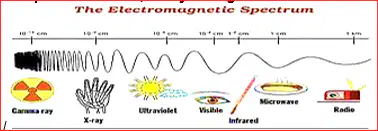
73. Which of the following electromagnetic waves has the most penetrating power?
A. UVR
B. visible light
C. microwave
D. gamma rays
74. How do electromagnetic waves reach the Earth? They travel through__________________.
A. gases in the air
B. liquid materials
C. solid materials
D. empty space
75. A person prefers to sit by a fire during the cold winter months. Which of the following
heat transfer types give him the most heat?
A. convection and radiation together
B. radiation will provide quick warmth
C. if it is near the fire, convection sounds good
D. conduction from the fire.

