
 Worksheets
Ch4- Ecosystems Review
Total questions: 60
Worksheet time: 58mins
Organisms only hold on to _____ percent of the energy they ingest.
100
10
25
55

What is a living thing that breaks down plant and animal material, returning the nutrients to the soil?
Producer
Primary consumer
Secondary consumer
Decomposer

an ecosystem consists of:
all of the biotic factors in a given area
the types of plants that inhabit a given area
abiotic factors such as the sun, salinity, temperature, and weather found in a specific area
all of the biotic (living)factors and their interactions with the abiotic (non-living) factors in a given area
Where does the food chain START?
with consumers that eat grass
with the sun giving energy to plants (producers)
with the sun giving energy to consumers
with consumers eating other consumers
In any food chain, the first trophic level is occupied by:
Herbivores
Secondary consumer
Producers
Keystone species
Producers are
Autotrophs
Heterotrophs
Herbivores
Carnivores
Consumers are
Autotrophs
Heterotrophs
Plants
Photosynthesis

In a food web, how is energy represented?
Arrows
Trophic levels
Producers
Consumers
Animals that eat a variety of meats, fruits, and vegetables are
producers
Carnivores
omnivores
herbivores

Large climatic regions with distinct plants and animals
Primary succession
Secondary succession
Pioneer species
Biomes
What is the photic zone?
the top layer, nearest the surface of the ocean and is also called the sunlight layer
the portion of a lake or ocean where there is little or no sunlight
___________ use photosynthesis and chemosynthesis to produce energy.
Autotrophs
Heterotrophs
Decomposers feed by chemically breaking down organic matter. This process produces _________, or small pieces of dead and decaying plant and animal remains.
detrius
dander
oxygen
nitrogen
Which statement describes ALL primary producers?
All make energy-rich compounds that can be used by other organisms
All make their own food using the energy of compounds in the environment
All take in energy-rich compounds that were made by other organisms
All make their own food using the energy of sunlight

What term describes the position of an organism on the food chain?
food web
energy levels
trophic levels
matter cycle


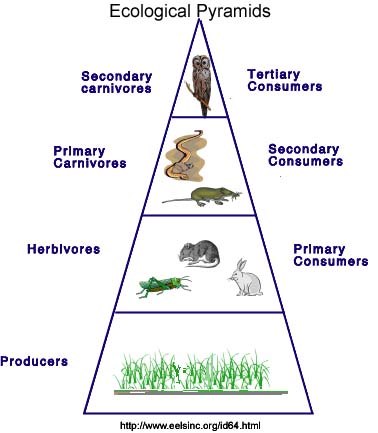

What is this an example of?
food web
food chain
food consumers
food producers

Which type of ecological pyramid is this?
energy
biomass
numbers

Which type of ecological pyramid is this?
energy
biomass
numbers

Which type of ecological pyramid is this?
energy
biomass
numbers
What cycle are fossil fuels part of ?
carbon
oxygen
nitrogen
phosphorus

Nitrogen in the atmosphere is unusable. What form is nitrogen in the atmosphere?
Nitrites
Ammonia
Nitrates
N2 gas
Which of the following is not an example of a biological process in a biogeochemical cycle?
Transpiration
Nitrogen fixation by bacteria
Erosion
Birds eliminating waste

According to the food web, which food chain is correct?
phytoplankton → krill → fish → penguins → elephant seal
phytoplankton → other herbivorous zooplankton → fish → leopard seal → toothed whales
phytoplankton → other herbivorous zooplankton → squid → penguins → leopard seal
phytoplankton → krill → carnivorous zooplankton → seals → toothed whales
Which of the following actions is most likely to have a negative effect on Earth's ecosystems?
the construction of new facilities to recycle metals
regulations minimizing air pollution
a gradual increase in human population
protection of native species

What is a producer? (give the definition of a producer)
A producer eats other plants and animals.
A producer makes its own food.
A producer eats plants.

What is a consumer? (Give the definition of a consumer.)
A consumer makes its own food.
A consumer does not need food.
A consumer eats plants and other animals for energy.
Consumers, such as vultures, that feed on the bodies of dead organisms
Carnivores
Omnivores
Herbivores
Scavengers
Which organisms break down dead organic matter into soil so that plants can use it to grow?
Producers
Carnivores
Scavengers
Decomposers

All energy in an ecosystem comes from the sun. This energy is passed through the ecosystem as organisms eat other organsims.
Ominvores
Herbivores
Detritivores
Flow of energy

Heterotrophs that “clean up” the ecosystem by eating dead and decaying organisms.
Autotrophs
Herbivores
Ominvores
Detritivores

Parts of an ecosystem that are living or deal with the living. Examples include producers, consumers, decomposers, predation, disease, competition, parasitism, and symbiosis.
Abiotic Factors
Biotic Factors
Community
Population

Parts of an ecosystem that are not living. Examples: water, soil, sunlight, temperature, altitude.
Detritivores
Herbivores
Biotic Factors
Abiotic Factors
Carbon, nitrogen, and phosphorus are examples of __________ that organisms need to stay alive.
compounds
reservoirs
sediments
nutrients
biological processes
activities performed by living organisms
Biogeochemical processes
cycling of nutrients through an ecosystem
geological processes
formation and breakdown of rock
physical processes
water cycles and weather patterns
human activity
activities that affect the cycles of matter on a global scale
1. Complete the following statement: “Energy _______________, while matter _____________ through the environment.”
Flows, flows.
Flows, cycles.
Cycles, flows.
Cycles, cycles.
How do non-human living things affect the carbon cycle (fill in the blank/short answer)
animals do cellular respiration
plants do photosynthesis
Fires release carbon into the atmosphere
All of the above
Humans are responsible for many negative changes in the natural environment. Which of the following best describes why humans have a profound impact on their environment?
Humans are able to preserve scarce resources.
Humans are able to modify habitats more than any other species.
Humans have made attempts to preserve the environment.
Humans have encouraged the development of wildlife refuges and parks.

According to the diagram, geologic activity, such as volcanoes,
Increases the levels of CO2 in the atmosphere.
Decreases the levels of CO2 in the atmosphere.

Phosphorus is released from rock through ________
decomposition
evaporation
weathering
transpiration
What is the role of bacteria in the nitrogen cycle?
convert nitrogen into a usable form for other organisms
produce sugars and starches
burn carbon dioxide
decay organisms into small bits
What process is part of the phosphorus cycle?
transpiration
nitrification
combustion
sedimentation
Water pollution is coming from
chemicals in herbicides, pesticides, and fertilizers
water treatment plants
fishing
As a part of the water cycle, water from Earth's surface enters the clouds and finally falls back to the ground in the form of rain. What is the correct sequence of processes water undergoes?
Evaporation, Condensation, Precipitation
Precipitation, Condensation, Evaporation
Condensation, Evaporation, Precipitation
Evaporation, Precipitation, Condensation

What are 3 ways humans affect the carbon cycle?
Burning fossil fuels, changing land use, deforestation
Burning fossil fuels, using limestone
Breathing it out of our bodies, planting trees, fishing
Which describes the relationship between plants and animals in the carbon cycle?
Plants produce and release oxygen that animals need
Plants produce and release carbon dioxide that animals need
Animals produce and release oxygen that plants need
Animals produce oxygen that plants turn into carbon dioxide

