
 Worksheets
Unit 3 Review - Physical Science - 2022-2023
Total questions: 78
Worksheet time: 1hrs 17mins

What elements generally make an ionic bond ?
Metal and nonmetal
2 or more nonmetals
2 or more metals
2 elements

An ionic bond is formed when
Valence electrons are shared.
Valence electrons surround the cations.
Valence electrons are transferred between atoms.
Valence electrons are completely transferred between two metals.
What is a valence electron?
an electron that is found in the outermost shell of an atom
an electron found in the innermost shell of an atom
an electron found in the middle shell
an electon found in the nucleus

What is the number of valence electrons of Oxygen?
1
2
6
8
What is the number of valence electrons of Neon?
6
7
8
9

What type of diagram is this?
Alkali Diagram
Bohr Model
Chemical Diagram
Electron Dot Diagram

How many valence electrons in this structure ?
4
5
6
7
What is the number of valence electrons of Neon?
6
7
8
9

How many electrons are being shared between the two carbon atoms in the compound ethyne?
1
2
3
6
The three dots in the Lewis dot diagram for boron indicate that it
Can bond with three other atoms
Can only form triple covalent bonds
Has five valence electrons
scores a 3 on Pauling's electonegativity scale

Predict the bond that will form between Se and Cl
Ionic-bond
Covalent-bond
Metallic-bond
Hydrogen-bond

Predict the bond formed between Be and F
Covalent-bond
Ionic-bond
Metallic-bond
Hydrogen-bond
Why don't noble gases form bonds?
Noble gases do form bonds
They all have a full octet
They only bond with each other



What kind of charge does an ionic compound carry?
unknown
negative
none
positive
NaCl is the chemical formula for what?
sodium chloride
sodium metal
water
chlorine gas
How many electrons are shared in a double bond?
one
two
one pair
two pairs
For an ion, the oxidation number is ________.
always negative
zero
the same as the charge on the ion
one less than the charge on the ion
In general, noble gases react with _______.
nothing
metals
other noble gases
water
A binary compound made with phosphorus will end with the word ________.
phophate
phosphrous
phosphate
phosphide
When an atom’s outer energy levels are not filled completely, the atom _______.
is a noble gas
is very stable
can gain, lose, or share electrons
cannot form a compound
A metal and non-metal molecule has bonded. What kind of bond will they create?
Hydrogen bond
Atomic bond
Ionic bond
Covalent bond
ionic bonding is the sharing of electrons between two non metals
true
false
H2O is an covalent bond
true
false
the subscript is written _____ the line to show the number of atoms
above
below
to the left of
to the write of
the superscript is written _____ the line to show the charge of the ion
above
below
to the left of
to the right of
on the periodic table, the non metals are on the left
true
false
The Alkaline-Earth metals are in the first column
true
false
This group is the most reactive
alkali metals
alkaline earth metals
noble gases
halogens
Sodium (Na) is _____ charged
ionicly
neutrally
positively
negatively
Ionic bonds and covalent bonds are both _____ bonds
chemical
metal
positive
negative
the _____ are on the _____ of the periodic table
metals, right
halogens, last group
alkaline earth metals, middle
transition metals, middle
the transition metals follow the valence electron rules
true
false
Which group of elements commonly forms ions that have a charge of 2+?
F, Cl, Br, I
Be, Mg, Ca, Sr, Ba
H, Li, Na, K, Rb, Cs
O, S, Se, Te
Most transition metals and group 13 and 14 metals have ______.
one common ion with a charge of 2+
one common ion with a charge of 3+
more than one possible ionic charge
one common ion with a charge of 1+
Na2S
Mg3N2
FeP
calcium arsenide
beryllium iodide
What is the correct name of this compound?
CBr4
Carbon Bromide
Monocarbon tetrabromide
Carbon tetrabromide
Tetracarbon Bromide
Choose the correct formula for this compound:
Dinitrogen Pentasulfide
N5S2
N2S5
Ni2Se5
NS
What is the correct chemical formula for magnesium sulfide?
Mg2S2
MgSO4
MgS
Mg2(SO4)2
A model of an atom that only shows valence electrons is called a(an)
electron dot diagram.
valence model.
Bohr model.
chemical formula.

What type of bonding does this picture show?
Ionic
Covalent

What type of bonding does this picture show?
Ionic
Covalent
Generally, atoms form bonds so that _______________.
Each atom loses its electrons
Each atom has a stable electron configuration
Each atom has an unstable electron configuration
Each atom gains electrons
Generally low melting and boiling points
Ionic compounds
Covalent compounds
Generally high melting & boiling points
Ionic compounds
Covalent compounds
Valence electrons are shared
Ionic bonds
Covalent bonds
Valence electrons are transferred
Ionic bonds
Covalent bonds
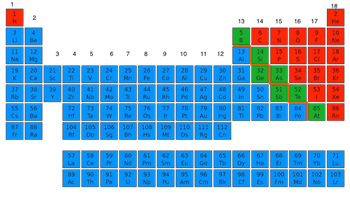
The chemical bond between a non-metal and another non-metal will be a ________ bond.
metal
ionic
covalent
polar
The chemical bond between a metal and a non-metal will be a _____ bond.
metal
ionic
covalent
polar
Sodium and Bromine will make a _____ bond.
ionic
covalent
metallic
Carbon and Oxygen will make a ___________ bond.
ionic
covalent
metallic
MgO
ionic
covalent
metallic
If two fluorine atoms bond they will make a _____ bond.
ionic
covalent
metallic
Hydrogen and Chlorine will from a _________ bond
ionic
covalent
metallic

