
 Worksheets
Forensics Unit 2 & 3 Review
Total questions: 60
Worksheet time: 40mins
Which of the following are examples of physical evidence?
DNA
Fingerprints
Fibers
Hair
All of the above
What is it called when evidence is too small to see with the naked eye?
Physical evidence
Trace evidence
Fingerprints are a good example of class evidence, because no two people have the same fingerprints. True or False?
True
False
What are the three layers that make up the hair? (select 3)
Keratin
Medulla
Cuticle
Root
Cortex
The follicular tag contains DNA and is also known as
the cortex
the root
the medulla
the shaft
Hair (without the root) can only be considered class evidence because it is impossible to link the hair to one individual. True or False?
True
False
Natural fibers can be harvested from
plants and animals
only from plants
only from animals
plants, animals, and minerals
Which of the following observations are used to help identify a specific fiber?
smell of the burned fiber
on contact with the flame, does the fiber coil or melt?
color and structure of the residue left after the riber burns
all of the above
What is Loccard's Exchange Principle?
Perpetrators always leave evidence behind.
Every contact leaves a trace.
All touches leave evidence.
Long, violent confrontations leave evidence.
Material that connects an individual or thing to a certain group.
Class Evidence
Individual Evidence
Circumstantial Evidence
The region of a hair located outside of the medulla containing granules of pigment. (wood part of pencil)
Cuticle
Medulla
Cortex
The tough outer covering of a hair composed of overlapping scales. (outer part of pencil)
Cortex
Cuticle
Medulla
A fiber made from a man-made substance such as plastic.
Natural Fiber
Synthetic Fiber
Monomer

Fibers are an excellent source of trace evidence because:
they are easily transferred from victim to suspect
they are often overlooked by a suspect
they can be easily collected and stored
all of the answers are correct
Which part(s) of a hair can be analyzed for DNA?
root
cuticle
medulla
cortex

Look at the picture above Match the letter to the correct cuticle scale. What is A?
Spinous
Imbricate
Coronal
Look at the picture above Match the letter to the correct cuticle scale. What is B?
Spinous
Imbricate
Coronal
Look at the picture above Match the letter to the correct cuticle scale. What is C?
Spinous
Imbricate
Coronal
Wool is a type of:
Animal Fiber
Plant Fiber
Synthetic Fiber
Which of these is a natural fiber?
rayon
nylon
cotton
polyester
Which of these is a synthetic fiber?
cotton
rayon
asbestos
hemp
________________ is a written record of all people who have had possession of an item of evidence
The crime scene log
Direct evidence
Circumstantial evidence
The chain of custody
Evidence that establishes the existence of a fact that is in question without relying on inference is known as _______________ evidence.
Direct
Circumstantial
Physical
Biological
any object that can establish that a crime has or has not been committed or can link a crime and its victim or its perpetrator is known as _______________ evidence.
Direct
Circumstantial
Physical
Biological
What type of evidence is shoe size?
Class
Individual
Which evidence is considered to be more reliable?
Testimonial
Physical
a folded paper used to hold trace evidence
paper bag
paper bindle
envelope
The reason it is important to separate the witnesses at the crime scene is to
prevent contamination of the evidence
prevent fighting among the witnesses
prevent the witnesses from talking to each other
protect them from the perpetrator
Correct collection of evidence requires which of the following?
documenting the location where the evidence was found
correct packaging of evidence
maintaining proper chain of custody
all of the above
Which of the following best describes the difference between circumstantial evidence and direct evidence?
Direct evidence can lead to the conviction of a suspect, while circumstantial evidence cannot.
Direct evidence is not admissible in court; however, circumstantial evidence is admissible with the approval of a judge.
Direct evidence is used to imply a fact, while circumstantial evidence proves an alleged fact.
Direct evidence proves and alleged fact, while circumstantial evidence is used to imply a fact.
What should be included on the packaging of any piece of evidence?
description of item
source/location of where item was recovered
names of anyone who has had contact with item
all of these
How should biological evidence be packaged?
it should be packaged in paper to allow for drying
it should be packaged in plastic immediately
it should be packaged in the same container as other evidence
Check all descriptions appropriate for: Polyester
Synthetic
Natural
Plant
Animal
Mineral
Fibers are classified as either:
natural fibers or synthetic fibers.
polymers or synthetic fibers.
acrylic fibers or plant fibers.
olefins or synthetic fibers.
Is it possible to determine the species of hair evidence without DNA?
Yes
no

Which number in the diagram represents the cuticle?
A
D
B
F

Which number in the diagram represents the medulla?
C
A
B
D

Which number in the diagram represents the cortex?
B
A
C
D
At crime scenes, it is usually more likely that investigators find individual physical evidence rather than class physical evidence
True
False
a compound microscope that allows the side-by-side comparison of hair samples
micrometer
comparison microscope
hair follicle
medulla
The school is vandalized on a Friday morning before school starts. School surveillance shows a student wearing a black hoodie, jeans, brown hair, and wearing a red hat. There are approximately 2000 students that attend the school.
If there are 25 people in your class and 4 of them are wearing a black hoodie, approximately how many students would be wearing black hoodies in the entire building?
320
16
need more information
500
The school is vandalized on a Friday morning before school starts. School surveillance shows a student wearing a black hoodie, jeans, brown hair, and wearing a red hat. There are approximately 2000 students that attend the school.
If there are 25 people in your class and 10 of them are wearing jeans. What percent of students are wearing jeans?
40%
10%
need more information
25%
Chain of custody must be maintained
so that the evidence does not have to be examined again.
or the evidence may not be admitted into court
only by the first officer on the scene
only by the forensic scientist who examines the evidence
all of these are true
Which of these is an example of class evidence?
a footwear impression left by a suspect's shoe that has been worn for a year
DNA of the suspect found at the scene
white powder residue on the victim
a torn piece of paper from the scene that matches up (fits together) with a notebook from the suspects house
True of False: Biological items, such as DNA, collected at crime scenes should be dried and kept frozen until ready for testing.
True
False
All evidence must be sealed in a tamper proof way. The person who seals the evidence should also:
not wear gloves when collecting the evidence
Sign & date the Seal
give it to the lead detective for safe keeping
do nothing else, it's sealed.
Can hair also be considered a type of fiber evidence?
YES
NO

A victim's fingernail scrapings would be correctly packaged in:
a druggist fold
sealed, airtight containers.
a plastic Ziploc® bag.
Paper evidence bag

Was this bag sealed properly?
Yes
No
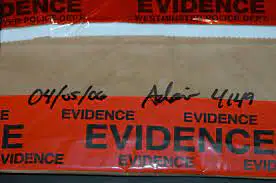
Is this evidence bag correctly sealed?
Yes
No

True or False: The cortex may contain pigment granules.
True. Melanin is found in the cortex of a hair.
False. Pigment granules are only ever seen on the cuticle.
It's ok to collect evidence at a crime scene, but wait until you arrive back at the lab to properly put it in the evidence bag, label it, and seal it. As long as it's done before the end of your shift.
True
False
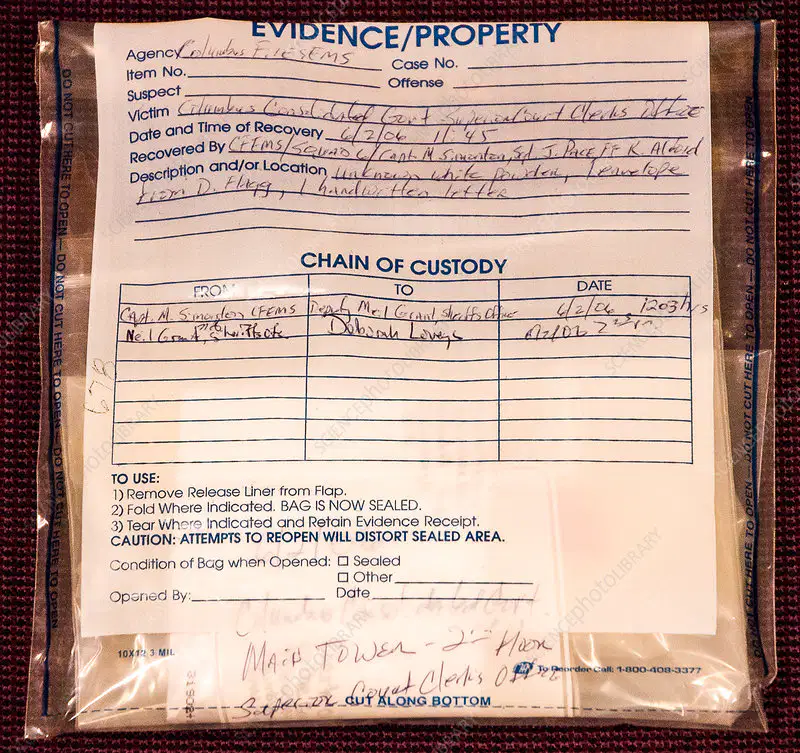
Review the evidence bag, was the chain of custody properly maintained?
Yes
No
I have no idea, there's not enough information
A material that can be related to a SINGLE source.
Trace Evidence
Class evidence
individual evidence

