
 Worksheets
Watercycle/ watershed intro.
Total questions: 57
Worksheet time: 58mins


Look closely at the map of the watershed below. If water enters the watershed at the top of the mountain where the arrow is pointing, at which point will it stop draining?
Point A
Point B
Point C
Point D

The boundaries of a watershed are determined by ___________
Elevation
Soil type
The amount of water that flows
The kinds of organisms found in the area
All water below the surface of land is called__________.
water table
watershed
groundwater
runoff

__________ tells you how healthy the water is.
water quantity
water quality
good water
tasty water

Where are you most likely to find a watershed?
In a lake
On a mountain top
At the bottom of a valley
Everywhere

What definition BEST describes a watershed?
An area where water infiltrates the soil
An area where aquatic plants and animals thrive
An area where snow melts and changes into liquid water
An area that collects precipitation and drains it to the lowest point
All water below the surface of land is called__________.
water table
watershed
groundwater
runoff
The process where water or irrigation runs over land and seeps into the ground, or flows into streams or oceans.
water cycle
runoff
precipitation
evaporation

Groundwater is recharged when rainwater infiltrates into the ground.
True
False

Runoffs recharge lakes and streams.
True
False

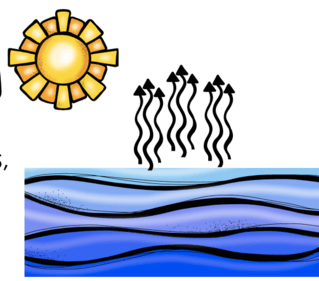
Infiltration is the process by which water enters and absorbs into the soil.
True
False
What effect does the sun have on surface water?
It causes it to boil
It causes it to sink
It causes it to rain
It causes it to evaporate
Which of the following options depicts precipitation?


An area of land that drains into one body of water is called -
a watershed
a wetland
a forest buffer
an estuary

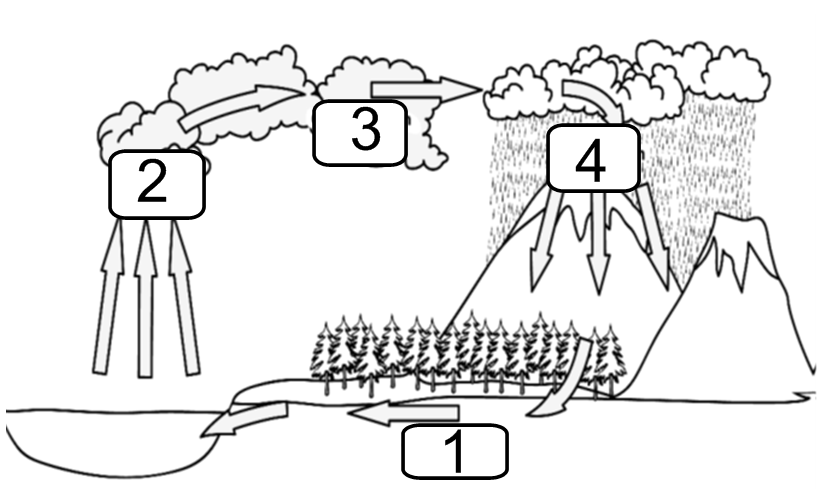
What does the number 3 shows?
Condensation
Evaporation
Transpiration
Precipitation

Water that collects in cracks and pores in underground soil and rock layers
Surface Water
Point Source Pollution
Groundwater
Watershed
As a part of the water cycle, water from Earth's surface enters the clouds and finally falls back to the ground in the form of rain. What is the correct sequence of processes water undergoes?
Evaporation, Condensation, Precipitation
Precipitation, Condensation, Evaporation
Condensation, Evaporation, Precipitation
Evaporation, Precipitation, Condensation

The image shows various stages in the water cycle. During which stage does water flow back towards the sea as runoff?
W
X
Y
Z
What is precipitation?
Sweat from our bodies on hot days
Warm rain but not cold snow or sleet
Gas that we use in furnaces or ovens
Any form of water that falls from the sky
The process when plants release water vapor from their leaves is called _____________.
precipitation
evaporation
transpiration
condensation

What step of the water cycle does this picture show?
Condensation
Runoff
Precipitation
Evaporation

Which best explains why runoff is important?
It returns water to other locations on Earth
It increases the chance of flooding
It makes evaporation occur faster
It increases condensation
In which area would the rate of evaporation be the lowest?
Over the ocean
Over the mountains
Over the rainforest
Over the desert

What are formed when water vapor condenses and come together?
Clouds
Mountains
Transpiration
Valleys


evapotranspiration

As permeability increases
Infiltration decreases and runoff decreases
Infiltration increases and runoff decreases
Infiltration decreases and runoff increases
Infiltration increases and runoff increases
What type of sediment tends to be the most impermeable?
sand
clay
silt
rocks
If water can easily move between cracks of a rock, we can say that...
water is permeable
rock is permeable
rock is impermeable
water is impermeable
______ is more permeable since water passes through it
gravel
sand
clay
Silt
What is porosity
Rocks
The percent of the volume of open spaces in rock or sediment
Ability rock sediment fluids pass through open spaces/pores
Nothing
If porosity is low then permeability is
low
high
A soil sample with a large amount of space between the particles WILL ALWAYS have a
high porosity
lower permeability rate
low porosity
high permeability rate

