
 Worksheets
Yr 10 Chemistry - Chemical Energy
Total questions: 76
Worksheet time: 6hrs 20mins
The minimum amount of energy that is required to break the chemical bonds of atoms or molecules is:
kinetic energy
light energy
activation energy
potential energy
What equipment would you use to detect an endothermic or exothermic reaction?
Ruler
Thermometer
Calorimeter
Balance

What type of reaction is this?
endothermic
combustion
hydrocarbon
exothermic
True or false: ΔH for an endothermic reaction is a positive value.
True
False
During a chemical reaction, the chemical potential energy of a substance is released as heat.
true
false
Potential energy is due to the composition or position of an object.
true
false
Chemical potential energy is stored in the chemical bonds of a substance.
true
false

How many joules of energy is required to raise the temperature of one gram of water by one degree Celcius?
41.84 Joules
4.184 Joules
418.4 Joules
4184 Joules
Breaking chemical bonds takes in energy from the surroundings. This is an example of?
endothermic
making
exothermic
breaking
Making chemical bonds gives out energy to the surroundings. This is an example of?
endothermic
exothermic
energy level diagram
combustion
Way to show overall change in energy?
table
line graph
pie chart
energy level diagram
In exothermic reaction the heat is
taken in
given out
In endothermic reaction the heat is
given out
taken in

Is photosynthesis an Exothermic or an Endothermic reaction?
Exothermic
Endothermic

Which letter corresponds to the activation energy?
A
B
C
D
What units are used to measure energy?
Watts
Newtons
Joules
Amps

In an endothermic reaction the products have....
more energy than the reactants
less energy than the reactants
the same energy as the reactants
no energy
In an exothermic reaction, the products have....
more energy than the reactants
the same energy as the reactants
less energy than the reactants
no energy
Which equation is correct?
Energy Change = bonds formed - bonds broken
Energy Change = bonds made - bonds broken
Energy Change = bonds broken - bonds formed

What elements generally make an ionic bond ?
Metal and nonmetal
2 or more nonmetals
2 or more metals
2 elements
What is a valence electron?
an electron that is found in the outermost shell of an atom
an electron found in the innermost shell of an atom
an electron found in the middle shell
an electon found in the nucleus

What is the number of valence electrons of Oxygen?
1
2
6
8

How many electrons are being shared between the two carbon atoms in the compound ethyne?
1
2
3
6

Why don't noble gases form bonds?
Noble gases do form bonds
They all have a full octet
They only bond with each other


Is this equation endo- or exo-thermic?
2KNO3 (s) + energy --> 2KNO2 (s) + O2
endothermic
exothermic
Is this equation endo- or exo-thermic?
PCl3 (s) + Cl2 (g) --> PCl5 (s) + energy
endothermic
exothermic
A measure of a chemical bond's strength
Enthalpy
Heat
Bond Energy
Joule
A chemical reaction that occurs between a fuel and an oxidizing agent that produces energy is...
Heat
Joule
Combustion
Thermal Energy
The following equation shows the formation of magnesium oxide from magnesium metal. Which statement is correct for this reaction?
2Mg(s) + O2(g) → 2MgO(s) ΔH = -1204 kJ
1204 kJ of energy are released for every mole of magnesium reacted
602 kJ of energy are absorbed for every mole of magnesium oxide formed
602 kJ of energy are released for every mole of oxygen reacted
1204 kJ of energy are released for every two moles of magnesium oxide formed
Does breaking bonds require energy, release energy, or not involve energy at all?
requires energy to break
releases energy when broken
No energy involved
Which of the following represents an exothermic reaction?


Which bond stores the least energy per mole?
C-H
N-H
H-H
C=C
Which bond stores the most energy per mole?
C-H
N-H
H-H
C=C

How many C-H bonds are present here?
4
5
6
7

How many carbon-oxygen double bonds are present here?
1
2
3
4

How many types of bonds are present in this molecule?
3
5
6
8

Which of the following is NOT a type of bond present in this molecule?
C-H
C-C
C=O
C-O
Calculate the total bond energy that exists within one molecule of water (H2O).
467kJ
467kJ/mol
934kJ
934kJ/mol
What is the bond energy that exists within a hydrochloric acid molecule (HCl)?
427 kj
427kJ/mol
427 cal
427 cal/mol

What are the products of combustion?
Hydrogen + oxygen
Carbon dioxide + water
Carbon dioxide + hydrogen
Carbon + water
Which picture is NOT an example of chemical potential energy?


In a Galvanic cell, the salt bridge...
completes the circuit so that electrons can flow through the wire
maintains charge balance
is soaked in an unreactive electrolyte such as KNO3
all of the above

In the above Galvanic Cell, which half cell is undergoing reduction?
Cu | Cu2+
Zn | Zn2+

Consider the galvanic cell reaction Zn (s) + Cu2+ (aq) → Cu (s) + Zn2+ (aq) When the cell is running spontaneously, which is the only true statement?
The copper electrode loses mass and the zinc electrode is the cathode.
The copper electrode gains mass and the copper electrode is the cathode.
The zinc electrode gains mass and the zinc electrode is the anode.
The zinc electrode loses mass and the zinc electrode is the cathode.
Show answersExplanationPreviousNext
In a redox reaction, the oxidising agent is...
oxidised
reduced

What reaction occurs at the anode?
Ag+ + e- →Ag
Ag → Ag+ + e-
Ni2+ + 2e- → Ni
Ni → Ni2+ + 2e-
WHAT DO WE CALL THE METAL COATING THE OUTSIDE LAYER OF ANOTHER METAL?
SACRIFICIAL METAL
ELECTROPLATED METAL
DYING METAL
OXIDISED METAL
ANOTHER NAME FOR A SPONTANEOUS ELECTROCHEMICAL CELL
SALT BRIDGE
VOLTMETER
ELECTROLYSIS CELL
VOLTAIC CELL

WHERE IS THE ANODE?
COPPER ELECTRODE
ZINC ELECTRODE
ZINC SULFATE SOLUTION
SALT BRIDGE
In a Galvanic cell, the electrons flow from the...
anode to the cathode
cathode to the anode
In a Galvanic cell, the cations in the salt bridge...
flow the same way as the electrons flow in the wire
flow the opposite way to the electron flow in the wire
stay in the salt bridge
Oxidation is the _________ of electrons.
loss
gain
sharing
transfer
Reduction is the _________ of electrons.
loss
gain
sharing
transfer
.................................................. process is any conversion between chemical energy and electrical energy.
An electrochemical
A biochemical
A geochemical
A typical half-cell consists of a piece of ................... immersed in a solution of its ions.
metal
nonmetal

Which combination would electroplate an object with copper?
A
B
C
D
In an electrochemical cell, which particles carry the electrical charge through the electrodes?
Electrons
Ions
Atoms
Molecules
In an electrochemical cell, which particles carry the electrical charge through the electrolyte?
Electrons
Ions
Atoms
Molecules
______ allows organisms to liberate the energy stored in the chemical bonds of glucose.
redox reaction
oxidizing agent
photosynthesis
Cellular respiration
Mg → Mg2+ + 2e–
What is another name for oxidation-reduction
Redox
chemical reaction
experiment
chemical change
The following ionic equation represents a redox reaction
Al + 3Ag+ -----> Al3+ + 3Ag
Which statement is correct?
Silver ion is oxidized
Silver ion is a reducing agent
Aluminium atom undergoes oxidation
Aluminium atom receives electrons
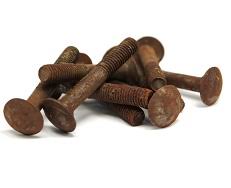
What are the two conditions that caused iron to rust ?
Air and Oxygen
Oxygen and Water
Water and Carbon dioxide
Carbon dioxide and Air
Rust is also known as
hydrated iron
iron oxide
copper carbonate
hydrated iron oxide
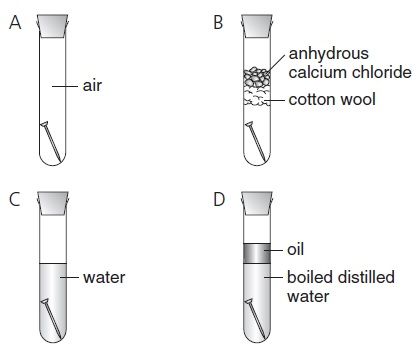
Which diagram shows the most favourable conditions for rust to appear on the nail?
A
B
C
D
To protect iron against corrosion, the most durable metal plating on it, is:
Zinc plating
Nickel plating

