
 Worksheets
RAD 156 Exam 1 Review
Total questions: 45
Worksheet time: 45mins
Electric currents passing through wires will produce a(n)
solenoid
magnet
magnetic field
insulator
Which of the following is not a subatomic particle that makes up an atom?
neutron
proton
nucleon
electron
Protons have a ____________ charge.
negative
neutral
positive
A charged atom is called a(n) __________.
proton
neutron
electron
ion
A current is produced when _______________ flow in a circuit.
protons
neutrons
electrons
nucleons
What happens when an electric current flows through a wire?
The wire begins to spin.
Nothing happens.
A field of gravity is created around the wire.
A magnetic field is created around the wire.
Electric current is measured in ____________.
Newtons (N)
Amperes (A)
Hertz (Hz)
The south ends of two magnets will _________ each other.
repel
attract
Opposite charges do what?
Attract
Repel
Determine how the following factor would affect the amount of resistance: longer wire
increase resistance
decrease resistance
would not affect resistance
Determine how the following factor would affect the amount of resistance: cooler temperature
increase resistance
decrease resistance
would not affect resistance
Determine how the following factor would affect the amount of resistance: insulating material
increase resistance
decrease resistance
would not affect resistance

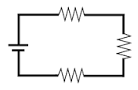
What type of circuit is this?
Series
Parallel
Simple
Materials that electrons do NOT flow through such as cloth, rubber, plastic
conductors
insulators
chargers
electrodes
Materials through which electrons flow easily
conductors
insulators
electrodes
chargers


The unit of energy is?
Amp
Joule
kiloWatt
Volt
A kilowatt (kW) is how many watts?
10
50
100
1000
Calculate the voltage applied when a 60 watt light-bulb uses a current of 5 amps
300 volts
30 volts
12 volts
0.08 volts
How much voltage would be necessary to generate 10 amps of current in a circuit that has 5 ohms of resistance?
(a)
What is the equation we can use to find a value for power?
E=mc2
V=IR
Q=It
P=VI
What is matter?
(a)
The unit of measure for electric potential is:
A
V
R
P
The removal of electrons from an object by rubbing it with another is electrification by
contact.
friction.
induction.
grounding.
Which of the following conditions or environments will provide the least resistance?
glass material
long conductor
large cross-sectional area
high temperature of conductor
Which of the following is Coulomb’s law?
Like charges repel, unlike charges attract.
Electrostatic force between charges is directly proportional to product of quantities and inversely proportional to square of distance between them.
Electric charges reside only on the external surface of conductors.
Only positive charges can move in solid conductors.
The intensity of a source is 25 R at 40 inches. What will the intensity be at 20 inches?
6.25 R
62.5 R
100 R
1000 R
Which of the following members of the electromagnetic spectrum has the ability to ionize matter?
Radiowaves
X-rays
Microwaves
Visible Light
As the frequency of electromagnetic radiation decreases, wavelength will:
increase.
decrease.
remain the same.

What is the atomic number of this atom?
2
4
6
8

What was J. J. Thomson's contribution to the atomic theory?
Discovered the electron
Discovered the nucleus -did the gold foil experiment
Created a model of the atom with electrons moving around the nucleus in fixed orbits
Discovered the neutron

