
Font size
 Worksheets
EOC Post practice
Total questions: 71
Worksheet time: 38mins

In the classroom demonstration below, a rubber ball is dropped from Position 1. The ball bounces as shown. At which of these positions does the ball have both the greatest kinetic energy and the least potential energy
1
2
3
4

Four students were asked to classify the activities of the people in the picture below as examples of either potential or kinetic energy. Which student correctly classified the activities?


Watch as Blake begins to run. What happens to the sheets of paper under his feet? Why? Which of Newton's Laws does this represent?
Newton's 1st Law, inertia
Newton's 2nd Law, Force = m x a
Newton's 3rd Law, action/reaction
The sum of all of the forces acting on an object is known as the (a) force.
When forces are acting in the same direction they should be added together.
True
False
Forces that are acting in opposite directions should be subtracted from each other.
True
False

On the Moon, an astronaut jumps a farther distance with more speed than he would on Earth while exerting the same amount of force. Why did the astronaut jump this way on the Moon as compared to on Earth?
The force of gravity on Earth is less than the force of gravity on the Moon, causing the astronaut’s net downward force to be greater on Earth.
The force of gravity on the Moon is greater than the force of gravity on Earth, causing the astronaut’s net downward force to be greater on the Moon.
The force of gravity on the Moon is less than the force of gravity on Earth, causing the astronaut’s net upward force to be greater on the Moon.
The force of gravity on Earth is greater than the force of gravity on the Moon, causing the astronaut’s net upward force to be greater on Earth.

The net force acting on the object is acting _____.
to the right
to the left
up
down

The net force (Fnet) acting on the object is (a) N.

During a lab investigation, students added four 50 g masses to two boxes and arranged the boxes so that they were motionless on a pulley, as shown in the diagram. The students then followed the procedure described in the box. The students recorded their observations after each procedure and reset the pulley system to the original conditions. During which procedures did students observe an unbalanced upward force on Box 1?
1,2,3
4and 5
3 and 4
1,3,5

A student graphed the position of a cart during a 7-second time interval. Which statement best describes the cart?
The cart was stationary with a velocity of 0 m/s for the entire 7 seconds.
The cart was stationary except for a short burst of acceleration of 0.5 m/s2
The cart moved at a constant velocity of 0.5 m/s for the entire 7 seconds.
The cart accelerated at a constant rate of approximately 0.8 m/s2
Observe what happens to the motion of the penny. Which of Newton's Laws does this represent?
Newton's 1st Law, inertia
Newton's 2nd Law, Force = m x a
Newton's 3rd Law, action/reaction
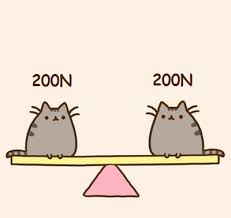
What is the net FORCE?
(a)

What is a force?
the PUSH or PULL on an object
The MOTION an object creates
The objects HITTING one another
Going REALLY FAST
A teacher rubbed a match against a piece of sandpaper. The match started to burn. Which statement best describes the energy changes that occurred?
The chemical energy stored in the match changed to thermal and light energy.
The thermal energy stored in the match changed to light energy and chemical energy.
The light energy and thermal energy stored in the match changed to mechanical energy.
The light energy and thermal energy stored in the match changed to chemical energy.


The diagram below shows a boat moving north in a river at 3 m/s while the current in the river moves south at 1 m/s. How will the boat be affected if it enters a part of the river where the current is moving south at 2 m/s?
The boat will move slower.
The boat will move faster.
The boat will stop.
The boat will move to the west.

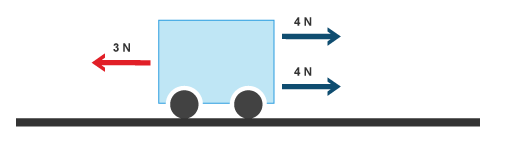
What is the NET FORCE and DIRECTION (of net force)?
4 N to LEFT
4 N to RIGHT
0 N to LEFT
4 N

What is the NET FORCE and DIRECTION (of net force)?
4 N to LEFT
4 N to RIGHT
0 N
0 N to RIGHT

Two students are working together to build a birdhouse. Student 1 applies a force of 10 N to a wooden board in order to slide it across the table to Student 2. If the force of friction resisting the student’s push is 4 N, what is the net force acting on the board?
4N
6N
10N
14N

What is the NET FORCE and DIRECTION (of net force)?
4 N to LEFT
4 N to RIGHT
0 N
0 N to RIGHT

What is the NET FORCE and DIRECTION (of net force)?
3 N to LEFT
3 N
0 N
3 N to RIGHT
What is the difference between the velocity and the speed of an object?
Velocity is the change in distance over time, while speed is the change in velocity over time.
Velocity has a direction associated with it, while speed has no specific direction.
Velocity has no direction associated with it, while speed has a specific direction.
Velocity is the change in speed over time, while speed is the change in distance over time.
Watch as Blake pushes the 2 cars of different masses with about the same force. Observe what happens. Which of Newton's Laws does this represent?
Newton's 1st Law, inertia
Newton's 2nd Law, Force = m x a
Newton's 3rd Law, action/reaction

What is the NET FORCE and DIRECTION (of net force)?
5 N to LEFT
7 N
2 N to RIGHT
5 N to RIGHT

The graph below shows the motion of a ball rolling on a straight track. What was the ball’s average speed during the time represented in the graph?
0.2 m/s
0.5 m/s
5.0 m/s
10.0 m/s

What is the NET FORCE and DIRECTION (of net force)?
1 N to LEFT
5 N to LEFT
1 N to RIGHT
4 N to RIGHT

Forces that have a net force of zero Newtons
Balanced force
Unbalanced force
A soccer ball is sitting in the middle of a field. The ball will remain at rest until an outside force like a players foot or the wind acts upon it. Which of Newton's laws is represented by this?
1st
2nd
3rd
Think about pushing a shopping cart and a car. If you apply the same amount of force to both, the shopping cart will travel fast, but the car will hardly move. To move the car yo would need a larger force. Which of Newton's laws is being represented?
1st
2nd
3rd
Sally jumps on her trampoline. She exerts a force on the trampoline and the trampoline exerts an equal but opposite force back on Sally. This represents
Law 1
Law 3
Law 2

What Newtons law does this picture represent
Newtons 1st law
Newtons 2nd law
Newtons 3rdt law
Newtons 4rth law

Which law explains that it would take more force to push the car than the lawnmower?
1st
2nd
3rd
Watch as I propel the washers across the desk. Observe what happens as I use different amounts of force.
Newton's 1st Law, inertia
Newton's 2nd Law, Force = m x a
Newton's 3rd Law, action/reaction
There is a skateboard rolling and then Billy steps on it and it stops. What Law of motion is this?
3rd
2nd
1st
When you are running. your foot exerts force on the ground and the ground exerts force back onto you. Which of Newton's laws is represented
1st
2nd
3rd

If we put the same force on a bowling ball and a soccer ball, the soccer ball will move faster! Which law explains this?
1st
2nd
3rd

Which way would a swimmer push to move forward in the water?
To the left
Forward
Backward

The reason a ball bounces up when it hits the ground:
The ball and ground repel each other.
The ball exerts a force on the ground, and the ground exerts a force on the ball.

For an investigation, a student measures the speed of a cart as it rolls down a ramp. The student then records data in the table below.
Which of these best explains the student’s data?
The speed of the cart decreases as the cart rolls down the ramp because of friction between the cart and the ramp
The speed of the cart increases as the cart rolls down the ramp because the force acting on the cart is greater than the force of gravity.
The speed of the cart increases as the cart rolls down the ramp because the forces acting on the cart are unbalanced.
The speed of the cart decreases as the cart rolls down the ramp because the forces acting on the cart are balanced.

The main parts of a working clothes dryer are shown in the diagram. This appliance dries clothes primarily by converting —
Electrical energy to heat and mechanical energy
Mechanical energy to heat and electrical energy
Electrical energy to heat and light
Mechanical energy to heat and vaporization
Which of Newton’s Laws explains a rocket’s movement during launch?
Newton's First Law of Motion
Newton's Second Law of Motion
Newton's Third Law of Motion
Newton's Fourth Law of Motion
Watch as I send the car down the track. What happens as I increase the force that I am using? Which of Newton's Laws does this represent?
Newton's 1st Law, inertia
Newton's 2nd Law, Force = m x a
Newton's 3rd Law, action/reaction
Because of inertia, a resting object ________.
will remain at rest
will move at a constant speed
will eventually move
is unbalanced

The diagram shows a homemade car being pushed with a force of 25 Newtons. The force causes the car to move at a constant speed of 3 m/s. What will happen if the force is changed to 35 N?
The speed of the car will increase.
The car will move at a constant speed of 13 m/s.
The speed of the car will not change.
The speed of the car will decrease to 1 m/s.
The first law of motion states that objects in motion will:
stop
accelerate
stay in motion
rest
The first law of motion states that objects at rest will stay at rest unless acted upon by an unbalanced:
motion
force
inertia
acceleration
Newton's second law of motion states that an unbalanced force is equal to mass times:
acceleration
force
motion
inertia
As more unbalanced force is applied to an object, its acceleration:
stays the same
decreases
increases
Newton's third law of motion states that for every action there is:
an opposite, but equal reaction.
an opposite and equal reaction.
a reaction.
Friction and air resistance are forces that:
can make an object slow down or stop
pulls an object toward the center of Earth
changes an object's position
can't be described
A force is:
a push
a pull
both
neither

Which law is this picture illustrating?
Law 1
Law 2
Law 3
A book sitting on the table does not move.
Law 1
Law 2
Law 3
A 20 kg bike accelerates at 10 m/s2. What was the force?
25 Newtons
20 Newtons
200 Newtons
10 Newtons

This car is turning, but there’s a puddle of water in the road. Which diagram best shows how the puddle will affect the path of the car after it hits the puddle?


A bus travels 20 km in 30 minutes. What is the average speed of the bus?
20 km/h
30 km/h
40 km/h
50 km/h
Which of the following statements is false?
Friction can only slow things down
Friction is never useful
Friction can stop things from moving
Observe the motion of the washer as I quickly pull the card out from under it. What happened to the washer? Why? Which of Newton's Laws does this represent?
Newton's 1st Law, inertia
Newton's 2nd Law, Force = m x a
Newton's 3rd Law, action/reaction

