Worksheets
22-23 Biology Check in Evolution
Total questions: 40
Worksheet time: 51mins
Niles Eldredge and Stephen Jay Gould researched the lenses of the eyes of fossil trilobites of
different species. In 1972 they published a paper in which they described the tendency of a
species to remain the same until a sudden change in the environment causes a new related
species to appear.
Which hypothesis was most challenged by the work of Eldredge and Gould?
Redi’s hypothesis that spontaneous generation does not occur
Haeckel’s hypothesis that embryological development mimics the evolution of species
Wallace’s hypothesis that geography affects the distribution of species
Darwin’s hypothesis that the development of species is a slow, gradual process

The diagram shows light- and dark-colored beetles that live on a tree.Which result is most likely to occur to the beetle population due to predation over time?
The number of light-colored beetles in the population will increase.
There will be more dark-colored beetles than light-colored beetles.
The number of light-colored beetles will decrease.
The dark-colored beetles will move to a different type of tree.
The gray squirrel, Eastern fox squirrel, and red squirrel are all different species of squirrels.
Why is having a scientific name for each species of an organism important?
To prevent existing named organisms from having their names changed as they become
extinct
To keep the classification system from being altered as new organisms are discovered
To allow organisms to be placed in many classification levels at the same time
To standardize the naming and organization of organisms to avoid confusion

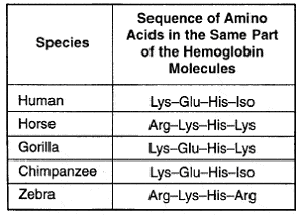
Scientists can determine relatedness among organisms by comparing partial amino acid
sequences. The table shows four partial amino acid sequences from four organisms.Which organism is the LEAST related to the other three organisms?
Organism 1
Organism 2
Organism 3
Organism 4

A prey population consists of individuals with a variety of running speeds. The adaptation that allows some of these animals to run fast would be an example of natural selection if it helps them —
survive and undergo mutations in their DNA
lower the mortality rates of the population
produce offspring that run at average speeds
reproduce and increase the frequency of their genes in the population
Bactrian camels, dromedaries, llamas, and alpacas are all members of the same taxonomic family, Camelidae. Members of this family all have two toes, no hooves, true canine teeth, and a split upper lip. The family Camelidae originated in North America. The physical features of animals in this family and the family’s geographical origin provide evidence that all these animals —
live in the same type of ecosystem
have slowly evolved to become herbivores
have a common ancestor
exchanged DNA at some point in the past
Arthropods are joint-legged animals. Spiders, crabs, pill bugs, centipedes, and millipedes
are examples of the many types of arthropods. Which of these arthropods are most closely
related?
Arthropods of the same family
Arthropods of the same class
Arthropods of the same genus
Arthropods of the same species

Scientists estimate that there are more than 20,000 species of ants. The species range in size from 1 mm long to 38 mm long and live in most environments. The diets of ants range from flowers and seeds to fluids from their own larvae. Ants have been able to successfully inhabit so many different environments because their populations have been able to --
hybridize with other species of insects
adapt to a variety of habitats and food sources
fill niches usually occupied by mammals
occupy habitats that have no other life-forms

Two populations of mice living in the same forest are separated by a large water-filled ditch. After a rainstorm, flooding brings several mice from one population to the other population. When the mice from the first population reproduce with members of the second population, which of the following will likely occur?
All of the offspring will die as a result of reproductive mutations.
The offspring will be forced to leave the second population.
The offspring will be genetically identical to their parent from the first population.
The offspring in the second population will have greater genetic variety.

Organisms are classified today using the Linnaean system, and the following table shows the taxonomic classification of two marine organisms living along the Pacific Coast.
Taxonomic classification is important to marine biologists because it provides a way to -
prove that marine evolution occurs
discover and name every marine organism on Earth
designate Latin as the universal language of marine biology
identify marine organisms and find evolutionary relationships between them
He was able to develop three theories which include Theory of Need, Theory of Use and Disuse and Theory of acquired characteristics.
Albert Einstein
Jean Baptiste de Lamarck
Charles Darwin
This revolutionary pattern selects organisms that will or will not survive based on their existing traits. Organisms with favorable traits are those that are best suited to the environment and have a better chance of survival.
Natural Selection
Genetic Drift
Speciation
One of the biggest ways that a species evolves is because some organisms with some traits survive
and reproduce better than others. This process is known as
natural selection
convergent evolution
coevolution
sexual selection
Genes for traits that help an organism be more successful reproductively can be
expected to
cause it to evolve into a new species.
become more common in the future.
cause the extinction of the species
eventually be eliminated by natural selection.
An adaptation is
any trait an organism possesses.
how an organism evolves during its own lifetime.
a gene an organism has
a trait that helps an organism survive in its environment.


5) The defenses of two flightless birds that live in different habitats are shown.
How do the wings of the Gentoo penguin and the legs of the common ostrich provide an advantage in their habitat?
Allows them to find prey
Allows them to escape from predators
Allows them to control their body temperature
Allows them to be camouflaged in their environments
Who proposed the Theory of Evolution through Natural Selection in 1859?
Stephen Jay Gould
Charles Darwin
Niles Eldridge
Isacc Newton
a predessor that an organism shares with another organism
homology
common ancestor
mutation
fossil
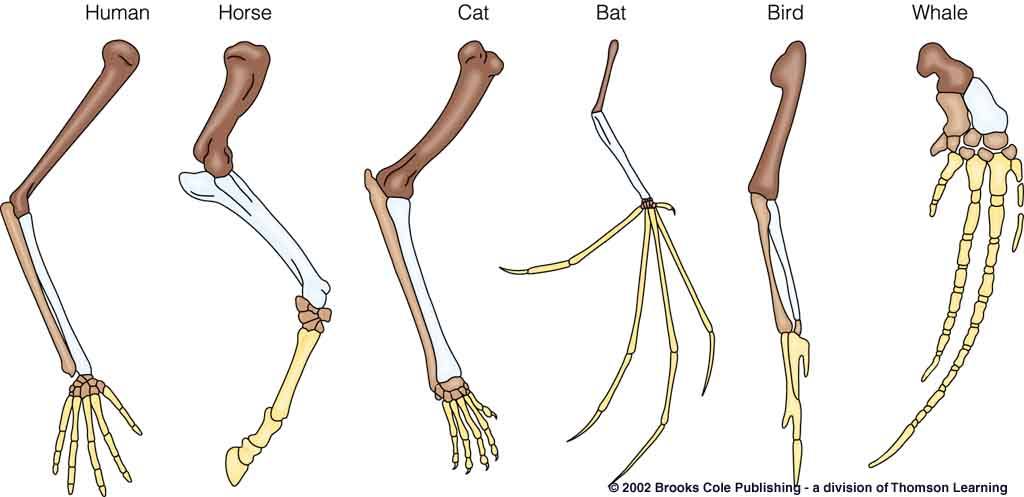
comparing bone structure is a
fossil record
anatomical homology
developmental homology
molecular homology
species that show similar embryonic development
fossil record
anatomical homology
developmental homology
molecular homology
comparing the molecules, specifically DNA or amino acid sequence, to show how closely they are related
fossil record
anatomical homology
developmental homology
molecular homology
structures that organisms no longer need in order to survive
homologies
vestigial structures
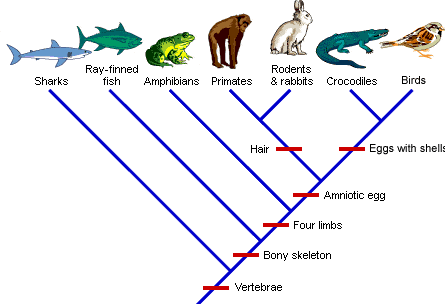
cladogram
analogous structures
Which of the following are types of homologies we discussed?
common ancestor
anatomical homologies
developmental homologies
molecular homologies
Which pattern of evolution occurs gradually?
biogeography
stasis
punctuated equilibrium
gradualism
Which pattern of evolution shows new species appearing suddenly?
biogeography
stasis
punctuated equilibrium
gradualism
study of past and present geographical regions of the distribution of species
biogeography
analogous structures
continental drift
natural selection
Survival of the fittest
natural selection
biogeography
homologies
stasis