
 Worksheets
Unit 1+2 Review
Total questions: 97
Worksheet time: 2hrs 51mins
A property of a substance that is observed when the substance undergoes a change in identity is known as
a physical property
a chemical property
a mixture
A property of a substance that can be observed without the substance changing identity is known as
a physical property
a chemical property
a mixture

A box has a mass of 10 kg and a volume of 2 m3. What is the box’s density?
5 oz/mi
0.2 kg/m3
5 km/m3
0.2 oz/mi
Which of the following is NOT a physical property?
Rust
Color
Magnetic
Texture
Which two factors make up density?
weight and volume
size and weight
mass and size
mass and volume

A student collected thermal data for acetic acid (CH3CO2H) and water (H2O) and graphed the heating curves for the two substances. Which comparison can be made about a phase change common to acetic acid and water based on the graph?
(Think about water's state of matter)
More heat energy is required to melt a gram of acetic acid than to melt a gram of water.
More heat energy is required to vaporize a gram of water than to vaporize a gram of acetic acid.
Given the same rate of added heat, the temperature of a gram of water will increase at a faster rate than a gram of acetic acid.

The illustration shows the lab equipment set up by a student to find the melting and freezing points for naphthalene, a chemical used as an insect repellent.
A small sample of solid naphthalene (C10H8) is placed in the capillary tube attached to the thermometer and is heated in the water bath until the white solid melts. The student then turns the heat off and observes the sample as it cools, recording the temperature at regular intervals. What happens to the particles in naphthalene as it cools?
the kinetic energy of the particles remains the same
the kinetic energy of the particles increases
the kinetic energy of the particles decreases

During which period of time is the substance completely in the liquid phase?
B-C
C-D
A-B and B-C

A student is shown a model of the particles that make-up a liquid.
How should the model be changed to show the particles of a solid?
Increase the speed of the particles, and decrease the space between the particles
Decrease the speed of the particles, and increase the space between the particles
Decrease the speed of the particles, and decrease the space between the particles

Consider the four phases of matter. How is a liquid different than a solid?
the particles are farther apart
energy has decreased
molecules begin to vibrate
Which of the following best describes the particles of a solid?
The particles are far apart and moving slowly.
The particles are closely packed and vibrate in place.
The particles are far apart and moving fast.

What is the boiling point of the substance?
150 degrees
90 degrees
50 degrees

What is the freezing point of this substance?
150 degrees
200 degrees
90 degrees

What happens to temperature and thermal (heat) energy during a phase change (ex: freezing)?
The potential (thermal) energy changes, but the temperature remains constant.
The temperature changes, but the potential (thermal) energy remains constant.
Both the potential (thermal) energy and temperature remain constant.
An element is heated to a temperature high enough to raise the kinetic energy of the molecules to a level where all of the molecules completely break free of the binding forces holding them together. What term is used to describe that temperature?
melting point
boiling point
decomposition
freezing point
How many significant figures are in 127.500?
(a)
How many significant figures are in 670?
(a)
How many significant figures are in 300900?
(a)
How many significant figures are in 1200?
(a)
How many significant figures are in 0.0730?
(a)
Give the answer to the correct number of significant figures to
3.419 + 3.912 + 7.0518 + 0.00013
14.383
14.382
14.3829
14.38293
Give the answer to the correct number of significant figures to
145.63 - 28.9
116.73
116.7
116.70
117
Give the answer to the correct number of significant figures to
17.3 x 6.2
(a)
Give the answer to the correct number of significant figures to
247.89 ÷ 43.5
5.70
5.7
5.699
5.69
Matter can be classified in:
Mixtures and Compounds
Substances and Elements
Mixtures and Substances
Elements and compounds
Substances are classified in Elements and (a)
NH3 is a:
Mixture
Element
Compound
Particle
Mixtures are divided in homogeneous and (a)
Water and sugar dissolved is an example of:
Compound
Homogeneous mixture
Substance
Heterogeneous mixture
A chocolate chip cookie is an example of:
Substance
Compound
Homogeneous mixture
Heterogeneous mixture
What mixture is an heterogeneous mixture?
Soluble coffee in water
Sand and water
Perfume
Apple juice
The mixtures where the components can be distinguished at simple sight
Homogeneous
Heterogeneous
Homogeneous and heterogeneous
None
Filtration can be used to separate...
an insoluble solid from a solution
a soluble solid from a solution
a dissolved solid from a solution
Combination of multiple substances is a...
pure substance
mixture
colloid
suspension
The liquid that condenses during distillation is called the
residue
filtrate
distillate
suspension
The change of a liquid to a gas to remove solvent and collect solute is called
Decantation
Filtration
Evaporation
Centrifuge

what type of mixture can be separated using the arrangement shown?
salt dissolved in water
ink components
saw dust and iron fillings
sand mixed with water
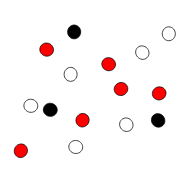


Which one of the following does not have an indicator for chemical change?
Two clear liquids form precipitate after mixing
The milk smells when you leave it out of the refrigerator
Fireworks explode with different shapes and colors
Prepare a cold Kool-Aid in a hot summer day.

1.Particles cannot change position in a ________
solid state
liquid state
gas state
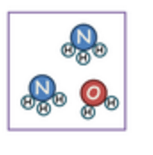
A marshmallow is toasted over a campfire is;
Physical Change
Chemical Change
A classification of matter that is made up on only 1 type of particle is called
a heterogeneous mixture
a pure substance
a homogeneous mixture
a blender
In identifying a sample of a pure substance, which may be its chemical property?
Its mass is 26.87 g
It melts when heated
It burns in air
It is a good heat conductor
What is the unit for density ?
g/ mL
g
cm3g
cm4

Which box has a higher density?
A
B
They both have the same density.
If a block of wood has a density of 0.6 g/cm3 and a mass of 120 g, what is its volume?
300 cm3
200 cm3
100 mL
150 cm3
Find the density of a 2 cm x 2 cm x 2 cm cube with a mass of 64 g.
(Hint: find the volume first!)
13 g/cm3
2 g/cm3
10 g/cm3
8 g/cm3
263.5 g/cm3
2.804 g

TRUE or FALSE: In order to change the state of matter, you need increase or decrease the energy (heat).
TRUE
FALSE

TRUE or FALSE: The particles in solids move around a lot and spread out.
TRUE
FALSE

TRUE or FALSE: Liquids have a fixed volume but not a fixed shape.
TRUE
FALSE

TRUE or FALSE: Gases have the least kinetic energy out all 3 states of matter.
TRUE
FALSE

Phase change from liquid to gas is called:
Freezing
Condensation
Vaporization
Sublimation
Phase change from solid to gas is called:
Freezing
Condensation
Vaporization
Sublimation
Phase change from gas to liquid is called:
Melting
Freezing
Deposition
Condensation
Phase change from liquid to solid is called:
Melting
Freezing
Deposition
Condensation

When changing a substance from liquid to solid, the energy has to...
INCREASE
DECREASE
When changing a substance from gas to liquid, the energy has to...
INCREASE
DECREASE

Which of the following statements is NOT true about gases?
Gases do not have fixed shape or volume
Gas particles do not move much, but vibrate
Gas particles have a lot of free space
Unlike solids, gases can be compressed

Which of the following statements is true about liquids?
Particles do not move around much, but vibrate
Particles have a lot of free space and spread out
Liquids have fixed shape & volume
Particles are less closely packed than solids

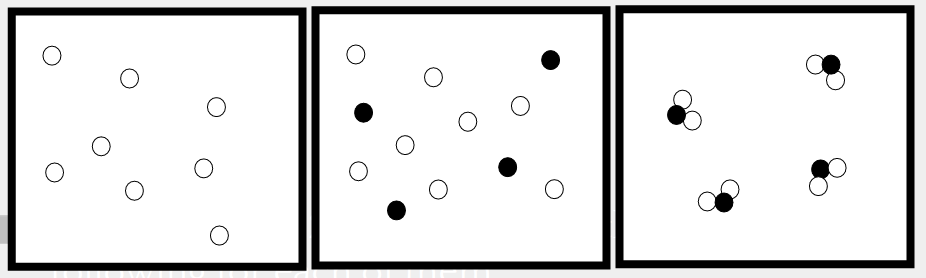
Look at the picture. Which state of matter is in beaker A?
Solid
Liquid
Gas
Blue thingys

Which of the following statements is true about solids?
Particles do not move around much, but vibrate
Particles have a lot of free space and spread out
Solids have fixed shape but not volume.
Particles are less closely packed than gas.
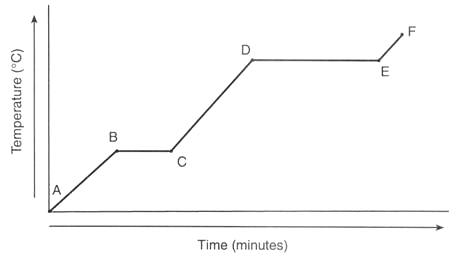
Are the particles moving faster or slower as time goes on?
Faster
Slower

The melting point of the sample is
-60 ºC
-100 ºC
60 ºC
100 ºC

Given the heating curve of a solid being heated at a constant rate, what is the boiling point of this substance?
20°C
50°C
110°C
170°C

What term goes on the y-axis? (A)
Heat(Energy)
Temperature
Phase
Type of Matter
What phase of matter exists in part C of the graph?
Gas
Liquid
Solid
Plasma
What phase change occurs when you start at D and end at C?
Freezing
Melting
Condensing
Vaporization
On which parts of the graph does the temperature remain the same?
Between C and D
Between D and E
At C, D, or E
On both flat sections
What values represent standard temperature and pressure?
273K
83 atm
100K
1atm
273K
1atm
0K
1atm
What energy is stored and waiting to be used?
Kinetic Energy
Potential Energy
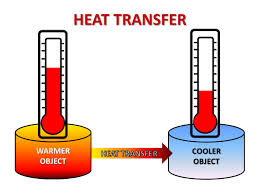
The law of conservation of energy states that
energy can be created or destroyed
energy cannot be created or destroyed
energy can be potential or kinetic only
heat energy is kinetic energy
What would likely happen if you were to touch the flask in which an exothermic reaction was occurring?
The flask would feel cooler
The flask would feel warmer
The flask would feel the same before and after a reaction
None of the above
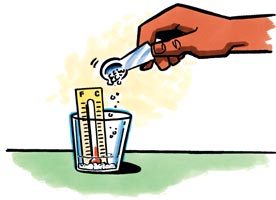

What instrument would you use to detect an endothermic or exothermic reaction?
triple beam balance
ruler
thermometer
A 15.75-g piece of iron absorbs 1086.75 joules of heat energy, and its temperature changes from 25°C to 175°C. Calculate the specific heat capacity of iron.
0.46 J/goC
1.654 J/goC
2,567,446.875 J/goC
How many joules of heat are needed to raise the temperature of 10.0 g of aluminum from 22.0°C to 55.0°C, if the specific heat of aluminum is 0.903 J/g°C?
298 Joules
0.003 Joules
297 J/g°C
0.003 J/g°C
A 300.0 g piece of copper is heated and fashioned into a bracelet. The amount of energy transferred by heat to the copper is 66,300 J. If the specific heat of copper is 0.3845 J/g 0C, what is the change of the copper's temperature? (INPUT THE NUMBER WITHOUT UNITS)
(a)

