
 Worksheets
Med Micro: NW1 Test
Total questions: 49
Worksheet time: 16mins
How many options should every branch in a dichotomous key have?
1
2
3
4

If you were to make a dichotomous key to identify this organism, which option would NOT be used?
Presence of webbed feet
Presence of tail
Fur on the body
Ability to swim
Absence of wings
Known as the Father of Microbiology due to his work with "animacules" found on his own teeth is:
Jonas Salk
Robert Koch
Semmelweiss
Anton Van Leeuwenhoek
The exponent for kilo is 10...
-3
3
6
-6
490,000 g = _______kg
490
49
4900
0.49
Which of the following is the correct prefix for 10-6?
milli-
nano-
mega-
micro-


Name this bacteria shape
cocci
bacilli
spirillium
Glycocalyx is a loose protein coat surrounding the prokaryotic cell which helps with either attachment or as a defense mechanism.
True
False
_____ types of proteins are fixed inside the cell membrane?
Peripheral protein
Integral protein
Both
None of the above
The movement of water molecules through a semi permeable membrane from an area of high water concentration to an area of lower water concentration.
Osmosis
Active transport
Co-transport
Counter-transport
Which of the following is true for Gram Positive bacteria?
Peptidoglycan layer is thin
Peptidoglycan layer is thick
No Peptidoglycan layer
Peptidoglycan layer is washed off
What are examples of passive transport
Simple diffusion
Exocytosis
Osmosis
Facilitated diffusion
Endocytosis

Looking at the picture, what type of solution are these cells in?
(a)

Looking at the picture, what type of solution are these cells in?
(a)

Looking at the picture, what type of solution are these cells in?
(a)
What is the job of the cell wall in bacteria?
To provide protection
To make protiens
To hold organelles in place
To hold water and nutrients
This is an area in a prokaryotic cell that contains a large, circular chromosome:
Chromosomal DNA
Capsule
Plasmid DNA
Nucleoid
Which bacterial cell wall contains lipopolysaccharide (LPS)?
Gram positive bacteria
Gram negative bacteria
Has Porin
Gram positive bacteria
Gram negative bacteria
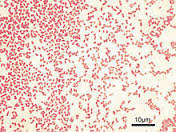


Which measurement is the largest?
nanometer
picometer
micrometer
milimeter
Which glycocalyx can prevent a bacteria from being recognized by a host?
Slimy Glycocalyx
Capsule Glycocalyx
Both types
Neither types
Bacteria exchange genetic information during
asexual reproduction
binary fission
conjugation using pili
photosynthesis
Which molecules CANNOT passively transport with diffusion?
Dissolved Oxygen
Dissolved Carbon Dioxide
Small Alcohols & Fatty Acids
Sodium Chloride
The structure that is used by bacteria for attachment
fimbriae
pilus
flagella
glycolayx
His "postulates" disproved the thought of spontaneous generation. He experimented with fruit flies in jars first.
Robert Koch
Joseph Lister
Edward Jenner
Anton Van Leeuwenhoek
What is Spontaneous Generation?
idea that organisms could come from non-living matter
the law that all living things come from nonliving things
living things come from living things
Non living things create all non living things
When is it OK to eat or drink at the lab tables?
Always
During group work, but not during lab activities
When you have teacher permission
During lab activities


Scientists create both scientific theories and scientific laws as they make observations and conduct experiments about the natural world. Which of the following statements most accurately compares the difference between scientific theories and scientific laws
science laws are based on evidence while science theories are not
science theories involve only biology, while laws involve all types of science
science theories involve mathematical equations, while science laws are based on observations
science theories are ideas that explain natural events, while science laws predict what will happen in a natural event.

