
 Worksheets
Unit 1 Review
Total questions: 132
Worksheet time: 3hrs 36mins
A description of what will always happen.
Hypothesis
Theory
Law
A well proven explanation of why something is happening for a set of observations.
Hypothesis
Theory
Law

When writing your hypothesis, what information follows IF?
dependent variable
how you know it will happen
independent variable
anything
When you do many trails during an experiment then it is called
Variables
Test
Repetition
For every experiments how many trails or repetitions usually scientist /we should do
3 to 5
no trials required
1 trial
More trails or repetitions of an experiment will make the results or conclusions more .........................
Accurate
False
Experimental
During replications others have to follow the same procedures to get the same output or results
True
False
When you replicate another scientists experiment, do you have to get the same answer?
Yes
No
It is how close a measurement is to the true or accepted value.
Accuracy
Precision
A set of data are all close to each other, and they are close to the actual value. This set of data can be described as...
Precise
Accurate
Both precise and accurate
An oceanographer checks the weather forecast the night before her trip so she knows what to wear on the boat. The TV forecaster says it will be between 26 and 31 degrees (°) Celsius (C) at noon the next day. The actual temperature reading the next day on the boat at noon is 28° C. This demonstrates ...
High accuracy
Low accuracy
Low precision
High precision
Neither accurate nor precise
When the oceanographer’s Global Positioning System (GPS) indicates that she is at the location of the underwater buoy, she anchors the boat and jumps in the water to collect the data logger. However, she can’t see the buoy. The other GPS units belonging to her colleagues on the boat also indicate that they are at the correct location. After an extensive search, the oceanographer finds the buoy 50 meters (m) from the boat. This demonstrates ...
High accuracy
Low accuracy
Low precision
High precision
Neither accurate nor precise

I use rulers, scales and calculators to make these observations.
Qualitative data
Quantitative data
The mass of the chocolate cake is 250 g.
Qualitative
Quantitative

What are observations made using our five senses called?
Qualitative data
Quantitative data
The ocean water looked bluish green.
Qualitative
Quantitative
The chimp identified 12 pictures correctly.
Qualitative
Quantitative
When another scientist does someone's experiment to see if the results are valid, it is called ___________.
Daniel and Alex are both scientists. Daniel conducts an experiment testing different fuel sources for cars in the future. Daniel conducts each test three times in order to compare his data. After he finishes the trials, Daniel showed Alex his results from each trial. Alex is confused about Daniel’s results, so he decides to conduct the experiment for himself. Which scientific process did each scientist use?
Alex and Daniel used each others data to compare their results.
Alex and Daniel used the same hypothesis to compare their results.
Daniel used repetition in his experiment while Alex replicated Daniel's experiment
Daniel used replication in his experiment while Alex used repetition to conduct Daniel's experiment.
What is the BEST reason you must always repeat an experiment?
Make sure your data is consistent and accurate.
Make sure your data supports your prediction.
Make sure your experiment is easy to do.
Make sure your experiment has lots of data.
Which statement is necessary in order for a scientific investigation to be valid?
The investigation must be able to be repeated by others.
The investigation must produce data that can be graphed.
The investigation must follow all the steps of the scientific method.
The investigation must have a conclusion that matches the prediction.
What is the benefit of another scientist replicating a science experiment?
increases the number of people who can see the research
Confirms the validity of the experiment and the research behind it
Increases profit for the scientists
Increases the opportunity for government funding for experiments
Cara read an article on why repetition and replication are so important, but she did not understand the difference between them. Which of the following best explains the two terms?
Repetition is when a scientist repeats an experiment; replication is when a scientist conducts an experiment on genetic material.
Repetition is when a scientist does the same experiment a number of times; replication is when other scientists reproduce a scientist’s experiment.
Repetition is when a scientist publishes in more than one scientific periodical; replication is when another scientist reproduces another scientist’s results
Repetition is when a scientist commits an error in an experiment the first time and must repeat it; replication is when a scientist repeats an experiment to make sure it is valid
Experiments are often repeated many times by the same or different scientists. What is the most important reason more than one scientist should conduct an investigation using the same methods?
If the results are the same, replication of the investigation helps to confirm the results.
The competition makes the scientists work more carefully.
More than one scientist is interested in the problem.
Different scientists might perform the experiment differently.
What is the BEST reason you always repeat an experiment?
Make sure your data is consistent and accurate
Make sure your experiment is easy to do
Make sure your data supports your prediction
Make sure your experiment has lots of data
Replication is when one scientist
copies another scientist's experiment.
laughs at another scientist's experiment.
clones another scientist.
repeats their own experiment several times.
Repetition is when one scientist
copies another scientist's experiment.
repeats their own experiment several times.
bumps into another scientists.
clones a T. rex.
Scientists repeat scientific studies to validate results
true
false
Anthony was given a set of 5 metal cubes. He calculated the densities of each to determine the type of metal in each. The densities were really close to each other, so he asked his friend Robert to do the same experiment and see if he gets the same results.
Repetition
Replication
Ryan is testing golf balls. He drops three different brands of balls from 40 cm and measures how high they bounce. He drops each ball 10 times.
Repetition
Replication
In what way is a scientific law different from a scientific theory?
A law describes a pattern between two or more variables, while a theory explains why something happens.
A law is true in all situations, while a theory is only true in some situations.
A law describes the major ideas of the universe, while theories are based on smaller ideas of the universe.
A law is based on testable facts and data, while a theory is just a combination of one or more hypotheses that still need to be tested.
Which of the following is true about theories and laws?
Laws and theories are created based on many observations and experiments.
Theories and laws cannot be altered or changed.
Theories become laws after experiments are successfully replicated.
Laws and theories are created based on the results of a single experiment.
Newton's 2nd Law of Motion states that the force acting upon an object is equal to the product of the object's mass and acceleration (F=ma). Which statement correctly explains why this is a law?
Laws are descriptions of how nature works, and theories are explanations of why a natural process happens.
Scientific theories that are not proven are accepted as laws.
Scientific laws are proven by experimentation and approved by scientists.
Theories are a descriptions of how nature works, and laws are explanations of why a natural process happens.
Which of the following is a characteristic of all scientific theories?
Theories explain why something happens.
Theories explain the order of events in history.
Theories never change.
Theories are always based on models.
Cell theory states that all living things are composed of cells and that cells are the basic unit of life. Why do scientists refer to it as cell theory instead of the cell hypothesis?
Centuries of observations and experiments verify the idea.
Since we haven't checked every organisms for cells, we cannot call it a hypothesis.
It explains what happens in cells, so it cannot be a hypothesis.
It is an idea accepted by more than just one scientist.
True or False? Scientific theories can be modified but scientific laws are unchangable.
False
True
True or False? Laws are generally modified as scientists discover specific conditions under which the law does not apply.
True
False
True or False? As scientific theories are modified with new evidence, they often tend to explain more natural events and being able to explain things in greater detail.
True
False
True or False? If a hypothesis is supported by data, it becomes a theory. If a theory is proven by all data, then it becomes a law.
False
True
When writing you hypothesis, what information follows IF?
dependent variable
how you know it will happen
independent variable
anything

When writing a hypothesis, what information do you fill in after THEN?
dependent variable
independent variable
how you know it will happen
anything good

Possible explanation for an observation that can be tested.
Hypothesis
Scientific Law
Scientific theory
Critical Thinking

Choose the correct hypothesis for "What effect does studying have on your test grade?"
IF I study for hours, THEN my test grade will be better.
IF I have a good test grade, THEN I will study.
Good grades are from studying.
What two words should be in your hypothesis?
I think
My guess
If... then
No idea
A hypothesis is never wrong.
True
False
Which of the following is NOT a rule when writing a hypothesis?
It is testable
It is an if/then statement
it should restate the question
It is a prediction.
In an experiment, the one variable that is changed is called the
dependent variable
independent variable
experimental variable
controlled variable
In an experiment, the factor that we measure is called the
independent variable
dependent variable
conclusion
controlled variable
A hypothesis has to have which two words? (Select two)
If
Think
Due
Then
What two words should be in your hypothesis?
I think
My guess
If... then
No idea
When writing your hypothesis, what information follows IF?
dependent variable
how you know it will happen
independent variable
anything
When writing a hypothesis, what information do you fill in after THEN?
dependent variable
independent variable
how you know it will happen
anything good
A description of what will always happen.
Hypothesis
Theory
Law
Widely accepted as true.
Hypothesis
Theory
Law
The cornerstone of scientific discovery.
Hypothesis
Theory
Law
A well proven explanation of why something is happening for a set of observations.
Hypothesis
Theory
Law
An explanation of how something happens.
Hypothesis
Theory
Law
Based on a single event or observation.
Hypothesis
Theory
Law
Based on proven hypotheses by many different scientists.
Hypothesis
Theory
Law
Can be created and tested by just one scientist.
Hypothesis
Theory
Law
Scientific inquiry, doing science, involves:
performing investigations
asking questions
collecting data
providing explanations
sleeping well and at regular periods

Scientists should share and communicate their results.
True
False
Science involves which of the following
Asking a question
Collecting Data (Evidence)
Providing Explanations
Making False Claims (Lying)
Science involves
Performing Investigations
Communicating Results
Hiding Data
Doing Nothing
Good scientific questions have
a narrow focus
looks at everything
addresses gaps in knowledge
May lead to a testable hypothesis
Which type of investigation has a scientific question?
Descriptive
Comparitive
Experimental
Which type of investigation has a hypothesis?
Descriptive
Comparitive
Experimental
Which type of investigation has variables?
Descriptive
Comparitive
Experimental
Which type of investigation has a control group?
Descriptive
Comparitive
Experimental
Which type of investigation has a procedure?
Descriptive
Comparitive
Experimental
Which type of investigation has a conclusion?
Descriptive
Comparitive
Experimental
This variable is the one thing that changed on purpose...
Dependent Variable
Control
Independent Variable
What are the constant variables?
what we are changing or testing
what we are observing or measuring
what we keep the same to make the experiment fair
The variable that is measured. It is the variable that is affected during the experiment.
Controlled Variable
Dependent Variable
Independent Variable
The one factor that a scientist changes during an experiment. (It affects the results of the experiment).
Controlled Variable
Dependent Variable
Independent Variable
A part of the experiment that does not receive the factor being tested and is used to compare results
control group
procedures
data
precision
What is important for science?
Curiosity
False Data
Closed Minded
No Process
These statements cannot be tested and are rather based on a belief, hunch, or gut feeling.
science
pseudoscience
These types of statements can be tested, replicated, and verified by other scientists.
science
pseudoscience
These statements consider ALL of the evidence available when drawing a conclusion.
science
pseudoscience
These statements may "cherry pick" evidence, or over-hype the facts.
science
pseudoscience
What is pseudoscience?
A set of beliefs whose conclusions and predictions that is NOT based on observation, objective reasoning, or scientific evidence.
A set of beliefs whose conclusions and predictions that is based on observation, objective reasoning, or scientific evidence.

Science is a discipline that involves systematic ____________ and ___________ of natural phenomena.
opinions
observations
beliefs
experiments

Good scientists do all of the following, EXCEPT:
Make observations
Ask critical questions
Give up when they don't get their expected results
Adjust failed attempts and keep trying

What is Science?
Collection of information supported by belief or opinion.
A way to find out what is wrong in this world.
An organized way of studying the natural world and finding solutions to common problems.
The way scientists make up general rules.
Science vs. Psuedoscience: which relies on a process?
Science
Psuedoscience
Science vs. Psuedoscience: which one is subjective (based on or influenced by personal feelings, tastes, or opinions.)?
Science
Psuedoscience
Science vs. Psuedoscience: which one is constantly updated and is not resistant to new information?
Science
Psuedoscience
What are the characteristics of a good scientist?
Curious
Observant
Creative
Skeptical
Angry
When another scientist does someone's experiment to see if the results are valid, it is called ___________.
I use rulers, scales and calculators to make these observations.
Qualitative data
Quantitative data
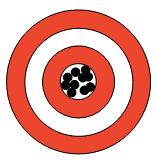
This bullseye demonstrates...
High Accuracy & High Precision
High Accuracy & Low Precision
Low Accuracy & High Precision
Low Accuracy & Low Precision
Scientific models can....
Make big things smaller
Make small things bigger
Make complex things simpler
Make simple things more complex

A globe is a kind of model because
It can spin
It makes a big system smaller
It is 3 dimensional
Which of the statements are INCORRECT about models.
Models must be exactly like what is being modeled.
Models communicate information.
Models can be modified and improved.
Models can be drawings with labels.
Models can be helpful in scientific investigations because
It may not be possible to work safely with the real thing.
They can be smaller and easier to study than the real thing.
They can help you notice patterns
Every scientist has to have a model

A science journal that publishes articles written by scientists and evaluated by other scientists before publishing (peer-reviewed) is considered
reliable
Why are reliable sources important when doing research?
So you can copy and paste it
So you can make sure the information is accurate to use.
Everything on the internet is written by an expert
100% True!!
Yea right! False!
Would this source be reliable or unreliable?
- domain is .edu or .gov
Reliable Source
Unreliable Source
A reliable source is....
Biased
Trustworthy
Which source would you expect to be more reliable?
Wikipedia.com
ilovehistory.com
USNationalArchives.gov
conspiracies.com
Choose the one that is most likely NOT a reliable source
Magazine
Book
Newspaper
Personal Website
a source that cannot be trusted
domain
reliable source
bias
unreliable source
Would this source be more reliable or more unreliable?
- information is up to date
- no typos
Reliable Source
Unreliable Source
Would this source be reliable or unreliable?
- does not list any sources
- does not list an author
Reliable Source
Unreliable Source
Would this source be reliable or unreliable?
- information is outdated
- has a lot of pop up advertisements (aka clickbait)
Reliable Source
Unreliable Source
What does reliable mean when referring to sources for your writing?
Something is credible, trustworthy, and objective.
Something is printed online by more than one site.
You can depend on that source to give you accurate opinions.
Why is using reliable sources important?
To clarify your understanding of the topic.
To find other people who think like you do.
So you can be sure you are providing the whole truth.
To prove that you're right and everyone who disagrees with you is wrong.
Identify which one measures the reliability of a source:
If the author is a well known blogger.
If the author is an expert on the topic.
If the article is published on Wikipedia.
If the author is unknown, but the publication is shared on social media a lot.
Which of the following is a good source for reliable information?
An article found online
Statistics presented in an election ad
A blog by your favorite influencer
A peer reviewed journal

Scientists use _________________ to visualize problems or ideas.
models
pickles
frogs
standards
_________________ is something that scientists use to represent an idea or explanation.
A question
A claim
A model
A theory
Which of these is not a model?
a hot wheels/match box car
a Princess Leia action figure
an eighteen-wheeler (semi-truck)
a diagram of the inner workings of a clock
A tennis ball could be used to represent the sun because it's round and yellow.
Which of the following could also be used to model the sun because they share similar characteristics?
a light bulb
an empty cup
an eraser
a Kleenex box
Which of the statements are INCORRECT about models.
Models must be exactly like what is being modeled.
Models communicate information.
Models can be modified and improved.
Models can be drawings with labels.
Models are used to better explain and understand a complex thing.
True
False
Which of these is not a model?


Is Facebook a reliable source to use when you research?
Yes
No

Wikipedia
Reliable source
Unreliable source

Merriam-Webster Dictionary
Reliable source
Unreliable source

Blogs
Reliable source
Unreliable source

Social Media
Reliable source
Unreliable source

Nonfiction books
Reliable source
Unreliable source

Newspaper
Reliable source
Unreliable source

