Wayground logo

Free Printable Worksheets

Font size

S
M
L
XL
Worksheets

Review Quizizz 1 for EOY

Total questions: 51

Worksheet time: 1hrs 6mins

Name
Class
Date
1.

I am ductile - I can be draw into wires

a)

Metals

b)

Nonmetals

c)

Metalloids

2.

I am a good conductor of electricity and/or heat

a)

Metals

b)

Nonmetals

c)

Metalloids

3.

I could be shiny OR dull

a)

Metals

b)

Nonmetals

c)

Metalloids

4.

I can be nonmalleable or malleable

a)

Metals

b)

Nonmetals

c)

Metalloids

5.

I am only dull

a)

Metals

b)

Nonmetals

c)

Metalloids

6.

I am a poor conductor of electricity and/or heat

a)

Metals

b)

Nonmetals

c)

Metalloids

7.

Provided is a list of five different substances.

NaOH     Cu    H2O     N2    H2

How many of these substances are elements?

a)

2

b)

3

c)

4

d)

5

8.

How many elements are in the compound Fe2O3?

a)

0

b)

1

c)

2

d)

3

9.

The smallest particle of matter

a)

Element

b)

Compound

c)

Atom

d)

Chemical

10.
Most of the elements on the periodic table are classified as _____.
a)
Metals
b)
Nonmetals
c)
Metalloids
d)
Periods
11.
These are found on the Periodic Table.
a)
Compounds
b)
Elements
c)
Mixtures
12.

Metals are found on the ______________ side of the periodic table.

a)

nonmetals

b)

left

c)

right

d)

metals

13.

This group of elements sit along a stair step line on the periodic table and have properties of both metals and nonmetals. _________________________

a)

luster

b)

metals

c)

nonmetals

d)

metalloids

14.
Each column in the periodic table is called a _________ .
a)
period
b)
group
c)
cluster
d)
unit
15.
Two elements chemically bonded form
a)
element
b)
compound
c)
mixture
d)
solutions
16.
Periods on the periodic table are __________.
a)
Horizontal Rows
b)
Vertical Columns
17.

The Atomic number is known as the _______

a)

Number of electrons in an atom

b)

Number of Protons in an atom

c)

Number of neutrons in an atom

d)

Number of Protons and electrons in an atom

18.

Which BEST describes the meaning of mass of an object?

a)

The amount of space an object or substance takes up

b)

Mass divided by volume

c)

The amount of matter in an object or substance

d)

The weight of an object only in solid form and in zero gravity

19.

Which of the following BEST describes volume?

a)

How much space an object takes up

b)

Where an object is in space

c)

How much an object weighs

d)

The mass of an object compared to its weight

20.

The formula for finding density is:

a)


The volume divided by the mass.

b)

The mass multiplied by the volume.

c)

The mass divided by the volume.

d)

The volume multiplied by the mass.

21.

You have a rock with a volume of 15cm3 and a mass of 45 g. What is its density? (a)   g/cm3

22.
What two types of measurements make up DENSITY? 
a)
Mass and Volume
b)
Temperature and Mass
c)
Grams and Centimeters
d)
Volume and Weight
23.
What is this tool to get mass?
a)
triple beam balance
b)
ruler
c)
thermometer
d)
graduate cylinder
24.
What is this tool to get volume?
a)
triple beam balance
b)
ruler
c)
thermometer
d)
graduate cylinder
25.
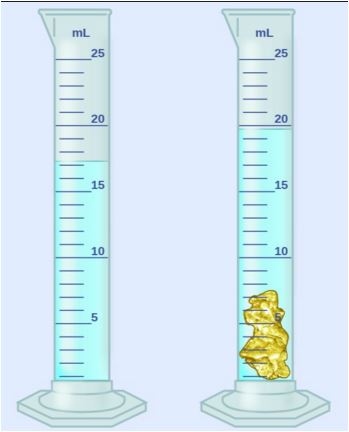
What is the volume of Object X?
a)
10.0 cm3
b)
15.0 cm3
c)
20.0 cm3
d)
25.0 cm3
26.

The unit for volume is

a)

grams

b)

milliliters (mL)

c)

Newton

d)

Centimeters Cubed

27.

What is the formula for Volume?

a)

Mass/Volume

b)

Density x Volume

c)

Mass/Density

d)

Volume/Mass

e)

Density/Mass

28.

What is the mass of a 100mL liquid if it has a density of 3 g/mL?

a)

300 g

b)

33.3 g

c)

.03 g

d)

103 mL

29.
Jack has a rock. The rock has a mass of 14g and a volume of 2cm3. What is the density of the rock?
a)
7 mL
b)
7 g/cm3
c)
28 g/cm3
d)
1/7 g/cm3
30.
a)

303.4 g

b)

370.4 g

c)

373.0 g

d)

373.4 g

31.

The particles in a solid are...

a)

loose and have high energy

b)

tightly packed and have very little energy

c)

move freely and have lots of energy

d)

I dont know Ms. Turner, I didnt take notes

32.

The particles in a liquid are...

a)

loose and have high energy

b)

tightly packed and have very little energy

c)

move freely and have lots of energy

d)

I dont know Ms. Turner, I didnt take notes

33.

The particles in a gas are...

a)

loose and have high energy

b)

tightly packed and have very little energy

c)

move freely and have lots of energy

d)

I dont know Ms. Turner, I didnt take notes

34.
Color, flexibility, texture and shape are examples of 
a)
physical properties
b)
solids 
c)
gases
d)
mixtures 
35.

sharpening a pencil

a)

physical change

b)

physical property

c)

chemical change

d)

chemical property

36.

flammability of a substance

a)

physical change

b)

physical property

c)

chemical change

d)

chemical property

37.

size of an object

a)

physical change

b)

physical property

c)

chemical change

d)

chemical property

38.

corrosion (rusting) of a bicycle frame

a)

physical change

b)

physical property

c)

chemical change

d)

chemical property

39.

fragrance of a flower

a)

physical change

b)

physical property

c)

chemical change

d)

chemical property

40.

a burning candle

a)

physical change

b)

physical property

c)

chemical change

d)

chemical property

41.
Look at this image.  Which object has the LOWEST density in water? How? 
a)
The Ping Pong Ball because it floats to the top 
b)
The bolt because it has sunk to the bottom
c)
The soda cap because it is not just full of air like the Ping Pong ball
42.
Jack has a rock. The rock has a mass of 14g and a volume of 2cm3. What is the density of the rock?
a)
7 mL
b)
7 g/cm3
c)
28 g/cm3
d)
1/7 g/cm3
43.
What is the formula for density?
a)
density = mass x volume
b)
density = mass / volume
c)
density = mass + volume
d)
density = mass - volume
44.
Calculate the density of the cube.
a)
2 g/cm3
b)
4 g/cm3
c)
6 g/cm3
d)
8 g/cm3
45.
An irregularly shaped piece of gold was lowered into a graduated cylinder holding a volume of water equal to 17 ml. The height of the water rose to 20 ml. If the mass of the gold was 27 g, what was its density?
a)
9 g/mL
b)
10.5 g/mL
c)
6.5 g/mL
d)
8 g/mL
46.
How much water has been displaced in the image shown?
a)
40 mL
b)
65 mL
c)
20 mL
d)
25 mL
47.
What is the volume of this prism?
a)
20 cubic feet
b)
8 cubic feet
c)
40 cubic feet
48.
What is the volume of this rectangular prism?
a)
60 cubic centimeters
b)
15 cubic centimeters
c)
20 cubic centimeters
d)
6 cubic centimeters
49.
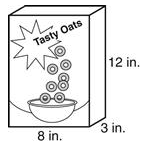
What is the volume of the cereal box?
a)
23 in3
b)
97 in3
c)
132 in3
d)
288 in3
50.

What is the volume of the solid object?

a)

100 mL

b)

125 mL

c)

225 mL

d)

250 mL

51.
If an object has a density of .6 g/mL and you put it into water, will it sink or float?  
a)
sink
b)
float