
 Worksheets
Earth's Changing Surface: Mountains, Landslides & Plate Boundarn
Total questions: 46
Worksheet time: 23mins
A homeowner in a mountain area removed all vegetation to reduce fire danger. What will happen if they receive heavy rainfall?
erosion
glaciers
avalanches
faulting
Which is a cause of chemical weathering?
lce
Wind
Oxygen
(oxidation)
Carbon
Which is a cause of PHYSICAL WEATHERING, but not chemical weathering?
salt
wind
acids
bases
Leaves release acids into the soil as they decay.
How could the decaying leaves affect the rocks in the soil underneath them?
They could increase the amount of physical weathering.
They could decrease the amount of physical weathering.
They could increase the amount of chemical weathering.
They could decrease the amount of chemical weathering.
A slowly moving mass or river of ice formed by the accumulation and compaction of snow on mountains or near the poles is a _________________
Lake
Ice cube
Glacier
Stream
A large deposit (deposition) of sediment that forms where a stream enters a large body of water like a lake or ocean
Ocean
Lake
Delta
Stream
Changes to materials that result in a new type of material(s)
Physical weathering
Chemical weathering
Abrasion
Earth's surface
Water enters cracks in rocks. When the temperature reaches 0 degrees Celsius the water freezes. Water expands as it freezes, and expansion widens the crack. Repeated freezing and thawing can break apart rocks. This weathering process is know as _______________
Abrasion
Ice Wedging
Chemical weathering
Plucking
The grinding away of rock or other surfaces as particles carried by wind, water, or ice scrape against them is known as _________
Abrasion
Ice wedging
Chemical weathering
oxidation
Physical weathering is also called __________
chemical weathering
abrasion
mechanical weathering
photosynthesis
A slowly moving mass or river of ice formed by the accumulation and compaction of snow on mountains or near the poles is a _________________
Lake
Ice cube
Glacier
Stream
Over __________ of years, the sea floor at the Mid-Atlantic Ridge will continue spreading. This will cause the area of the Atlantic Ocean to become a much __________ area than it is today.
thousands......larger
thousands....smaller
millions....larger
millions...smaller

The mid-Atlantic ridge is an area of the ocean floor that is experiencing sea-floor spreading. Where would the newest rock be located?
The middle of the diagram, where the plate boundaries are moving apart.
Furthest away from where the plate boundaries are moving apart.
Closest to the edges of the continents
All the rock will be the same age.
When tectonic plates are diverging (divergent; di = two), it means...
the plates are moving towards each other.
the plates are moving away from each other.
the plates are moving past each other.
the plates are not moving.
Which evidence could be the result from an asteroid impact on Earth's surface?
petrified trees that have tree rings showing several years of stunted growth
alternating layers of lava and volcanic ash erupted from a volcano
ice cores that show a gradual change in the carbon dioxide content of the atmosphere
fossils that show a steady rate of evolution in a certain type of organism.

Why do folded mountain belts sometimes form at convergent plate boundaries?
because subducted oceanic lithosphere melts and rises as magma to Earth's surface
because rock is compressed and forced upward
because convergent plate boundaries occur above hotspots
because the rock is stretched apart and breaks, which allows magma to rise to Earth's surface.
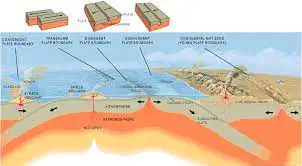
Where is volcanic activity most likely to be found?
at high elevations
near plate boundaries
along seashores
near magnetic poles
What is the most likely cause of jagged mountains becoming smoother over time?
deposition
weathering and erosion
movement of continents
collisions between continental plates
When tectonic plates are converging, it means...
the plates are moving towards each other.
the plates are moving away from each other.
the plates are moving past each other.
the plates are not moving.
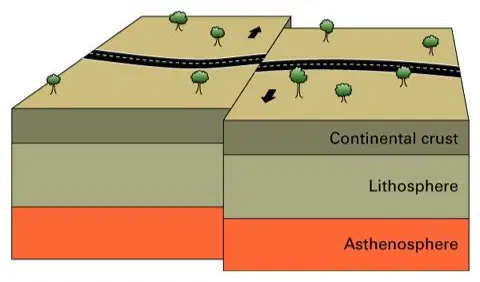
After an earthquake, a stream changes its course (pathway). What would most likely explain the movement of the streams?
The stream runs across a fault in a rift zone where two plates are diverging.
The stream runs across a transform fault that was offset by the earthquake.
The stream runs across a hotspot far from any tectonic plates.
The stream runs across a subduction zone where two plates are converging.

When a rock is placed under stress, it deforms or changes shape.
deformation
fold
fault
sheer stress
The pressure that is put on rocks when tectonic plates move.
fault
fold
stress
tension
The bending of rocks because of stress caused by the movement of tectonic plates.
folding
faulting
tension
compression

This is an example of a/an
anticline
syncline
A reverse fault is caused by?
shear stress
tension
compression
The stress that is formed when rocks are pushing in opposite direction at a transform boundary.
compression
tension
shear stress


When magma moves to the surface due to weathering
Normal faults are caused by?
shear stress
tension
compression

What are the four kinds of mountains?
Fault-Block, Folded, Volcanic &Towering
Folded, Fault-Block, Mechanic, and Volcanic
Folded, Volcanic, Fault-Block & Upwarped
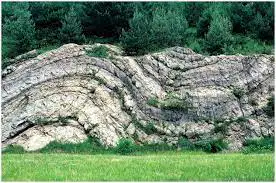


This is an example of a/an
anticline
syncline

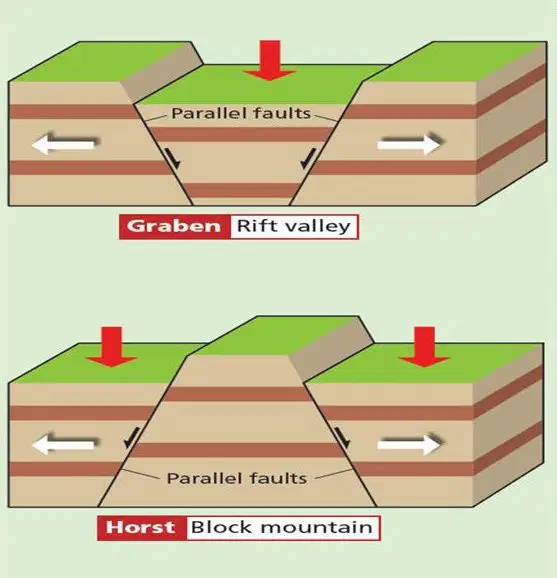
How do Fault-Block mountains form?
Tension pushes the blocks of lithosphere on top of each other.
Tension makes the lithosphere break into many pieces causing some to fall relative to others.
Shear stress makes the mountains break.
Compression makes the mountains rise up.
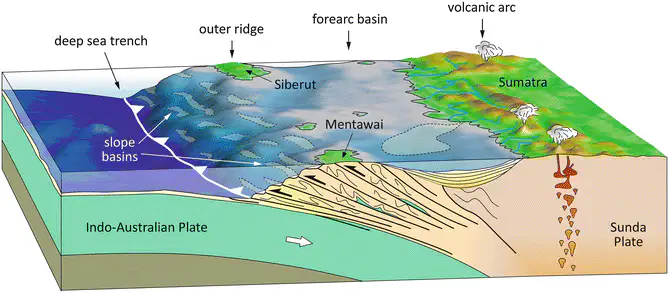
An accumulation of different sedimentary and metamorphic rocks combined with scraps of ocean crust are called
dome
volcanic island arc
accretionary wedge
fault-block mountain
Mud Flows



