
 Worksheets
HOMEWORK #14
Total questions: 62
Worksheet time: 47mins
Find the molar mass of CaCO3
68.1 g/mol
216.8 g/mol
100.1 g/mol
Find the molar masses of the following compounds:
Ca(OH)2
303.3 g/mole
102.9 g/mole
74.1 g/mole
160.0 g/mole
96.0 g/mole

Determine the number of moles of AlNO3 that are in 264 g of the compound.
2.97 mol
80 mol
0.337 mol
4.63 mol

Determine the amount of moles in CuBr that are in 276.9 g of the compound.
143.5
0.5182
1.930

Find the mass of 3.8 mol of H2O. Round to the nearest tenth.
18.0 g
68.4 g
4.7 g
Lewis number
Avocado's number
What is a mole?
6.022 x 10²³ particles of any substance
A small burrowing animal
A dark spot on your skin
A spy
An element's molar mass can be found on what part of an element's entry on the periodic table?
atomic number
atomic mass
group number
it can't be found on the periodic table
Which of these elements has the highest molar mass?
Hydrogen
Iron
Carbonate
Cobalt
6.02 x 10²³ _____.
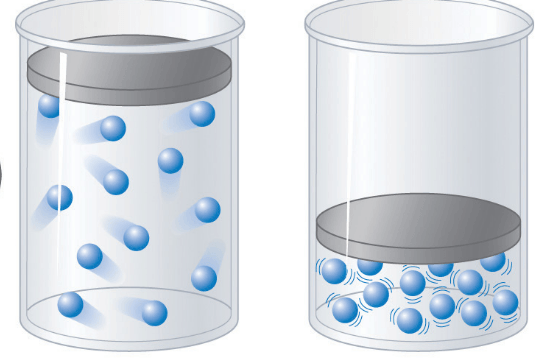
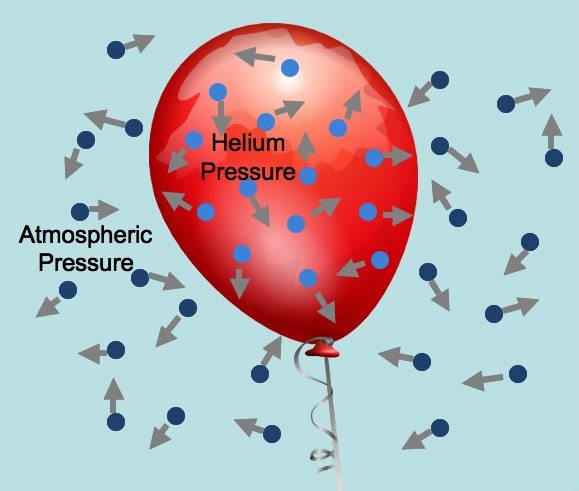
Ice is a good example of matter in what phase?
Solid
Liquid
Gas
Water vapor is an example of what phase of matter?
Solid
Liquid
Gas
What occurs when a liquid becomes a solid?
Freezing
Melting
What occurs when a gas becomes a liquid?
Melting
Condensation
What state of matter has its own shape and a definite volume?
Solid
Liquid
Gas
What state of matter takes the shape of its container and has a definite volume?
Solid
Liquid
Gas
What state of matter takes the shape of its container and doesn't have a definite volume?
Solid
Liquid
Gas
When ice cubes form, heat is
Added
Removed
When water vapor turns back into a liquid, heat is
Evaporated
Condensed
When liquid turns into a gas, heat is
Added
Removed
Anything that takes up space and has mass is
Matter
Mass
What happens when a liquid turns into a gas?
Condensation
Evaporation
What happens to water while it is boiling?
Condensation
Evaporation
Liquid to Gas
melting
vaporization
condensation
sublimation

Freezing
F
C
A
D
Melting
endothermic
exothermic
Gas to liquid
vaporization
melting
condensation
sublimation

Sublimation
A
B
C
F
Condensation
endothermic
exothermic
Solid to liquid
freezing
melting
sublimation
condensation

Vaporization
B
E
D
F
Freezing
endothermic
exothermic

Deposition
A
C
B
F

Under what temperature and pressure conditions does a gas behave the most like and ideal gas? (Choose all that apply.)
high pressure (above 1 atm)
low temperature (below 273 K)
standard temperature
(273 K)
standard pressure (1 atm)
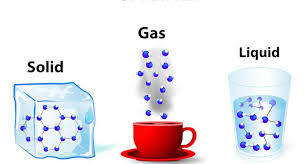

What is one assumption that must be made for the kinetic molecular theory to be applied to gases?
Collisions between gas particles are elastic.
Gases consist of closely spaced particles.
Gas particles rarely move.
Each gas particle has a definite volume.

Under what temperature and pressure conditions does a gas deviate from the ideal behavior? (Choose all that apply.)
higher pressure (above 1 atm)
lower temperature (below 273 K)
standard temperature
(273 K)
standard pressure (1 atm)

What state of matter exists at A, B, and C?
Solid, Liquid, Gas
Gas, Liquid, Solid
Solid, Gas, Liquid
Liquid, Solid, Gas

Approximately, what is the temperature and pressure at the triple point for this substance?
500C and 300 atm
2000C and 300 atm
-150C and 6 atm
1500C and 1.5 atm

According to Charle's Law, volume and temperature are directly related. Explain what is meant by stating that volume and temperature are directly related. T1V1 = T2V2
Volume increases, temperature decreases.
Volume increases, temperature increases.
Volume decreases, temperature increases.
Temperature increases, volume decreases.

If a balloon has a volume of 1.0 L at 00 C, which of the following locations would cause the balloon to increase in size?
Long Beach, CA where the temperature is about 380 C.
Mt. Everest where the temperature is about -270 C.

What units must temperature always be in for ALL the gas laws?
Celcius
Kelvin
Fahrenheit
Kelvin or Celcius

What units must volume be in for the ideal gas law?
mL
torr
Liters
mmHg

