
 Worksheets
DNA to Identify Pathogens
Total questions: 44
Worksheet time: 38mins
Which pathogen is non-living?
Virus
Bacteria
Fungi
Parasite/Protist
They are all alive
Which type of pathogen is responsible for causing the flu, chicken pox, and yellow fever?
viruses
parasites
fungi
bacteria
Which pathogen is treated with antibiotics?
virus
bacteria
parasite
fungi
Athlete's Foot is caused by:
fungus
bacteria
parasite
virus

The picture below shows an enzyme unwinding and unzipping DNA.
What is the name of this enzyme?
DNA Helicase
DNA Ligase
DNA polyermase
RNA Polymerase
Which of the following DNA nucleotides are paired with the correct corresponding DNA nucleotide? (mark all that apply)
Adenine with Thymine
Guanine with Cytosine
Thymine with Cytosine
Adenine with Uracil.
Uracil with Thymine
Which is the role of DNA polymerase?
Unwinds the original DNA strand
Lays down RNA primer for new nucleotide bases.
Builds new strands by bringing in new nucleotide bases.
Remove Okazaki fragments for new nucleotides.
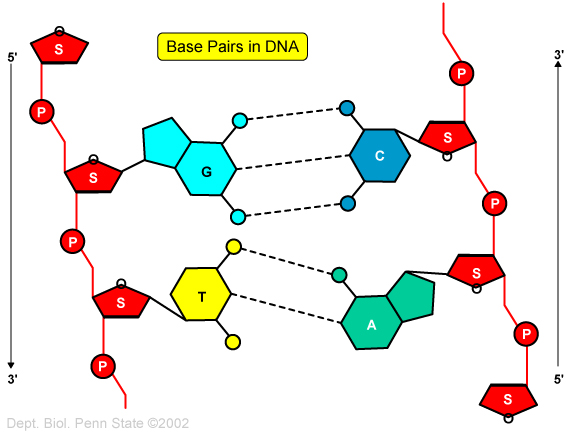

What makes up the SIDES of a DNA ladder?
nitrogen bases
sugars & phosphates
genes & chromosomes
RNA

If one strand of a DNA molecule has the following order of bases, what will be the correct order of bases on the complementary (matching) strand?
AATTGGCC
AATTGGCC
TTAACCGG
GGCCAATT
GACTGACT

What is DNA made up of?
nucleotides
cytoplasm
RNA
cells

The picture below shows the steps of DNA replication beginning with step one and ending with step three.
Because you are reusing the old, or parent, DNA strand DNA replication is said to be
Semi- Conservative
Semi-discontinuous
Continuous
Fully-Conserveative
Which enzyme is responsible for adding the free nucleotides to the replicating DNA?
DNA Helicase
DNA Ligase
DNA polyermase
RNA Polymerase
DNA replication creates two strands of DNA from one. If pink is parental DNA and blue is new DNA - which picture demonstrates the accepted model of DNA replication after the SECOND replication cycle?


Many enzymes are involved in DNA replication. Which is the correct order of enzymes involved in DNA replication from beginning to end?
Helicase, DNA primase, DNA polymerase, Ligase
RNA primase, Helicase, DNA polymerase, Ligase
Helicase, RNA primase, DNA polymerase, Ligase
DNA primase, Helicase, RNA polymerase, Ligase
Which is the last step of DNA replication?
RNA Helicase unwinds original DNA strand
DNA Primase lays down RNA primer for new nucleotide bases.
RNA polymerase builds new strands by bring in new nucleotide bases.
Ligase knits together fragments on lagging strand

What are the components of a DNA nucleotide? (Mark all that apply)
Deoxyribose
Ligase
Nitrogen Base
Phosphate group
Ribose

What part of the cell cycle is considered interphase? Select all that apply.
G1
G2
S
M
You have DNA and you wish to find other DNA sequences that look like it. Which of the five Basic Blast programs should you use?
Blastn
Blastp
blastx
blastd
What does BLAST stand for?
(a)
What is the purpose of Polymerase Chain Reaction (PCR) in the process of sequencing DNA?
To separate DNA fragments by size
To synthesize copies of template DNA
To change the structure of template DNA
To terminate the elongation of a DNA strand

Write the correct sequence that matches this chromatogram.
(a)
What type of sequencing was used to obtain Sue's DNA sequence?
Sanger
Cycle
BLAST
Chargoff
All the genetic material in an organism
is the definition of which key term?
Proteome
Genome
Genotype
Exon
Bioinformatics is related with
Computers
Biology
Both computers and biology
none of these
4. In the nucleus, DNA is first ____ into an RNA molecule.
a. Translated
b. Transcribed
c. Transferred
d. Transmitted
8. Which of the following statements about DNA and RNA is incorrect?
a. Both have cytosine as a base
b. Both are composed of a nitrogenous base
c. The DNA copies specific instructions from the RNA
d. DNA is a double-stranded helix, while RNA is a single-stranded helix
Which column details the probability that the BLAST results were by chance?

Which columns when interpreted shows how the DNA query in question aligns with the pathogen DNA?
(a)


If a DNA strand contains 60 Cytosine's and 40 cytosine's. What does this mean?

What is it called when the unique 3-D shape of a protein has been disrupted or 'unravelled'?
Denaturation
Deproteination
Decoupling
Depeptidasing

What are the three most common bacteria shape names?
coccus, bacillus, sprillum
round, short, circuluar
bacillus, streptobacillus, staphylococcus
cocci, sarcina, bacillus
What does staphylo mean?
In a line
group of 4
groups or clusters
single
What does strepto mean?
in a line
group of 4
groups or clusters
single
What is Step 3 of DNA sequencing?
1. isolate DNA
2. Separate DNA from pathogen DNA.
3 (a)
4. Use Sanger Sequencing
BONUS:
Define Meningitis
List 3 consequences of meningitis

