Wayground logo

Free Printable Worksheets

Font size

S
M
L
XL
Worksheets

Chemistry Review

Total questions: 65

Worksheet time: 11hrs 50mins

Name
Class
Date
1.
How many electrons can the first energy level hold?
a)
1
b)
2
c)
8
d)
0
2.

The second shell from the center of an atom can hold how many electrons?

a)

2

b)

6

c)

8

d)

18

3.

Valence electrons are located...

a)

inside the nucleus

b)

in outer space

c)

on the outermost orbit of an atom

4.
a)

10

b)

2

c)

8

d)

18

5.
a)

14

b)

4

c)

3

d)

28

6.
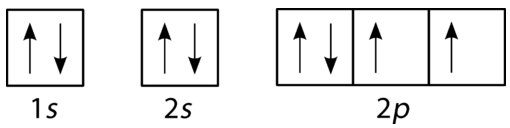
How many valence electrons are represented here?
a)
7
b)
5
c)
2
d)
8
7.

How many electrons can the d sublevel hold?

a)
8
b)
10
c)
2
d)
4
8.
There are 4 different types of subshells s,p,d,f
a)
true
b)
false
9.

What is the maximum number of electrons that an s orbital can have?

a)

1 electron

b)

2 electrons

c)

3 electrons

d)

4 electrons

10.

How many electrons can the p sublevel hold?

a)
8
b)

6

c)
2
d)
4
11.

What is the maximum number of electrons that an f orbital can have?

a)

11 electrons

b)

14 electrons

c)

13 electrons

d)

12 electrons

12.
What atom matches this electron configuration?
1s22s22p63s23p64s23d10
a)
Zinc
b)
Copper
c)
Nickel
d)
Germanium
13.
What atom matches this electron configuration?
1s22s22p63s2
a)
Neon
b)
Magnesium
c)
Aluminum
d)
Potassium
14.
What electron configuration matches an oxygen atom?
a)
1s22s22p63s2, 3p64s23d104p5
b)
1s22s22p4
c)
1s22s22p6
d)
1s22s22p63s23p64s23d1
15.
Which electron configuration belongs to Chlorine (Cl)?
a)
1s2 2s2 2p6 3s2 3p5
b)
1s2 2s2 2p6 3s2 3p6
c)
1s2 2s2 2p6 3s2 3p7
16.
What atom matches this electron configuration?
[Xe] 6s2 4f14 5d9
a)
Mercury
b)
Gold
c)
Platinum
d)
Thallium
17.
What is the shorthand electron configuration for Sulfur atom?
a)
[Ar] 3p4
b)
[He] 3s23p4
c)
[Ne] 3s23p4
d)
[Na] 3s23p3
18.
Which element is pictured?
a)
neon
b)
fluorine
c)
magnesium
d)
argon
19.
What noble gas should be used to write the shorthand configuration for Te?
a)
Ar
b)
Kr
c)
Xe
d)
Sb
20.
What does Pauli exclusion principle state ?
a)
states that each electron occupies the lowest energy orbital available
b)
states that a maximum of two electrons can occupy a single atomic orbital, but if only if the electros have opposite spins
c)
states that single electrons electrons with the same spin must occupy each-energy orbital before additional electrons with opposite spins can occupy the same orbitals
21.
Electrons occupy orbitals of lowest energy first is part of what electron configuration rule?
a)
Hund’s Rule
b)
Aufbau Principle
c)
Pauli Exclusion Principle
22.

Each row on the periodic table represents:

a)

an energy level

b)

a sublevel

c)

an electron

d)

an orbital

23.
This orbital diagram represents:  
a)
C
b)
B
c)
N
d)
O
24.

Which would be the correct electron configuration for the silver ion?

a)

1s2 2s2 2p6 3s2 3p6 4s2 3d10 4p6 5s1 4d9

b)

1s2 2s2 2p6 3s2 3p6 4s2 3d10 4p6 5s2 4d9

c)

1s2 2s2 2p6 3s2 3p6 4s2 4d10 4p6 5s1 5d9

d)

1s2 2s2 2p6 3s2 3p6 4s2 3d10 4p6 5s2 4d8

25.

What is the charge of an atom that has gained one electron?

a)
-1
b)
-2
c)
+1
d)
+2
26.
This is a correct dot diagram for oxygen (O)
a)
true
b)
false
27.

This is a correct Lewis dot diagram for fluorine (F)

a)
true
b)
false
28.
When writing Lewis Structures, only __________ electrons are used.
a)
Inner shell
b)
Core 
c)
Valence
d)
Stable
29.

How would you draw a Lewis dot diagram for Magnesium?

a)
b)
c)
d)
30.
This is the correct dot diagram for sodium (Na)
a)
true
b)
false
31.

What is the Lewis symbol of a carbon?

a)
b)
c)
d)

All are correct

32.

By replacing the element symbol, this could be a diagram of which element?

a)

Li

b)

Al

c)

C

d)

Be

33.

Which of these is correct?

a)
b)
c)
34.
This could be the dot diagram of 
a)
Ne
b)
Si
c)
Al
d)
Be
35.

Why do all bonds form?

a)

to fill the outermost energy level

b)

so an atom can be unstable

c)

so the number of protons and electrons can equal.

d)

so they can gain neutrons.

36.

An atom with 1 valence electron 'needs' a full shell, so it can either gain 7 electrons or lose 1. Which is more likely to occur?

a)

nothing

b)

gain 7

c)

lose 1

37.

How do covalent bonds form?

a)

by sharing electrons between atoms

b)

by donating or receiving electrons

38.

What two types of atoms make a covalent bond?

a)

2 nonmetals

b)

2 metals

c)

1 metal and 1 nonmetal`

39.

When an atom loses an electron, it becomes a

a)

positive ion

b)

negative ion

40.

Ionic bonds are between

a)

metals and nonmetals

b)

2 metals

c)

2 nonmetals

41.

Atoms are most stable when their outer shell is full or complete.

a)

true

b)

false

42.

How are ionic bonds formed?

a)

transfer of electrons

b)

sharing of electrons

43.

Water is an example of what?

a)

molecular compound (covalent compound)

b)

ionic compound

44.

Salt is an example of what?

a)

ionic compound

b)

covalent compound

45.

If an atom has no charge, which of the following must be true?

a)

It has more neutrons than protons or electrons.

b)

There are only neutrons inside the atom.

c)

Its number of protons is equal to its number of electrons.

d)

The neutrons in the atom outnumber the electrons and protons.

46.

Why don't noble gases form bonds?

a)

Noble gases do form bonds

b)

They all have a full octet

c)

They only bond with each other

47.

An anion is a negatively charged ion due to gaining 1 or more protons.

a)

True

b)

False

48.

A cation is a positively charged ion due to the loss of 1 or more electrons.

a)

True

b)

False

49.

Type of covalent bond in which the electrons are being shared equally.

a)

Nonpolar bond

b)

Reactant

c)

Coefficient

50.
What type of bond is illustrated above?
a)
Covalent
b)
Metallic
c)
Ionic
d)
Oxygen
51.
What type of bond is illustrated above?
a)
Metallic
b)
Ionic
c)
Covalent
d)
Wiggly
52.
What type of bond is present when electrons are freely shared between metal atoms?
a)
Metallic
b)
Ionic
c)
Covalent
d)
Hippie
53.

Identify the following compound as ionic, metallic or covalent: MgO

a)

ionic

b)

covalent

c)

metallic

54.

Identify the following compound as ionic or covalent: Na2SO4

a)

ionic

b)

covalent

55.

Identify the following compound as metallic, ionic or covalent: SO2

a)

ionic

b)

covalent

c)

metallic

56.

Identify the following compound as ionic or covalent: CO

a)

ionic

b)

covalent

57.

This type of bonding can be described as "I give, I get"

a)

ionic

b)

covalent

c)

metallic

58.

This type of bonding can be described as a "cooperation"

a)

ionic

b)

covalent

c)

metallic

59.

Sodium chloride, NaCl

a)

Ionic

b)

Covalent

c)

Metallic

60.
A substance which has a high melting point, conducts electricity when dissolved in water, and has a crystalline structure probably has what type of bond?
a)
Ionic
b)
Metallic
c)
Covalent
d)
Crystalline
61.
A solid substance is an excellent conductor of electricity. The chemical bonds in this substance are most likely?
a)
ionic, because the valence electrons are shared between atoms
b)
covalent, because the valence electrons are mobile
c)
metallic, because the valence electrons are stationary
d)
metallic, because the valence electrons are mobile
62.
Low melting point
a)
Ionic Bonds
b)
Covalent Bonds
c)
Both bonds
d)
Neither bond
63.

Cations tend to be ________.

a)

metals

b)

nonmetals

64.

Anions tend to be

a)

metals

b)

nonmetals

65.

Which two elements would NOT form an ionic bond?

a)

calcium and lithium

b)

calcium and oxygen

c)

lithium and oxygen

d)

calcium and carbon