
 Worksheets
Quiz #4 - Molecules and Chemical Reactions
Total questions: 76
Worksheet time: 43mins
Two or more atoms bonded together
Molecule
Subatomic particle
Atom
Element
A substance made up of atoms of two or more different elements joined by chemical bonds
Matter
Mixture
Periodic table
Compound
A pure substance made of only one kind of atom
Element
Pure substance
Mixture
Solubility
Two or more elements or compounds that are physically mixed together but not chemically combined
Mixture
Element
Compound
Atom
A sample of matter, either a single element or a single compound, that has definite chemical and physical properties throughout
Solubility
Atom
Pure substance
Element
How many electrons can fit on the 1st energy level (orbital) for any Bohr Model?
2
6
8
10
Which of these is a compound?
Aluminium (Al)
Carbon Dioxide (CO2)
Nitrogen (N)
Sand
Which of these is an element?
Salt (NaCl)
Water (H20)
Oxygen (O)
Carbon Dioxide (CO2)
Which of these is a mixture?
Laundry Detergent
Salt (NaCl)
Oxygen (O)
Fluorine (Fl)
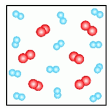
An _______________ is made up of one or more of the same kind of atom chemically combined.
atom
element
molecule
compound
A ______________ is made up of different kinds of atoms chemically combined.
element
compound
mixture
molecule
True or False: elements AND compounds are pure substances.
True
False
A _____________ contains a variety of elements and compounds that are not chemically combined with each other.
compound
element
molecule
mixture

What type of substance is pictured?
element
compound
mixture
solution

What type of substance is pictured?
element
compound
mixture
solution

What type of substance is pictured?
element
compound
mixture
solution

What type of substance is pictured?
element
compound
mixture
Which is a mixture of compounds?


Which is a pure substance?


two or more atoms bonded together is...
an element
a big atom
a molecule
a mixture


Di = two
Mono = one
Atomic = atom
diatomic
monoatomic

Di = two
Mono = one
Atomic = atom
diatomic
monoatomic

Di = two
Mono = one
Atomic = atom
diatomic
monoatomic

Di = two
Mono = one
Atomic = atom
diatomic
monoatomic
2H2 + O2 --> 2H2O
2H2 + O2 --> 2H2O
Al + O2 --> 2Al2O3


Is this equation balanced?
Yes
No

Is this equation balanced?
Yes
No
The products of a reaction have the same ________as the reactants.
molecule
atoms
subscripts
coefficients
Which is the Law of Conservation of Matter?
matter cannot be created or destroyed, it only rearranges
matter can be created but it cannot be destroyed, it never rearranges
matter can be destroyed but it cannot be created, it usually just rearranges
matter is an unproven theory created by Hans Geiger
4Ca(OH)2

The Coefficient (3) in the Chemical Formula, 3H2O, tells you how many _____________ there are.
Atoms of Hydrogen
Atoms of Oxygen
Atoms of Water
Molecules of Water
The Subscript (2) in the Chemical Formula, 3H2O, tells you how many _____________ there are.
Atoms of Hydrogen
Atoms of Oxygen
Atoms of Water
Molecules of Water
How many Ca (Calcium) atoms are found in Ca(OH)2?
5 atoms
3 atoms
2 atoms
1 atom
How many atoms do you have in the chemical formula 3H2O2?
7 atoms
12 atoms
4 atoms
6 atoms
How many atoms do you have in the chemical formula 2Mg(ClO3)2?
2 atoms
7 atoms
9 atoms
18 atoms
Does the equation H2+O2 →H2O follow the Law of Conservation of Mass?
Yes, because the atoms are equal.
No, because more info is needed.
No, because there are more atoms in the product.
No, because there are more atoms in the reactant.
What is the part of the chemical equation in green called?
Fe + S → FeS
Reactants
Products
Yield
Chemical equation
What happens in a chemical reaction?
Atoms are destroyed.
Atoms are created.
Atoms are rearranged.
Atoms gain/lose atomic mass.
Which statement best describes what happens to atoms in a chemical reaction?
New atoms are created which become products
Some atoms disappear while others multiply to become the products
The atoms of the reactants rearrange to become the products
The atoms of the reactants are transformed into different types of atoms which become the products
Atoms are conserved during a chemical reaction. Pick the statement that best describes what it means for atoms to be conserved in a chemical reaction.
The reactants and products have the same # of atoms but different types of atoms
The reactants and products have the same type of atoms but different numbers of atoms
The reactants and products have the same number and same type of atoms
The reactants always have less atoms than the products
Which of the following would provide the evidence that the number of atoms present before a chemical reaction is equal to the number of atoms present after the chemical reaction?
What are valence electrons?
The total number of electrons in an atom
The number of electrons in the outermost shell
The number of electrons in the second shell
The number of protons in the outermost shell
All atoms are most stable with (or would "prefer") how many electrons in their valence shell?
1
2
8
18
When trying to identify an unknown element, a scientist determines what other elements reacts with chemically. Which property of the unknown element determines the other element it reacts with?
The total number of neutrons in the unknown element
The total number of particles in the nucleus of the unknown element
The number of protons in the nucleus of the unknown element
The number of valence electrons in the unknown element
How do electrons of an element determine that element's reactivity?
If the valence shell has missing electrons it is very reactive to attract or lose more electrons.
If the valence shell has a full ring of electrons it is very reactive because it needs more.
If the valence shell has a full shell of electrons it is very reactive because it is already full.
If the valence shell has missing electrons it is not reactive because it is missing electrons.
Which elements are chemically reactive?
Group 18
Groups 1-17
Groups 3-12
All groups
Which elements are NOT chemically reactive?
Group 18
Groups 1-17
Groups 3-12
All groups
All elements are generally trying to find how many valence electrons?
2
4
6
8
Elements in the same group have the same
mass
energy levels
protons
chemically reactivity
Elements in the same group have the same
energy levels
valence electrons
protons
atomic number

