
 Worksheets
PHYSICS 001
Total questions: 100
Worksheet time: 53mins
Which fundamental quantity is measured in amperes?
electric current
amount of substance
temperature
intensity of light
The standard unit of length is
meter
second
kilogram
newton
Which one of these options is NOT a derived quantity?
Area
Volume
Density
Temperature
Which one of the following is the derived unit?
speed
length
mass
luminous intensity
How many fundamental quantities are there?
10
5
7
8
Force is a
fundamental quantity
derived quantity
What are physical quantities?
Physical quantities are anything that the mind can think of. Dreams, thoughts and feelings are quantities.
Physical quantities are any activities that human beings can participate in.
Physical quantity are anything that can be counted or measured and a value be placed on.
Physical quantities are things that CANNOT be counted or measured.
m
mL

The capacity of a glass of orange juice would be measured in...
litres (L)
cubic metres (m3)
millilitres (mL)
Which one of these options is NOT a derived quantity?
Area
Volume
Density
Current
What is the SI unit for length?
foot (ft)
meter (m)
kilometer (km)
centimeter (cm)
The SI unit for mass is _____
gram (g)
pound (lb)
kilogram (kg)
Newton (N)
Vernier Scale Calipers and Micrometer are tools that can be used to measure _______
mass
length
temperature
time
Which of the following can be used to measure time? Select all that can be used
Analog clock
digital stop watch
pendulum
micrometer
The SI unit of candela (cd) is a unit of _______
luminous intensity
electric current
thermodynamic temperature
electromagnetic frequency
There are _______ meters in a Mm (megameter).
106 or 1 000 000
103 or 1 000
109
or 1 000 000 000
10−6 or 0.000001
3.58 has ___ significant figures
3
1
2
0
How many significant figures does 0.038 have?
3
1
2
4
How many significant figures does 0.03800 have?
3
5
2
4
How many significant figures does 7900 have?
1
2
3
4
How many significant figures does 7900.0 have?
2
5
4
3
The SI Unit for electric current is the _______
Volt
Ohm
Ampere
Candela
What is the SI Unit for temperature?
Fahrenheit
Kelvin
Celsius
Rankine
15 km is how many m?
15 000 m
1500 m
150 m
150 000 m
2.75 m3 is how many cm3
2.75 x 109 cm3
275 cm3
2.75 x 106 cm3
2.75 x 103 cm3
It is used to express very small and very large numbers:
scientific method
scientific notation
Einstein notation
Newton's method
How many SI base units are there?
5
6
7
8
In multiplication and division, the final answer should have no more significant figures than the quantity with the LEAST number of significant figures
True
False, it should have the same number as the quantity with the MOST number of significant figures
False, it should have the same number as the addition of each quantity's number of significant figures
False, it should have the same number as the multiplication or division of each quantity's number of significant figures
5. One light year is ______________m.
1.496 x 10¹¹m
9.46 x 10¹¹m
1.496 x 10¹⁵m
9.46 x 10¹⁵m
7. [M L T-2] is the dimension of:-
energy
momentum
power
force
What is the unit of Force??
N
m/s
m
kg
9. Which of the following pairs have same dimensions:-
work and potential energy
pressure and stress
velocity and speed
all of the above
8. Name a dimensionless quantity with unit
strain
relative density
angle
angular velocity
7. [M L T-2] is the dimension of:-
energy
momentum
power
force
4. Steradian is the unit of_____________
plane angle
solid angle
stress
strain
1. Name the weakest force in nature
nuclear force
weak force
gravitational force
electromagnetic force
Slope of distance time graph represents-
speed
acceleration
displacement
none of these
SI unit of acceleration is-
ms-1
ms-2
ms2
none of these
Which of the following is a scalar quantity?
acceleration
velocity
distance
displacement
Rate of change of velocity is called-
average speed
average velocity
acceleration
none of these
When an object travels equal distance in equal intervals of time, it is said to be in-
uniform acceleration
non uniform accelration
uniform motion
non uniform motion
Displacement is represented by-
slope of s-t graph
slope of v-t graph
area under s-t graph
area under v-t graph
Speed of an object is equal to the magnitude of velocity if-
the object is travelling in uniform circular motion
the object is travelling along a straight path
the initial and final positions are same
none of these
An object moving in a circular path with uniform speed experiences a continuous change in its
direction
velocity
speed
both a and b
The numerical ratio of distance to displacement is always
more than 1
equal to one
less than or equal to 1
more than or equal to 1
The nature of s-t graph for rest -
straight line passing through origin
straight line parallel to time axis
straight line perpendicular to time axis
straight line overlapping time axis
Position time graph for zero acceleration -
straight line parallel to time axis
straight line passing through origin
curved line
zig zag line
Straight line overlapping time axis on v-t graph shows -
uniform velocity
uniform acceleration
rest
none of these
WHAT I LEARNT?
MOTION ALONG A STRAIGHT LINE
RATE OF CHANGE OF VELOCITY
GRAPHICAL REPRESENTATION OF MOTION
UNIFORM CIRCULAR MOTION
WHAT I FOUND INTERESTING?
MOTION ALONG STRAIGHT LINE
RATE OF CHANGE OF VELOCITY
GRAPHICAL REPRESENTATION OF MOTION
UNIFORM CIRCULAR MOTION
WHAT I FOUND DIFFICULT?
MOTION ALONG A STRAIGHT LINE
RATE OF CHANGE OF VELOCITY
GRAPHICAL REPRESENTATION OF MOTION
UNIFORM CIRCULAR MOTION


Match the graph to the description:
"The car is stopped."
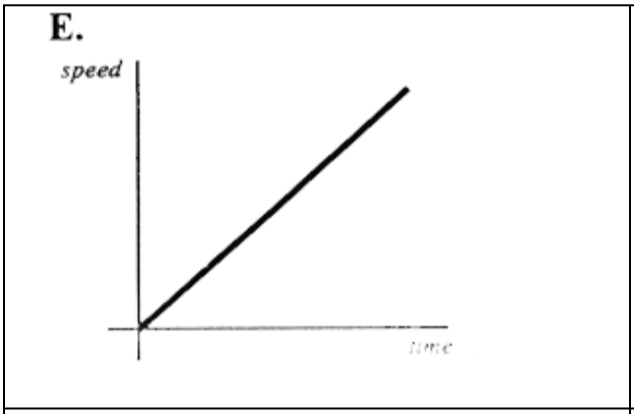
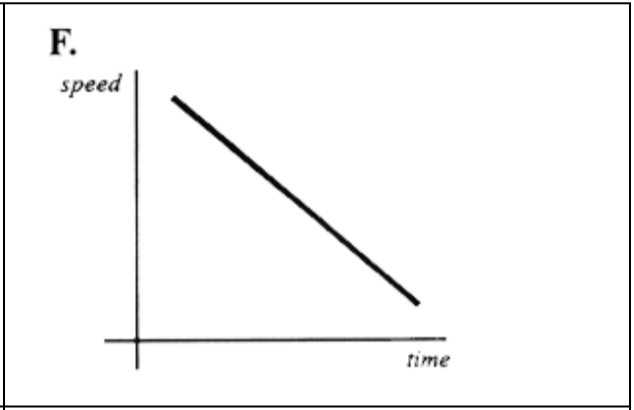
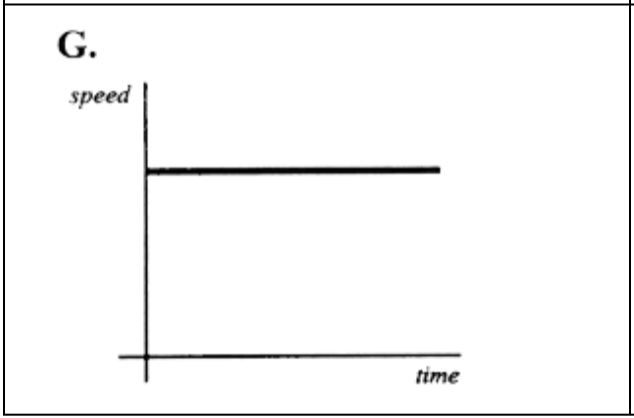
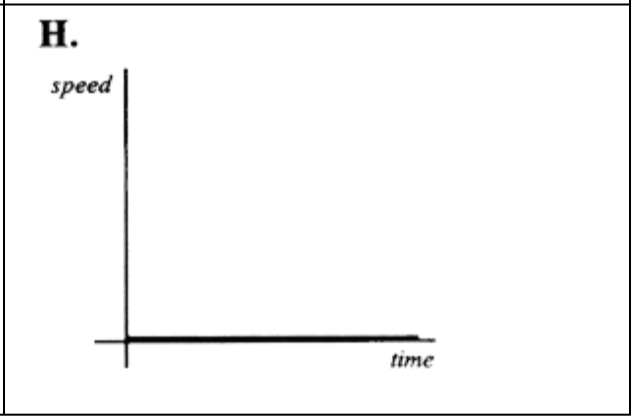
Match the graph to the description:
"The car is traveling at a constant speed."

A body travels from position A to position B with a velocity of 40 m/s and return from B to A with a velocity of 40 m/s. Then average speed of the body is :
25 m/s
40 m/s
45 m/s
70 m/s
When a body is at rest, its velocity is :
zero
positive
negative
unity
Angular velocity (w) and linear velocity (v) of a body moving in a circle of radius (r) are related as :
v = w/r
v = rw
r = vw
None of these
When a car driver travelling at a speed of 10 m/s applies brakes and brings the car to rest in 20 s, the retardation will be
+2 m s -2
-2 m s -2
– 0.5 ms-2
+ 0.5 m s-2
A bus starting from rest moves with uniform acceleration of 0.1 m/s2 for 2 minutes. The distance covered by the bus is
720 m
620 m.
320 m
520 m
If a bus decreases its speed from 80 km/h to 60m/h, then its retardation is
11.1 ms-2
1.11ms-2
-1.11 ms-2
111 ms-2
A ship is moving at a speed of 56 km/h. One second later it is moving at 58 km/h, then its acceleration is
72 km h-2
720 km h-2
7200 km h-2
7.2 m h-2
A ball is thrown vertically upwards. It rises to a height of 40 m and comes back to the thrower:
the total distance covered by the ball is zero
the net displacement of the ball is zero
the displacement is 80 m
the displacement is 40 m.
The distance covered by a car moving at a speed of 36 km/hour in 10 minutes is :
6km
3km
18km
1km
A person travels distance π R along the circumference of radius R. Displacement of the person is :
R
2R
2Πr
zero
The displacement – time graph for two particles A and B are straight lines inclined at angles of 300 and 600 with the time axis . The ratio of velocities of a vA : vB is
1 : 2
1 : √3
√3 : 1
1 : 3
A man walks on a straight road from his home to market 2.5 km away with a speed of 5 km/h. Finding the market closed, he instantly turns and walks back home with a speed of 7.5 m/h .The average speed of the man over the interval of time 0 to 40 min is equal to
5 km/h
25/4 km/h
30/4 km/h
45/8 km/h
An object is projected upwards with a velocity 0f 100 m/s . It will strike the ground after
( approximately )
10 s
20s
15 s
5 s
A moving train is brought to rest within 20 seconds by applying brakes. If the retardation due to brakes is 2 m/s2, then the initial velocity was,
10 m/s
20 m/s
30 m/s
40 m/s
The velocity- time graph of a particle is not a straight line. Its acceleration is
zero
constant
negative
variable
Three different objects m1, m2 and m3 are allowed to fall from rest and from the same point O along three different frictionless paths. The speeds of the three objects, on reaching the ground , will be in the ratio of
m1 : m2 : m3
1 : 1 : 1
m1 : m2 : m3
1/m1 : 1/m2 : 1/m3
The angular velocity of the second hand of a clock is
0.105 rad/s
1.105 rad/s
2.102 rad/s
3.120 rad/s
A firefighter drops from a window into a net. If the window is 34 meters above the net, the speed with which firefighter hit the net
18 m/s
20 m/s
12 m/s
26 m/s
A particle moving in a straight line covers half the distance with speed of 3 m/s. The other half of the distance is covered in two equal time intervals with speed of 4.5 m/s and 7.5 m/s respectively. The average speed of the particle during this motion is
4.0 m/s
5.0 m/s
5.5 m/s
4.8 m/s
A body , moving in a straight line, with an initial velocity u and a constant acceleration a, covers a distance of 40 m in the 4th second and a distance of 60 m in the 6th second. The values of u and a respectively are
10 m s-1 , 5 m s-2
10 m s-1 , 10 m s-2
5 m s-1, 5 m s-2
5 m s -1, 10 m s-2
The speed that shows up on the speedometer on a car is known as what?
Average speed
Instantaneous speed
Velocity
Acceleration
3 m/s north is an example of a(n)____.
speed
velocity
time
acceleration
A car moves around a wide turn going 45 mi/hr the whole time. The car has a constant _____.
speed
velocity
direction
acceleeration
If you ride your bicycle down a straight road for 500 m then turn around and ride back to your starting point, your distance is _____ your displacement.
greater than
equal to
less than
can't determine
An object in motion must be undergoing a change of
velocity
position
acceleration
direction
A group of bike riders took a 4 hour trip. During the first 3 hours, they traveled a total of 50 km, but during the last hour they traveled only 10 km. What was the group’s average speed for the entire trip?
60 km/hr
40 km/hr
30 km/hr
15 km/hr
When a car traveling at 30 m/s hits the gas pedal, it speeds up to 65 m/s in 3.5 sec. What is the car’s acceleration during that time?
5 m/s2
15 m/s2
10 m/s2
20 m/s2
Motion is a change in _____.
time
speed
velocity
position
An indicator that orients you when describing motion is called the _.
time
speed
reference point
point of motion
How long will it take an object traveling at 25 m/s to reach a distance of 125 meters?
5 s
0.2 min
5 m
0.2 s
. A high-speed train travels with an average speed of 227 km/hr. The train travels for 2 hrs. How far does the train travel?
113.5 km
454 km
0.0088 km
225 km
A cross-country runner runs 10 km in 40 minutes. What is his average speed?
30 km/min
4 km/min
400 km/min
0.25 km/min
What does the slope of a distance vs. time graph tell you?
the total distance traveled
the speed of the object
the time it took for the object to travel
the acceleration
A horizontal (flat) line on a velocity vs. time graph shows ____ acceleration.
positive
negative
changing
zero
Acceleration is rate of change of ____.
position
time
velocity
speed
The horses on a carousel or merry-go-round are accelerating because ____.
the speed of the horses is constantly increasing
the speed of the horses is constantly decreasing
the direction of the horses’ motion is constantly changing
the travel time is different for every ride
Find the acceleration of a car that goes from 32 m/s to 96 m/s in 8.0 s.
8.0 m/s2
-8.0 m/s2
12 m/s2
4.0 m/s2
When a car traveling at 30 m/s hits the gas pedal, it speeds up to 65 m/s in 3.5 sec. What is the car’s acceleration during that time?
5 m/s2
15 m/s2
10 m/s2
20 m/s2
Which statement about the movement of an object with zero acceleration could be true?
the object is speeding up
the object is slowing down
the object is moving at a constant speed
the object is changing direction
A car travels a distance of 98 meters in 10 seconds. What is the average speed of the car?
4.9 m/s
49 m/s
9.8 m/s
98 m/s
A group of bike riders took a 4 hour trip. During the first 3 hours, they traveled a total of 50 km, but during the last hour they traveled only 10 km. What was the group’s average speed for the entire trip?
60 km/hr
40 km/hr
30 km/hr
15 km/hr
A skateboarder is traveling 12 m/s down a hill. The skateboarder crashed and slid to a stop in 2.0 seconds. What was the rider’s acceleration?
6 m/s
0.17 m/s2
-6 m/s2
-0.17 m/s2
What is true about a car with constant velocity?
it has a positive acceleration
it has zero acceleration
it has a negative acceleration
it has a changing direction
Which fundamental quantity is measured in amperes?
electric current
amount of substance
temperature
intensity of light

