wayground logo

Free Printable Worksheets

Font size

S
M
L
XL
Worksheets

Midterm review

Total questions: 83

Worksheet time: 1hrs 24mins

Name
Class
Date
1.

Where is DNA made into RNA?

a)

Cytoplasm

b)

Nucleus

c)

Ribosome

d)

Cell Membrane

2.

Where is RNA made into protein?

a)

Cytoplasm

b)

Nucleus

c)

Ribosome

d)

Cell Membrane

3.

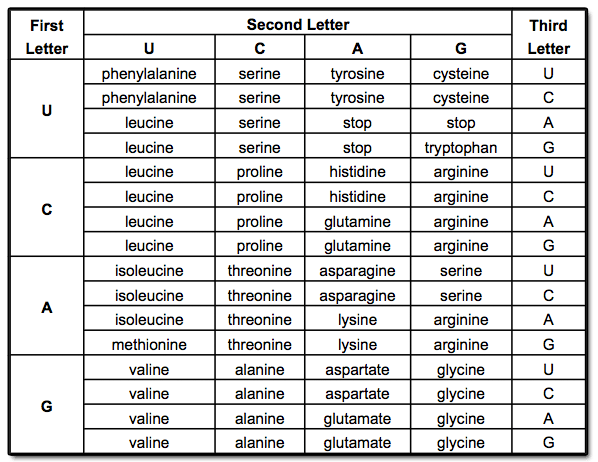
Select the RNA sequence or sequences for Glutamine.

a)

CGU

b)

CAG

c)

CUA

d)

CAA

4.

DNA is used as a guide to rewrite the genetic code into RNA. RNA can then leave the nucleus.

a)

This is Transcription.

b)

This is Translation.

5.

Find the amino acid that this segment of RNA codes for: GAC

a)

Arginine

b)

Asparagine

c)

Aspartic Acid

d)

Alanine

6.

In RNA, C pairs with G , and A pairs with

a)

U

b)

A

c)

C

d)

T

7.

A codon is a group of ___ RNA bases.

a)

1

b)

3

c)

5

d)

6

8.

Select the DNA sequence or sequences for Tyrosine.

a)

ATC

b)

ATA

c)

ACC

d)

ATG

9.

The ribosome is mainly made up of ..?

a)

tRNA

b)

mRNA

c)

rRNA

d)

DNA

10.

The process of a complementary strand of DNA being copied is called?

a)

Translation

b)

DNA replication

c)

Transcription

d)

DNA sequencing

11.

What happens once a stop codon has been reached? (Multiple answers).

a)

The process will restart once a start codon is reached again

b)

The process will stop and the protein will be released

c)

The protein will then take its shape in the cytoplasm

d)

The tRNA molecule will continue to try to find a matching anticodon

12.
Which of the following would be a nucleotide found in DNA
a)
Ribose + phosphate + uracil
b)
Deoxyribose + phosphate + uracil  
c)
Deoxyribose + phosphate + adenine
d)
Ribose + phosphate + adenine
13.
In mRNA, each codon specifies a particular 
a)
nucleotide
b)
amino acid
c)
purine
d)
pyrimidine
14.
If the mRNA sequence is AGA UUU CGA GCC,
what is the complementary tRNA anticodons?
a)
AGA TTT CGA GCC
b)
UCU AAA GCU CGG
c)
TCT AAA GCT CGG
d)
UCU AAA CGA GGG
15.
Brings the amino acids to the ribosome
a)
mRNA
b)
tRNA
c)
rRNA
d)
DNA
16.
How many amino acids are coded for by this sequence of nucleotides:
ATG GGA ACT CCA
a)
4
b)
2
c)
6
d)
12
17.
What are the three components of a nucleotide?
a)
sugar, hydrogen, nitrogen base
b)
sugar, oxygen, nitrogen base
c)
sugar, phosphate, nitrogen base
d)
sugar, phosphate, protein
18.

TRANSCRIBE this DNA sequence into RNA: TAC GTT ACT

a)

AUG CAA UGA

b)

ATG CAA TGA

c)

AUG GAT UGA

d)

TAC GTT ACT

19.

What enzyme transcribes DNA into mRNA?

a)

DNA polymerase

b)

RNA polymerase

c)

helicase

d)

rRNA

20.

The tRNA binds to specific codons. What part of the tRNA binds with a specific codon?

a)

anti-codon

b)

mRNA

c)

rRNA

d)

antisense

21.
The two strands of a DNA molecule are held together by ________ bonds between their base pairs.
a)
covalent
b)
hydrogen
c)
ionic
d)
peptide
22.
What will be the resulting mRNA from this DNA sequence:
GAT-TAC-AGA-TTA-CAT?
a)
CTA-ATG-TCT-AAT-GTA
b)
GAU-UAG-UGA-UUA-GUT
c)
CUA-AUG-UCU-AAU-GUA
d)
CAT-ACA-TAC-ATA-TAG
23.
What is the correct amino acid sequence for the mRNA code AUGCCAGUAUGA
a)
Met-Pro-Ala-Val
b)
Met-Pro-Val
c)
Tyr-Gly-His
d)
Tyr-Gly-Arg-His
24.
The anti-codon 
a)
contains a sequence the same as the codon
b)
contains a sequence complementary to the codon 
c)
contains the base thymine
25.
The chromosomes that pair up during meiosis, are called __________ chromosomes.  
a)
homozygous 
b)
asexual
c)
homologous
d)
genes
26.
The process of crossing over occurs in what phase of meiosis?
a)
anaphase 1
b)
prophase 1
c)
prophase 2
d)
telophase 1
27.
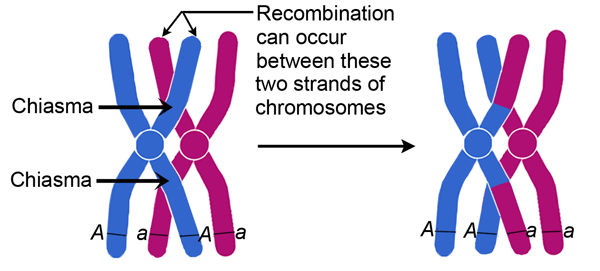
This image shows chromosomes during Prophase 1. Which of the following correctly describes the process shown?
a)
segregation of sister chromatids
b)
condensation and segregation of alleles
c)
mutationin which the DNA content of the gene is altered
d)
crossing - over in which alleles are exchanged
28.
 Cell created at the end of meiosis are best known as
a)
somatic cells
b)
gamete cells
c)
skin cells
d)
diploid cells
29.

Unlike mitosis, meiosis results in the formation of

a)

Two genetically identical cells.

b)

Four genetically different cells.

c)

Four genetically identical cells

d)

Two genetically different cells

30.

If an organism has a haploid number of 23, what would be the diploid number?

a)

3

b)

23

c)

46

d)

92

31.

In meiosis I, ________ _________ separates.

a)

Homologous chromosomes

b)

Sister chromatids

c)

Crossing over

d)

Independent Assortment

32.

In meiosis II, ________ _________ separates.

a)

Homologous chromosomes

b)

Sister chromatids

c)

Crossing over

d)

Independent Assortment

33.

In which phase of meiosis do the chromosomes condense, form a tetrad structure and crossing over occurs.

a)

Prophase I

b)

Prophase II

c)

Anaphase I

d)

Anaphase II

34.

True or False:

In Meiosis, DNA replication occurs during interphase before meiosis I begins

a)

True

b)

False

35.

How do you classify the following genotype : AA

a)

Homozygous Dominant

b)

Homozygous Recessive

c)

Heterozygous

36.

If Purple Flowers (P) are dominant over white flowers (p), what would the phenotype be for a Pp genotype?

a)

Purple flowers

b)

White flowers

c)

Not enough information

37.
The physical appearance of a trait is known as the-
a)
genotype
b)
phenotype
c)
characteristics
d)
intelligence
38.
Alternative forms of a gene are called
a)
Alleles
b)
Homozygous
c)
DNA
d)
Genetics
39.
The allele combinations
a)
genetics
b)
mitosis
c)
genotype
d)
phenotype
40.

The alleles of a gene pair in a heterozygote are both expressed with no blending.

a)

codominance

b)

incomplete dominance

c)

polygenic

d)

multiple alleles

41.
incomplete dominance means that there traits are,,,
a)
expressed equally
b)
dominant
c)
recessive
d)
blended
42.

Which of these Punnett squares represents a cross between a homozygous dominant parent and a heterozygous parent?

a)
b)
c)
d)
43.
A heterozygous round seeded plant (Rr) is crossed with a homozygous dominant round seeded plant (RR). What percentage of the offspring will be homozygous dominant?
a)
100%
b)
75%
c)
50%
d)
25%
44.
Cross Two Homozygous plants
(
RRYY x rryy)
R = round seeds, r  = wrinkled seeds Y = yellow seeds, y = green seeds
What percent will have Round and Yellow seeds? 
a)
0%
b)
25%
c)
50%
d)
100%
45.
What is the genotype for a pea plant heterozygous for round seeds (R), and homozygous recessive for green seeds (y)?
a)
Ry
b)
RRyy
c)
RrYy
d)
Rryy
46.

What would be the gametes for the YyRr plant?

a)

YR, YR, yR, yR

b)

YR, Yr, yR, yr

c)

Yy, Rr, YY, RR

d)

yy, rr, yy, rr

47.

What is the genotype that should be in the blank square?

a)

yyRr

b)

YYRR

c)

yyrr

d)

YrYr

48.
What type of inheritance do two alleles have if their traits blend together? 
a)
Incomplete Dominance
b)
Co-Dominance
49.

Parent 1 is heterozygous for both pea color and shape. Parent 2 is heterozygous for both pea color and shape.

What should the genotype be for the box with the "?" ?

a)

EEAa

b)

EeAa

c)

eeAa

d)

eeaa

50.

Parent 1 is heterozygous for both pea color and shape. Parent 2 is heterozygous for both pea color and shape.

What should the genotype be for the box with the "?" ?

a)

EEAa

b)

EeAa

c)

eeAa

d)

eeaa

51.

Parent 1 is heterozygous for both pea color and shape. Parent 2 is heterozygous for both pea color and shape.

What should the phenotype be for the box with the "?" ?

a)

Yellow & Smooth

b)

Green & Wrinkled

c)

Green & Smooth

d)

Yellow & Wrinkled

52.
What proportion of the offspring in Figure 11-4 would be expected to have white, smooth hair?
a)
9/16
b)
3/16
c)
4/16
d)
1/16
53.

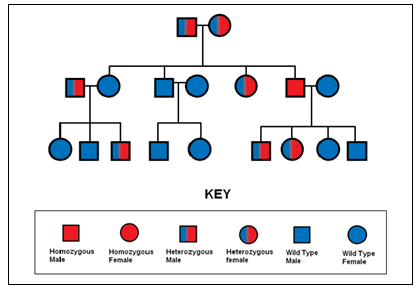
In a pedigree, which shape represents a male?

a)

circle

b)

square

54.

How many individuals are there in the 3rd generation?

a)

1

b)

2

c)

4

d)

6

55.

How are individuals III-2 and II-4 related?

a)

Brother and sister

b)

Dad and daughter

c)

Uncle and niece

d)

Grandfather and granddaughter

56.
How many generations are shown in this pedigree?
a)
1
b)
2
c)
3
d)
4
57.
How many kids did the mother and father from the first generation have?
a)
2
b)
4
c)
5
d)
6
58.

Where is pollen made?

a)

Stigma

b)

Sepal

c)

Anther

d)

Ovary

59.

Where is the ovule found in a flower?

a)

Petals

b)

Style

c)

Nectary

d)

Ovary

60.

The stamen is consisted of...

(a)  

61.

The carpel is consisted of...

(a)  

62.

The two mechanisms for pollination are?

(a)  

63.

Flowers are adapted for wind-pollination by...

a)

Having bright petals and a scent

b)

Having a nectary

c)

Having feathery stigmas

d)

Having sticky stigmas

64.

Which parts of the flower are labelled below:

a)

X=style, Y=stigma

b)

X=filament, Y=anther

c)

X=stigma, Y=style

d)

X=anther, Y=filament

65.
In human reproduction, which sequence of events if correct?
a)
menstruation > ovulation > fertilisation > implantation
b)
menstruation > ovulation > implantation > fertilisation
c)
ovulation > menstruation > fertilisation > implantation
d)
ovulation > menstruation > implantation > fertilisation
66.

Where does implantation take place?

a)

vagina

b)

uterus wall

c)

ovary

d)

oviduct

67.

The fertilised egg is called

a)

zygote

b)

embryo

c)

foetus

68.
Which produces egg cells and female hormones?
a)
cervix
b)
fallopian tube
c)
vagina
d)
ovaries
69.
What do you call the process in which the ovary releases a mature egg cell?
a)
penile erection
b)
ejaculation
c)
ovulation
d)
nocturnal emission
70.
What do you call the union of egg and sperm cell?
a)
penile erection
b)
ejaculation
c)
fertilization
d)
ovulation
71.
Structure 4 is the
a)
cervix
b)
vagina
c)
uterus
d)
ovary
72.
Structure 5 is the
a)
cervix
b)
Fallopian tube
c)
uterus
d)
ovary
73.
Structure 2 is the 
a)
cervix
b)
vagina
c)
uterus
d)
ovary
74.
Structure 7 is the 
a)
cervix
b)
vagina
c)
uterus
d)
ovary
75.

The two hormones that maintain the lining of the uterus are:

a)

FSH and estrogen

b)

LH and estrogen

c)

estrogen

d)

Progesterone and estrogen

76.
What is the main role of FSH?
a)
Stimulates follicle to burst and release the ovum
b)
Stimulates rebuilding of the uterus wall
c)
Stimulates one egg cell to develop (become follicle)
d)
Completes development of uterus wall, promotes glycogen storage
77.
On what day of the cycle is ovulation?
a)
Day 4
b)
Day 8
c)
Day 14
d)
Day 28
78.

The lining of the uterus coming out through the vagina (sometimes called 'having a period').

a)

Conception

b)

Fertilization

c)

Implantation

d)

Menstration

79.

Where do the eggs begin to mature in a follicle?

a)

Labia

b)

Uterus

c)

Fallopian tubes

d)

Ovaries

80.

The area in an ovary where an egg matures?

a)

Follicle

b)

Ova

c)

Luteal

d)

Fallopean

81.

Which is the correct order of human development?

a)

fetus, embryo, zygote

b)

zygote, embryo, fetus

c)

embryo, fetus, zygote

d)

zygote, fetus, embryo

82.

Which hormone inhibits the release of FSH?

a)

estrogen

b)

progesterone

c)

FSH

d)

LH

83.

Which hormones maintains the lining of the uterus following ovulation?

a)

oestrogen

b)

progesterone

c)

FSH

d)

LH