
 Worksheets
Phase Change
Total questions: 71
Worksheet time: 1hrs 11mins
A solid (a) into a liquid
A liquid (a) into a gas
Phase change from a solid to gas:
Freezing / Solidification
Melting
Deposition
Sublimation
Evaporation
Phase change from a gas to solid:
Freezing / Solidification
Melting
Deposition
Sublimation
Evaporation
Phase change from a liquid to solid:
Freezing / Solidification
Melting
Deposition
Sublimation
Evaporation
Phase change from a liquid to gas:
Freezing / Solidification
Melting
Deposition
Sublimation
Evaporation
Phase change from a gas to liquid:
Freezing / Solidification
Melting
Condensation
Sublimation
Evaporation
The change of one state of matter to another is called
Osmosis
Phase Change
Matter
Energy
A phase change is a chemical or physical change?
Physical
Chemical
When an object undergoes phase change, its mass
increases
stays the same
decreases

This is an example of
Freezing
Melting
Condensation
Sublimation

This is an example of
Deposition
Condensation
Melting
Evaporation

The temperature at which a liquid evaporates to a gas is called
freezing point
boiling point
melting point
condensation point
The temperature at which a liquid freezes to a solid is called
Freezing Point
Melting Point
Boiling Point
Condensation Point
The temperature at which a solid melts to a liquid is called
Boiling Point
Freezing Point
Condensation Point
Melting Point
The temperature at which a gas condenses to a liquid is called
boiling point
condensation point
melting point
freezing point

Three containers with the same amount of the same material are shown below. Which container has the substance with the highest amount of energy?
The container on the left
The middle container
The container on the right
All have an equal amount of energy
What happens to molecules when their kinetic energy increases?
The molecules move slower
The molecules move faster
The molecules get heavier
It depends on the type of molecule
Three containers with the same amount of the same material are shown below. Which container has the substance with the lowest amount of energy?
The container on the left
The middle container
The container on the right
All have an equal amount of energy
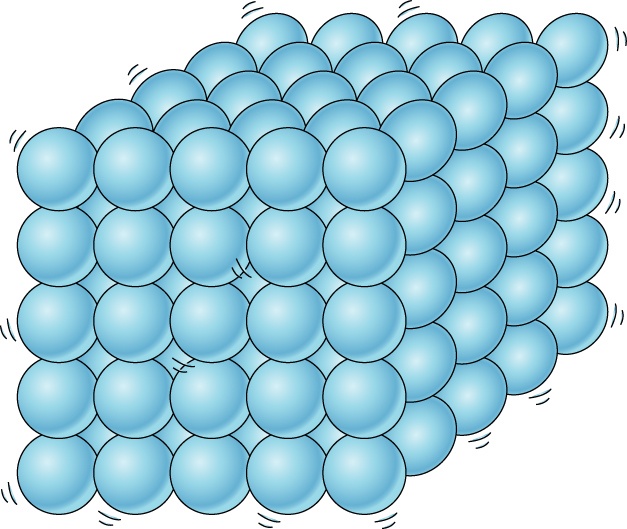
What state of matter?
Solid
Liquid
Gas
Plasma!!!
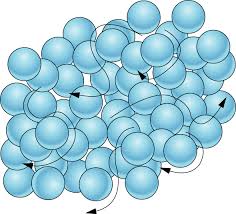
What state of matter?
Solid
Liquid
Gas
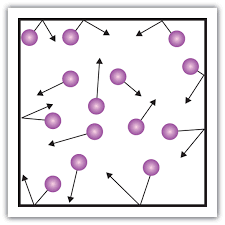
What state of matter?
Solid
Liquid
Gas

TRUE/FALSE: Matter can change from one phase to the other just as water can evaporate.
True
False

Based on this photo, when liquid turning to gas is which of the following down below?
Consensation
Freezing
Evaporation
Melting
If you transfer energy INTO a substance, how will the movement of the molecules change?
They will move SLOWER.
They will move FASTER.
They will not change speed.
Not enough information is provided.
If you transfer energy OUT OF a substance, how will the movement of the molecules change?
They will move SLOWER.
They will move FASTER.
They will not change speed.
Not enough information is provided.
If you transfer energy OUT OF a liquid, which state of matter will it be in?
Solid
Gas
Plasma
Water
If you transfer energy INTO a substance, how will the movement of the molecules change?
They will move SLOWER.
They will move FASTER.
They will not change speed.
Not enough information is provided.
Water molecules were moving IN PLACE and then after energy was transferred into it they were moving AROUND EACH OTHER. What phase change occured?
Freezing
Melting
Evaporation
Condensation
How are molecules moving in a GAS.
Moving in place.
Moving around each other.
Moving away from each other.
Not moving at all.
How are molecules moving in a SOLID?
Moving in place.
Moving around each other.
Moving away from each other.
Not moving at all.
How are molecules moving in a LIQUID?
Moving in place
Moving around each other
Moving away from each other
Not moving
In which state of matter are molecules always moving?
Liquid
Solid
Gas
Molecules are ALWAYS moving in all three states!
What happens to the speed of the molecules as the temperature increases?
The speed increases.
The speed decreases.
The speed remains the same.
The speed doubles.
What happens to the speed of the molecules as the temperature decreases?
The speed increases.
The speed decreases.
The speed remains the same.
The speed doubles.
Scientists increased the speed of the substance’s molecules and caused a phase change. How did they do this?
They put the substance outside.
They transferred energy OUT OF the substance.
Not enough information given.
They transferred energy INTO the substance.

The energy that an object has because it is moving
Molecule
Refute
Density
Kinetic Energy
Which of the following is an intensive property?
Mass
Density
Volume
Size
Which of the following is an extensive property?
Mass
Density
Color
Viscosity
What does Endothermic mean?
Energy is released by a substance
Energy is absorbed by a substance
Energy stays the same in a substance
What does Exothermic mean?
Energy is released by a substance
Energy is absorbed by a substance
Energy stays the same in a substance

The melting point of the sample is
-60 ºC
-100 ºC
60 ºC
100 ºC
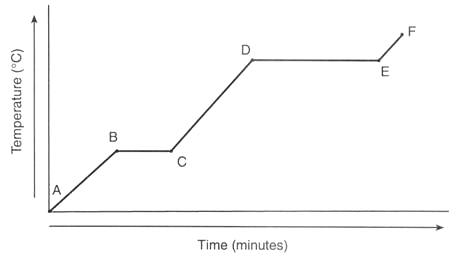
Are the particles moving faster or slower as time goes on?
Faster
Slower

Given the heating curve of a solid being heated at a constant rate, what is the boiling point of this substance?
20°C
50°C
110°C
170°C

What term goes on the y-axis? (A)
Heat(Energy)
Temperature
Phase
Type of Matter
What phase of matter exists in part C of the graph?
Gas
Liquid
Solid
Plasma
What phase change occurs when you start at D and end at C?
Freezing
Melting
Condensing
Vaporization
On which parts of the graph does the temperature remain the same?
Between C and D
Between D and E
At C, D, or E
On both flat sections
Sulfur has a melting point of 215 ℃. If Sulfur has a temperature of 215 ℃, what phase(s) of matter can it be in?
Both Liquid and Gas
Sulfur has a melting point of 215 ℃. If Sulfur has a temperature of 210 ℃, what phase(s) of matter can it be in?
Both Liquid and Gas
Sulfur has a melting point of 215 ℃. If Sulfur has a temperature of 220 ℃, what phase(s) of matter can it be in?
Both Liquid and Gas
The condensation point for H2O is ___. (remember to use the scientific temperature measurement)
100 °F
100 ℃
99 ℃
32 ℃
Which is an endothermic phase change?
Melting
Freezing
Condensing
Deposition
Which is an exothermic phase change?
Melting
Freezing
Evaporating
Sublimation
Which phase change is endothermic
Melting
Freezing
Which phase change is exothermic
Melting
Freezing
Which phase change is exothermic
Condensing
Evaporating
Which phase change is Endothermic
Condensing
Evaporating
Which phase change is Endothermic
Deposition
Sublimation
Which phase change is Exothermic
Deposition
Sublimation

