
Font size
 Worksheets
Science 8 Unit 2 Review
Total questions: 43
Worksheet time: 22mins
Phases of the moon in which the moon appears to be getting larger are referred to as ____.
waxing
new
waning
eclipse

Which of the following is most responsible for the changing of seasons on Earth?
Orbit of the Earth around the Sun
Rotation of the Sun
Tilt of axis of Earth
Rotation of the Earth

Which type of eclipse occurs when the Moon comes directly between Earth and the Sun?
Lunar Eclipse
Solar Eclipse

A solar eclipse only happens during a ____ moon.
New
Gibbous
Crescent
Full

Name the eclipse.
solar eclipse
lunar eclipse

A lunar eclipse only occurs during which moon phase?
New Moon
Full Moon
3rd Quarter
1st Quarter
As the moon's shape appears to get smaller, we say that the moon is ____.
swelling
waning
waxing
disappearing
The cycle of the moon lasts about a _____.
day
week
year
month

You are less likely to see a total solar eclipse than a total lunar eclipse because...
new moon phases occur less often than full moon phases
only people on the daytime side of Earth can see a solar eclipse
the moon's shadow covers all of Earth during a solar eclipse
the moon's umbra only covers a small area on Earth's surface
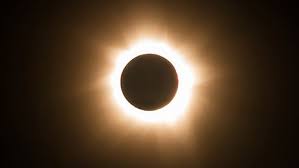
A solar eclipse happens during the day.
True
False
A __________ is the lighter, outer part of a shadow cone.
penumbra
umbra
An ____________ is the inner, darker part of a shadow.
penumbra
umbra
When the moon does not completely cover the sun it is known as a
Partial lunar eclipse
Partial solar eclipse
Total solar eclipse
Penumbral lunar eclipse
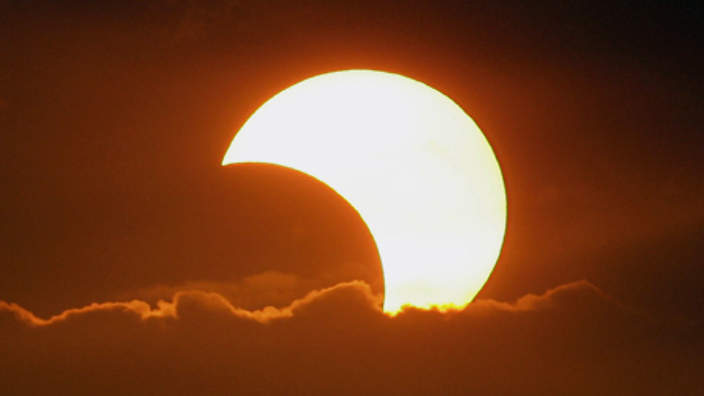
An __________ occurs any time something passes in front of the sun, blocking its light.
Black hole
Super Nova
Eclipse
Star

When you block the sun's light, you make a ________ .
a light
a sound
a shadow
What are the phases of the Moon during neap tides?
new and full
first and third quarter
waning and waxing gibbous


During a summer solstice the America, the southern hemisphere experiences
a vernal equinox
the autmunal equinox
a summer solstice
a winter solstice
Why is summer warmer than winter?
The hemisphere experiencing summer is tilted more directly toward the sun
During summer, the entire planet is closer to the sum
The sun radiates more energy during the summer
The earth spins slower on its axis during the summer
Which hemisphere do we live in?
Northern Hemisphere
Southern Hemisphere
Western Hemisphere
Eastern Hemisphere

Based on the diagram, which season would the northern hemisphere be experiencing?
Winter
Spring
Summer
Fall

Students in a science class in Marfa, Texas, made a poster with a diagram to represent seasonal change in the Northern hemisphere. Which statement best describes conditions for Earth at position 1 in the diagram?
There are an equal number of hours of daylight and nighttime in the Northern hemisphere, and the north pole is tilted away from the Sun.
The Northern hemisphere has the fewest hours of daylight, and the Earth's axis does not tilt at this position.
There are an equal number of daylight and nighttime hours in this position because the Earth is not tilted in this position.
The Northern hemisphere has the fewest hours of daylight, and the north pole is tilted away from the Sun.

At which point is the northern hemisphere experiencing summer?

How long does it take Earth to make one revolution around the Sun?
240 days
100 days
365 days
400 days
When do we experience the longest DAY of the year?
Vernal Equinox
Summer Solstice
Winter Solstice
Autumnal Equinox
The sun's ________ keeps the planets in their orbits.
friction
gravity
inertia
magnetism
The greater the mass, the ___ its gravitational pull is on the second object.
greater
less
The greater the distance, the ___ its gravitational pull is on the second object.
greater
less
The moon also exerts gravitational pull on the Earth.
True
False
Describe gravity. Select all that apply.
Gravity holds the solar system together.
The strength of the gravitational pull between 2 objects depends on the it temperatures.
Gravity is a force of attraction
There is no gravity beyond the edge of our solar system.
The strength of the gravitational pull between two objects depends on masses.

What two factors affects gravitational force?
nothing affects gravity
size and shape
size and distance
shape and distance

