
 Worksheets
Practice Quiz Engphys 2
Total questions: 90
Worksheet time: 23hrs 30mins
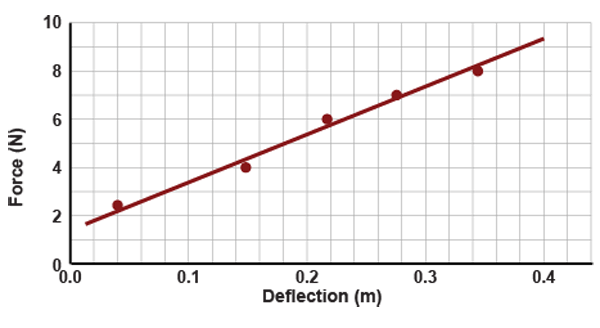
What is the quantity that can you calculate from the graph? Give the magnitude of that quantity.

What type of force is shown on the picture?
Tension
Friction
Elastic
Electromagnetic
Spring constant is measured in
N
N/m
m
The relationship between stretching force, F, with the extension, x, of a spring, is given by the equation: F = kx where k is the spring constant. What is the unit of k?
N m-1
N m-2
kg m-1
kg m-1

Which graph shows the correct relationship between the force, F, and the extension, x of a spring?
A
B
C
D

The diagram shows a load M supported by the arrangement of springs P, Q and R. All the springs are identical.
Which comparison is correct about the extension of P, Q and R?
P < Q < R
Q < R < P
R < Q < P
Q < P < R

Diagram 13 shows three springs arrangements, P , Q and R. All spring used are identical.
Which comparison of the length of spring arrangement, P, Q and R is correct when weight of 1 kg is hung?
R > P > Q
P > R > Q
P > Q > R
R > Q > P
All physical bodies are perfectly elastic
True
False
Both
Strain has no dimensions and Units.
True
False
Both
I don't know
Volume StrainVolume Stress= ?
Young's modulus
Shear modulus
Bulk modulus
none of the choices

Resistance of a material to change in shape and size.
Which of the mechanical properties has the above behaviour?
Strength
Stiffness
Elasticity
Ductility

Plastic deformation occurs when a material is deformed beyond its elastic limit.
True
False

The straight line graph (OA) obeys Hooke’s law which states ‘Below the proportionality limit, the restoring force, 𝐹𝑠 is INVERSELY proportional to the extension, 𝐹𝑠=−𝑘𝑥, where 𝑥 is the amount of extension.
True
False

What happened at point D?
The change in the internal structure of the material.
The force (stress) on the material is maximum and is known as the breaking force (stress).
This is the point where the material breaks or fractures.

Young’s modulus DOES NOT depend to the length of the wire, but it depends on the MATERIAL that made the wire.
True
False
Viscosity can be described as...
a physical property of liquids
a physical property of solids
a chemical property of liquids
High viscosity can be described as...
a liquid that flows quickly
a liquid that flows slowly
Parallel forces acting in opposite directions
compression
shear
tension
A cylindrical rod of cross-sectional area A experienced pressure p due to a compressive force F. If the force applied is reduced to one-third what happens to pressure?
also reduced to one-third
tripled
remains the same
Liquids with very low viscosity ,flow very _______________________.
fast
not at all
slow
whenever it wants
Which type of fluid flow is smooth, and predictable?
Turbulent
Viscous
Laminar
Inertial
stress
the process by which the shape of a rock changes because of stress
the amount of force per square unit area on a given material
stress that occurs when an object is stretched
stress that occurs when an object is squeezed
A force that is experienced by an object that is being pulled in opposite directions is called...
Compression
Tension
Torsion
Shear
A force that is experienced by pushing two points towards each other.
Compression
Tension
Torsion
Shear
A force that is being applied in opposite but parallel directions is called...
compression
tension
torsion
shear
What is the deformation of materials in response to stress?
Stress
Strain
Elastic Deformation
Plastic Deformation
Fault

Which letter is pointing to the elastic limit?
A
B
C
D
Which letter points to the section that shows elastic deformation?
A
B
C
D
Which letter is pointing to where the material will break?
A
B
C
D
All fluids are:
gases
liquids
gases or liquids
non-metallic
To obtain the absolute pressure from the gauge pressure:
subtract atmospheric pressure
add atmospheric pressure
subtract 273
add 273
Several cans of different sizes and shapes are all filled with the same liquid to the same depth. Then,
The pressure on the bottom of each can is the same
The weight of the liquid on the bottom of each can is the same
The least pressure is at the bottom of the can with the largest bottom area
the force of the liquid on the bottom of each can is the same

The vessels shown above all contain water to the same height. Rank them according to the pressure exerted by the water on the vessel bottoms, least to greatest.
1,2,3,4
3,4,2,1
4,3,2,1
2,3,4,1
All pressures are the same

The diagram shows a U-tube with cross-sectional area A and partially filled with oil of density ρ . A solid cylinder, which fits the tube tightly but can slide without friction, is placed in the right arm. The system is in equilibrium. The weight of the cylinder is:
ALρg
L3ρg
Aρ(L+h)g
Aρ(L−h)g

According to Archimedes' principle, if a body is immersed partially or fully in a fluid then the buoyancy force is _______ the weight of fluid displaced by the body.
equal to
less than
more than
unpredictable
If the weight of an object is < the Buoyant Force, the object will ......................
Sink
Rise
Remain at the same level
According to Bernoulli's theorem in a flowing liquid
velocity is inversely proportional to pressure
velocity is directly proportional to pressure
velocity is directly proportional to volume
What is an ideal fluid?
A fluid which has no viscosity
A fluid which is incompressible
A fluid which has no surface tension
All the above
Bernoulli's equation cannot be used for flow of water in river because the flow is
streamlined
turbulent
laminar
viscous
Due to Bernoulli's principle, the pressure is ............... above an airplane's wing than below it.
Lower
Higher

Bernoulli's principle states that as the velocity of a fluid ______, the pressure exerted by the fluid ______
increases; increases
decreases; decreases
increases; decreases
decreases; increases
As the temperature of a substance rises, the average kinetic energy of the particles making up the substance
increases
decreases
remains the same
When are two objects consider to be at thermal equilibrium
when one object is hotter than the other
when on object is colder than the other
when one object is at the same temperature as the other
The liquid in the thermometer rises when it is placed in the hot water because
it gains heat from the hot water and expands
loses heat from the hot water and contracts
the surrounding air is too warm
the liquid is boiling
How much energy is required to increase the temperature of 1g of water 1°C?
【specific heat capacity of water = 4200 J/kg°C】
2260 J
334 J
100 J
4.20 J
The specific heat of aluminum is 900 J/kg°C. How much heat(Q) is released when a 10 g piece of aluminum foil is taken out of the oven and cools from 100° to 50°?
450 J
900 J
45 J
90 J

Copper, Stainless Steel, Carbon Steel, and Zinc were all heated using the same thermal energy. What material would be the coolest after being heated?
Copper
Carbon Steel
Zinc
Stainless Steel
In nature, heat always flows from a:
cold object to a warm object.
small object to a big object.
warm object to a cold object.
large object to a small object
Mix 700 g of water at 100°C with 500 g of water at 30°C. Find the final temperature of the water.
【specific heat capacity of water = 4200 J/kg°C】
65 °C
42.5 °C
70.8 °C
45.8 °C
For a steel rod with a radius of 7 cm, if the temperature rises from 30 ℃ to 300 ℃, What will the cross sectional area become?
[coefficient of linear expansion of steel = 1.1×10⁻⁵ K−1
1.55×10⁻² m2
2.16×10⁻² m2
1.54×10⁻² m2
2.22×10⁻² m2
The linear expansion coefficient of glass is 1×10⁻⁵ K−1 , and the volume expansion coefficient of water is 6×10⁻⁴ K−1 . If the volume of the open glass bottle is 500 ml , filled with water, and the temperature rises from 7°C to 77°C, how much water will overflow during this process?
19.95 ml
20.65 ml
21.00 ml
0.35 ml
Winnie uses a 0.7 kW heater to completely turn 700g of water at 10 ℃ into water vapor at 100 ℃. How long does it take?
specific heat capacity of water = 4200 J/kg℃
latent heat of vaporisation of water = 2260000 J/kg
10 min
12 min
8 min
6 min

The picture shows a bimetallic strip in a fire alarm. When there is a fire outbreak, the bimetallic strip will get hot, ....
bend downwards, complete the circuit and the alarm rings.
bend upwards, open the circuit and the alarm will not ring.
becomes longer, open the circuit and the alarm will not ring.
When atoms vibrate more, they
become further apart
become closer together
not changing distance

What type of heat transfer takes place when you touch a warm mug of hot chocolate?
Radiation
Convection
Conduction
None of the above

Conduction requires
Electricity
the electromagnetic spectrum and particles
air or water flow
direct contact
If you walk barefoot on hot asphalt, energy is transferred by which process?
Convection
Radiation
Conduction
Reflection

When air is heated, what happens to its mass?
increases
decreases
remains the same
When air is heated, its volume ____________.
increases
decreases
remains the same
When air is heated, its density ___________.
increases
decreases
remains the same
In the process of convection, energy is transferred _________.
because of temperature differences in a solid
because of density differences in a liquid
by the diffusion of molecules throughout a fluid
by the vibration of molecules

Some dye in a beaker of water is gently heated. Why are the streaks of dye seen in the water?
The hot dye is a better conductor than the cool water.
The hot dye is a better convector than the cool water.
The hot water is less dense than the cool water.
The hot water is denser than the cool water.
By which process is thermal energy transferred through a vacuum?
conduction only
convection only
conduction and convection only
radiation only
If two objects have different temperatures, heat will flow from the warmer object to the cooler one UNTIL ____________
[Specific latent heat of vaporization of water = 2.26 × 10⁶ J kg−1, specific heat capacity of water = 4.2 × 10³ J kg−1°C−1]

What is the temperature of the metal cube when thermal equilibrium is achieved between the cube and the liquid?

