
 Worksheets
Periodic Trends & Electron Configuration Review
Total questions: 74
Worksheet time: 2hrs 7mins
Horizontal row in the periodic table
group
valence electrons
period
family
subatomic particles that are transferred to form positive and negative ions
electrons
protons
neutrons
type of element that is a good conductor of energy (ex. heat , electricity)
nonmetal
metalloid
metal
all elements
ability of an atom to attract electrons when the atom is in a compound
electronegativity
ionization energy
atomic radius
periodic law
an ion with a positive charge
anion
cation
nonmetals
halogens
the amount of energy needed to remove an electron
electronegativity
ionization energy
periodic energy
atomic energy
Which statement is true about electronegativity
electronegativity is the ability of an anion to attract another anion
electronegativity generally increases as you move from top to bottom within a group
electronegativity generally is higher for metals than for non metals
electronegativity generally increases from left to right across a period

Which of the following will have a larger radius than Zinc (Zn)?
Gallium (Ga)
Aluminum (Al)
Magnesium (Mg)
Strontium (Sr)

Which of the following will have a lower ionization energy than Scandium (Sc)?
Helium (He)
Titanium (Ti)
Calcium (Ca)
Magnesium (Mg)

Which atom has the largest atomic radius?
potassium (K)
rubidium (Rb)
francium (Fr)
cesium (Ce)

Fluorine, chlorine, bromine, and iodine all have the same number of valence electrons and have a tendency to gain electrons. Which element has the greatest ionization energy and electronegativity?
fluorine (F)
chlorine (Cl)
bromine (Br)
iodine (I)

Based on their locations in the periodic table, which element has chemical properties most similar to those of calcium, Ca?
beryllium, Be
potassium, K
titanium, Ti
yttrium, Y
Each period in the periodic table corresponds to a(n)
principle energy level
energy sublevel
orbital
suborbital

Of the following elements which is a non metal
Pt
V
Li
Kr
Which statement is true about electronegativity
electronegativity is the ability of an anion to attract another anion
electronegativity generally increases as you move from top to bottom within a group
electronegativity generally is higher for metals than for non metals
electronegativity generally increases from left to right across a period
For groups 13 through 18, the number of valence electrons is equal to the group number
plus 1
plus the period number
minus the period number
minus 10

Which element has the highest electronegativity?
cesium (Cs)
helium (He)
fluorine (F)
calcium (Ca)
How does atomic radius change from left to right across a period in the periodic table
it tends to decrease
it tends to increase
it first increases, then decreases
it first decreases, then increases

Which has the greater electronegativity:
H or F?
H
F
Which atom has the largest atomic radius?
potassium (K)
rubidium (Rb)
francium (Fr)
cesium (Ce)
Fluorine, chlorine, bromine, and iodine all have the same number of valence electrons and have a tendency to gain electrons. Which element has the greatest ionization energy and electronegativity?
fluorine (F)
chlorine (Cl)
bromine (Br)
iodine (I)

All elements found on the left side of the Periodic Table of the Elements have what properties in common?
They conduct heat and electricity
They are all gases
They are brittle and dull
They are radioactive
Based on their locations in the periodic table, which element has chemical properties most similar to those of calcium, Ca?
beryllium, Be
potassium, K
titanium, Ti
yttrium, Y

The number of valence electrons in an element affects the reactivity of that element. Which element listed has the fewest valence electrons?
beryllium (Be)
sodium (Na)
oxygen (O)
neon (Ne)

According to the Periodic Table of the Elements, which set of elements has similar properties?
H, C, I
He, H, Al
He, Ne, Ar
Na, Ca, Al

Which element has 2 valence electrons?
cesium (Cs)
magnesium (Mg)
boron (B)
argon (Ar)

How many valance electrons does Iodine (I) have?
6
16
7
17

How many periods are on the periodic table of elements
6
7
8
9

Which type of element is boron (B)?
Metal
Nonmetal
Metalloid
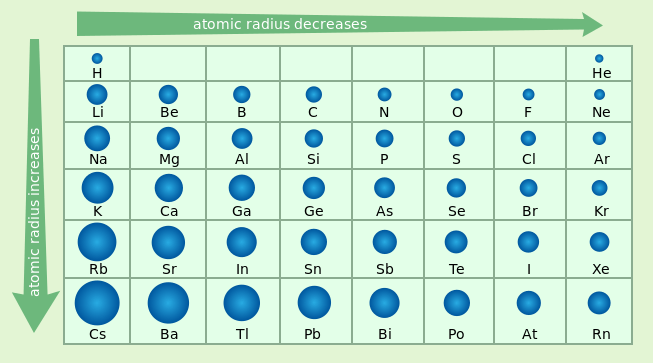
As you move across the periodic table atoms tend to get smaller because, ______________.
the atoms have more mass.
the atoms have more protons and increased electron shielding.
the atoms have more protons and electrons are added to the same energy level.
the atoms have more protons, electrons, and increased electron shielding.
The most dominant factor affecting the attraction between the outermost electrons and the nucleus is the
distance between the nucleus and outermost electrons.
none of these are correct.
total number of electrons.
number of protons/ nuclear charge.
What kind of element can conduct electricity, but be brittle (not malleable)?
some nonmetals
metalloids
some metals
all nonmetals


Which color on the image of the periodic table corresponds with the transition metals.
red
black
blue
orange
Which color on the image of the periodic table corresponds with the metalloids.
bright yellow
gold
teal
light blue

What atom matches this electron configuration?
1s2 2s2 2p6 3s2
Neon
Magnesium
Aluminum
Potassium


What is this element?
1s22s22p63s23p64s23d104p6
Argon
Krypton
Selenium
Bromide

What is the shorthand electron configuration for Sulfur atom?
[Ar] 3p4
[He] 3s23p4
[Ne] 3s23p4
[Na] 3s23p3

Which element is pictured?
neon - 1s22s22p6
fluorine - 1s22s22p5
magnesium - 1s22s22p63s2
argon - 1s22s22p63s23p6

Identify the element in Period 5 that has 1 valence electron?
Rb
Nb
Ag
Sb

What element in Period 4 has 5 valence electrons?
Zr
As
V
Sb

Primary energy levels are denoted by:
letters
numbers
a combination of letters and numbers
subscripts

Which element is depicted from this orbital diagram
Fluorine - 1s22s22p5
Neon - 1s22s22p6
Chlorine - 1s22s22p63s23p5
Argon - 1s22s22p63s23p6


Which of the following sub-levels is correctly designated?
1p5
3f9
2p6
3d11
What is the difference in a 1s orbital and a 2s orbital?
The shape of the orbital
The size of the orbital
The number of electrons it can hold
None of the above

Why does Ca have a larger radius than Se?
It has more energy levels
It has fewer energy levels
It has a more effective nuclear charge
It has a less effective nuclear charge

Why is S smaller than Te?
It has more energy levels.
It has fewer energy levels.
It has a more effective nuclear charge.
It has a less effective nuclear charge.
What is effective nuclear charge?
The charge that effects the mass of the atom.
The charge that the protons feel from the rest of the atom.
The charge felt by the valence electrons.
The charge felt by the core electrons.
In the following configuration, which electrons are the core electrons? 1s2 2s2 2p6 3s2 3p4
1s2 2s2 2p6
3s2 3p4
1s2 2s2
2s2 2p6 3s2 3p4
What electron configuration matches an oxygen atom?
[Ar]4s23d104p5
[He]2s22p4
1s22s22p6
[Ar] 4s23d1

This could be the dot diagram of
Mg
Cl
C
O
How many electrons should Boron have around its Lewis dot model?
1
2
3
4

