Worksheets
Solutions, Mixtures, Photoelectric Effect
Total questions: 53
Worksheet time: 1hrs 6mins
A student combines a solution of NaCl(aq) with a solution of AgNO3(aq), and a precipitate forms.
Which of the following is evidence that ionic bonds formed during the precipitation?
The resulting solution is colorless.
The resulting solution conducts electricity.
The precipitate has a high melting point.
The temperature of the solution did not change significantly during the precipitation.
The range of IR radiation is....
200-400 nm
400-800 nm
700 nm - 1 mm
0.1 - 10 mm
The basis of IR absorption is .................
Electronic transition
Vibrational transition
Nuclear spin
Rotational transition
This method separates dissolved substances based on differences in how well they dissolve in a solvent.
Filtration
Evaporation
Distilation
Chromatography
Which method(s) separate substances based on them having different boiling points? (Select all that apply)
Filtration
Evaporation
Distilation
Chromatography
Distillation is used to separate ______.
a liquid from its solution.
an insoluble solid from its solution.
a soluble solid from its solution.
Polar organic compound is
CCl4
C3H8
C2H6O
CH3OH
If the brightness of a beam of light increases without changing its color, the ______ will increase.
number of photons
frequency of the light
energy of the photons
wavelength of the photons
Light of a given wavelength is used to illuminate the surface of a metal. However, no photoelectrons are emitted. In order to cause electrons to be ejected, light of __________ should be used.
lower energy
higher intensity
shorter frequency
higher frequency
The energy of a photon is directly proportional to its _____ and inversely proportional to its ______.
intensity - speed
wavelength - frequency
frequency - wavelength
intensity - wavelength
In the photoelectric effect, if the incident photons have a wavelength that is larger than the threshold wavelength, _______.
electrons will be ejected from the metal surface
there will be photoelectric current
no electrons will be emitted from the metal surface
the kinetic energy of the ejected electrons increases
What color of light has the greatest energy per photon?
Red
Green
Blue
Violet

What is the best description of 'threshold frequency'?
The minimum energy needed for electrons to escape a surface.
The maximum kinetic energy that an emitted electron has.
The minimum frequency of a photon that will cause an electron to be emitted.
The frequency that an emitted electron will have.
When light of specific frequencies is shined on a surface, electrons are ejected from the surface. This is the idea behind...
Quantization of Energy
Photoelectric Effect
Compton Effect
deBroglie Waves
Uncertainty Principle
A photon with frequency of 1.5 x 10^15 Hz is incident on a piece of metal in the standard photoelectric experimental setup. What is the wavelength of this photon?
20 nm
150nm
200nm
500nm


What is the electron configuration for this PES graph?
1s22s22p63s23p2
1s22s22p63s23p1
1s22s22p63s23p3
1s22s22p63s2

The complete photoelectron spectrum for an element is shown above. Which of the following observations would provide evidence that the spectrum is consistent with the atomic model of the element?
A neutral atom of the element contains exactly two electrons.
The element does not react with other elements to form compounds.
In its compounds, the element tends to form ions with a charge of +1.
In its compounds, the element tends to form ions with a charge of +3.
The energy in joules of a photon of wavelength 355 nm is
5.596 x 10¹⁹ J
5.596 x 1028 J
Rank these in order of strength (#1 = strongest)
UV
Blue Light
Red Light
Infrared
microwaves
Microwave radiation
molecular rotation
Infrared Radiation
molecular vibration
Ultraviolet - Visible Light
Transition in electronic energy levels
Spectroscopy can only be used on solutions that have a color.
True
False


To gravimetrically analyze the silver content of a piece of jewelry made from an alloy of Ag and Cu, a student dissolves a small pre-weighed sample in HNO3(aq). Ag+(aq)and Cu2+(aq) ions form in the solution. Which of the following should be the next step in the analytical process?
Centrifuging the solution to isolate the heavier ions
Evaporating the solution to recover the dissolved nitrates
Adding enough base solution to bring the pH up to 7.0
Adding a solution containing an anion that forms an insoluble salt with only one of the metal ions
Why are ionic compounds soluble in water?
They form between nonmetals, are nonpolar and so water is repelled and dissolves them
They form between nonmetals, are polar and so water is attracted and dissolves them
They form between a metal and a nonmetal, are polar and so water is attracted and dissolves them
They form between a metal and a nonmetal, are polar and so water is repelled and dissolves them
If you have 34 mL of a 0.50 M NaBr solution, what will the concentration be if 56 mL of water is added to it?
.188 M
3.78 M
.389 M
1.76 M
What is the acetate ion concentration [C2H3O21-] of a 100. mL of Calcium Acetate solution Ca(C2H3O2)2 with 25.0 g dissolved of the compound?
MM of Calcium Acetate = 158.17 g/mol
1.58 M
0.812
3.16 M
4.50 M

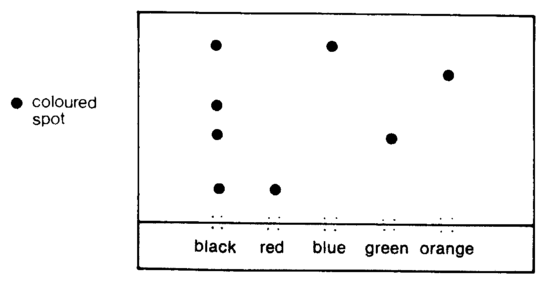
The solvent used was water, rank the following colors from Most Polar (#1) to Least Polar (#5)
Yellow
Green
Blue
Pink
Red
Which of the following laboratory setups is most appropriate for the student to use in order to separate and collect a substantial sample of each of the two pigments?


Which of the following diatomic molecules would be MOST soluble in Water?
F2
Cl2
I2
Br2
Polarizability is a term to describe the ability of a nonpolar (or polar) molecule to become polar (or more polar). Which of these nonpolar particles would be most polarizable? Why?
CF4; because it has a larger electron cloud
CH4; because it has a larger electron cloud
SiF4; because it has a larger electron cloud
SiH4; because it has a larger electron cloud

Match the following particles to their type of IMF
NaF
Ionic
Au/Cu
Metallic
C2H4
LDF
NH4Cl (pictured)
Ionic and molecular
CF4
Molecular
Both of the following particles have polar covalent bonds and liquid at room temperature: HCN and HCP.
Which would have a greater boiling point?
HCN; it has a stronger dipole since N is more EN
HCN; it has a stronger dipole since N is less EN
HCP; it has a stronger dipole since P is more EN
HCP; it has a stronger dipole since P is less EN
Q. chromatography separates the mixture of dyes on the basis of their ----------------------------
solubility
boiling point
boiling point
boiling point
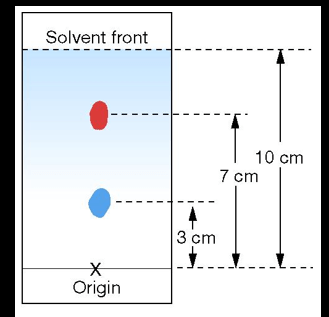
How to calculate Rf?
Rf = distance travelled by sample / distance travelled by solvent
Rf = distance travelled by solvent / distance travelled by sample

A student performed a (fractional) distillation of a mixture of two straight-chain hydrocarbons, C7H16 and C8H18.
Using four clean, dry flasks, the student collected the distillate (the liquid boiled and condensed in the other container) over the volume ranges (A, B, C, and D) shown in the graph above. Over what volume range should the student collect the distillate of the compound with the stronger intermolecular forces?
A
B
C
D
A student performed a (fractional) distillation of a mixture of two straight-chain hydrocarbons, C7H16 and C8H18.
Using four clean, dry flasks, the student collected the distillate (the liquid boiled and condensed in the other container) over the volume ranges (A, B, C, and D) shown in the graph above.
What is happening in each part of the graph?
A
The mixture is being heated
B
The hydrocarbon with the lower BP boils
C
The remaining hydrocarbon continues to heat
D
The hydrocarbon with the higher BP boils
Of the following organic compounds, which is LEAST soluble in water at 298 K?
CH3OH, methanol
CH3CH2CH2OH, l-propanol
C6H12O6, glucose
C6H14, hexane
CH3COOH, ethanoic (acetic) acid

A student prepared five solutions of CuSO4 with different concentrations, and then filled five cuvettes, each containing one of the solutions. The cuvettes were placed in a spectrophotometer set to the appropriate wavelength for maximum absorbance. The absorbance of each solution was measured and recorded. The student plotted absorbance versus concentration, as shown in the
figure above. Which of the following is the most likely explanation for the variance of the data point for the 0.600 M CuSO4 solution?
The cuvette into which the 0.600 M solution was placed had some water droplets inside.
The cuvette into which the 0.600 M solution was placed was filled slightly more than the other cuvettes.
The wavelength setting was accidentally moved away from that of maximum absorbance.
The cuvette used for the 0.600 M solution had not been wiped clean before being put in the spectrophotometer.
M+ is an unknown metal cation with a +1 charge. A student dissolves the chloride of the unknown
metal, MCl, in enough water to make 100.0 mL of solution. The student then mixes the solution with
excess AgNO3 solution, causing AgCl to precipitate. Which of the following diagrams best represents the AgNO3 solution before the reaction occurs?


In IR spectrophotometry, analyte concentration is quantified based on ........
Wavenumber
Frequency
Absorbance
Transmission
What is a calibration curve?
Graph of light versus absorbance
Graph of absorbance versus concentration
Graph of concentration versus light
Graph of absorbance volume
A calibration curve is used in colorimetry to
visualise the inverse relationship between ion concentration and light absorbance
determine the concentration of an ion with known absorbance of light
visualise the proportional relationship between ion concentration and light absorbance
determine the absorbance of an ionic solution with a known concentration
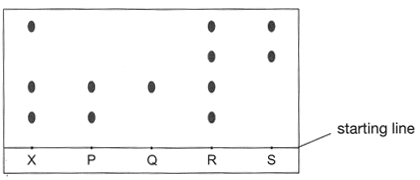
The diagram below shows a chromatogram obtained when a sample X was analysed together with four other known dyes P, Q, R and S. Dye Q was known to cause cancer. Which of the following dye(s) is/are safe for use?
P only
S only
P and S
P and X