
Font size
 Worksheets
Review for Unit 7 & 8 Test
Total questions: 61
Worksheet time: 1hrs 1mins
Which of the following organizes the divisions of geologic time from longest to shortest?
eons, eras, periods, epochs
epochs, periods, eras, eons
periods, eons, epochs, eras
eras, epochs, eons, periods
Which of the following is used as evidence to construct the geologic time scale?
fossils
radiometric age data
comparative studies of different rock sequences
all of the above
Which of the following is NOT a division of geologic time?
eons
periods
generations
epochs
Which of the following is NOT a Precambrian eon?
Hadean
Phanerozoic
Archean
Proterozoic
Iridium is an element that is common in meteors bur very rare on Earth. An iridium layer 65.5 million years old has been discovered in rock layers in many different locations all over the world. For which of the following hypotheses does this discovery provide evidence?
The supercontinent Pangaea began to break apart during the Mezozoic Era.
A glaciation event caused the mass extinction that marks the end of the Ordovician period.
An impact event caused the mass extinction that marks the end of the Cretaceous period.
The "Cambrian Explosion" that marks the evolution of complex organisms happened at the beginning of the Phanerozoic eon.
Which of the following would be an example of evidence that could be used to construct the geologic time scale?
a geologic event observed in different rock sequences around the world
index fossils
radiometric dating of rocks in an impact crater
all of the above
In which time period are we currently living?
Precambrian Time
Paleozoic Era
Mesozoic Era
Cenozoic Era
Dinosaurs, small mammals, and birds are found in this time period.
Precambrian
Paleozoic
Mesozoic
Cenozoic
What are fossils that are abundant, easily recognizable, short lived, and widespread called?
Preserved fossils
Index fossils
Imprints
Radioactive dating
The Law of Superposition states
Younger rocks layers are on top of older rock layers
Fossils are found in sedimentary rocks
Older rock layers are on top of younger rock layers
Absolute age dating
Which era was the longest, taking up 88% of geologic time?
Precambrian
Paleozoic
Mesozoic
Cenozoic
What does absolute age tell us about a rock layer or fossil?
The 'exact' age of a fossil determined by radiometric dating
The relative age of a fossil determined by radiometric dating
Younger rock layers sit on top of older rock layers
Older rock layers sit on top of younger rock layers

Which fossil would make the best index fossil?
Beetle
Flower
Frog
Fish
What two methods are used for determining the age of rocks and fossils?
Relative and Absolute Dating
Carbon and Water Dating
Sedimentary and Igneous Rocks
Spatial and Layered Dating

Use relative age dating to put the rock layers in correct order from oldest to youngest.
B, D, A, E, C
C, E, D, A, B
A, C, E, D, B
C, E, D, B, A
Marine plants and invertebrates were abundant during which era?
Precambrian
Paleozoic
Mesozoic
Cenozoic

Which is the youngest rock layer?
Siltstone
Conglomerate
Mudstone
Limestone

Which rock layer is oldest from Site 1?
G
B
A
E

Which of the fossils is the oldest?
Dinosaur
Bird
Shell
Ammonite
What does relative age tell us about a rock layer or fossil?
The age of one rock layer or fossil compared to another.
The relative age of a fossil determined by radiometric dating
Younger rock layers sit on top of older rock layers
Older rock layers sit on top of younger rock layers


The Jurassic period is in the Paleozoic era.
True
False
During what PERIOD were the first flowering plants found?
Jurassic
Creataceous
Triassic
Mesozoic
Which period does NOT belong to the Mesozoic era?
Cretaceous
Devonian
Jurassic
Triassic

What type of event usually marks the end of an Era
A Mass Extinction
A Quinceanera
An earthquake
A Volcanic Eruption

What are the four eras in order from OLDEST to NEWEST?
Pre-Cambrian, Paleozoic, Mesozoic, Cenozoic
Pre-Cambrian, Mesozoic, Paleozoic, Cenozoic
Cenozoic, Mesozoic, Paleozoic, Pre-Cambrian
Mesozoic, Pre-Cambrian, Cenozoic, Paleozoic

Scientists chose where units of geologic time began and ended based on the appearance or disappearance of life.
true
false

90% of Earth’s history occurred during which era?
Precambrian
Paleozoic
Mesozoic
Cenozoic
Which could contribute to a mass-extinction event?
an earthquake
a hot summer
a hurricane
a volcanic eruption
In what time period did Pangaea, the super-continent, appear?
Precambrian
Paleozoic
Mesozoic
Cenozoic
During this period Earth was flowing with lava, the core was unstable, and was the first Era of the Precambrian Eon.
Paleozoic
Hadean
Archean
Cenozoic
The period of geologic time when the biodiversity of life on the planet increased dramatically was
Jurassic
Triassic
Permian
Cambrian

The time when the first jawed fishes and amphibians appeared
Devonian
Jurassic
Cambrian
Hadean
Order the Eons from oldest to youngest.
Hadean
Achaean
Proterozoic
Phanerozoic
Arrange the Eras from oldest to youngest.
Precambrian
Paleozoic
Mesozoic
Cenozoic
Arrange the Periods of the Paleozoic Eon (minus Cambrian) from oldest to youngest.
Ordovician
Silurian
Devonian
Carboniferous
Permian
Arrange the Periods of the Mesozoic from oldest to youngest.
Triassic
Jurassic
Cretaceous
Arrange the Periods of the Cenozoic from oldest to youngest
Paleogene
Neogene
Quaternary


Which layer is OLDER? Intrusion M or Layer D?
Intrusion M
Layer D


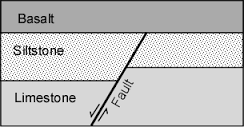
Which of the following is tue?
A fault is younger than the rock layers that it goes through.
A fault is older than the rock layers that it goes through.
The rock layers are younger than the fault that cuts through it.
Which of the following is an example of a trace fossil?
A skeleton preserved in a tar pit
A footprint of an extinct animal
A mummy buried in ice
An insect preserved in amber

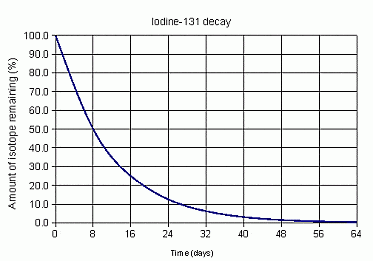
The % of the parent isotope remaining after 2 Half Lives.
50%
25%
12.5%
6.25%
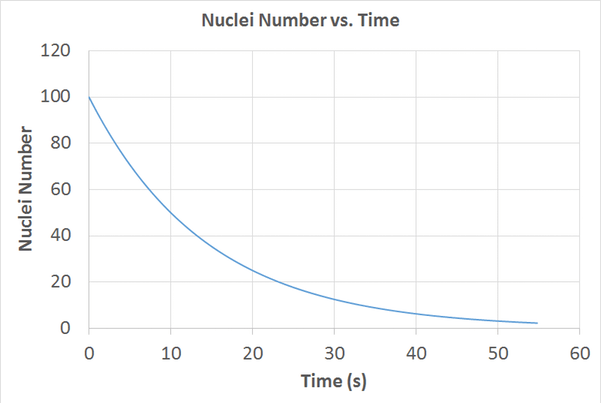
What is the Half life of this isotope?
5 seconds
10 seconds
15 seconds
20 seconds
The element that is the product of radioactive decay is known as the...
daughter element
half-life
parent element
carbon-14

Arrange the outcrops from oldest to youngest
Outcrop II
Outcrop I
Outcrop III

Arrange the layers A through D and the fault line from oldest to youngest
B/D
C
Fault x-y
A

